
Zimbabwe’s Cosmic Archive: A Guide to the Nation's Registered Meteorites
Zimbabwe possesses a rich history of celestial activity ranging from ancient cosmic collisions to modern witnessed meteorite falls. Finding space rocks in sub-Saharan Africa is an incredibly rare occurrence due to weathering and vegetation cover. While many meteorites have been recovered from the arid sands of the Sahara,[1] Zimbabwe holds exactly five officially registered specimens—making its small tally a highly precious cosmic archive.
These extraterrestrial specimens offer an extraordinary window into the early Solar System. They range from pristine, primitive metal structures to complex planetary hybrids forged under intense cosmic pressure.
The Five Registered Meteorites
Zimbabwe’s documented space rock heritage comprises four witnessed meteorite falls and one significant ground discovery. For more extensive analytical details on these specimens, researchers can reference the Meteoritical Bulletin database or the Lunar and Planetary Institute archive.
Mangwendi Meteorite (1934): A witnessed stony chondrite fall accompanied by dramatic eyewitness accounts from local communities.
Mafuta Meteorite (1984): A significant iron-body ground discovery, boasting a pristine, primitive metal structure
Magombedze Meteorite (1990): Another recovered stony specimen from a witnessed atmospheric entry.
Dotito / Chaworeka Meteorite (2005): A modern witnessed fall that startled residents and was quickly recovered for scientific study.
Nkayi Meteorite (2009):. A witnessed fall that provided critical insights into asteroid dynamics and planetary evolution.
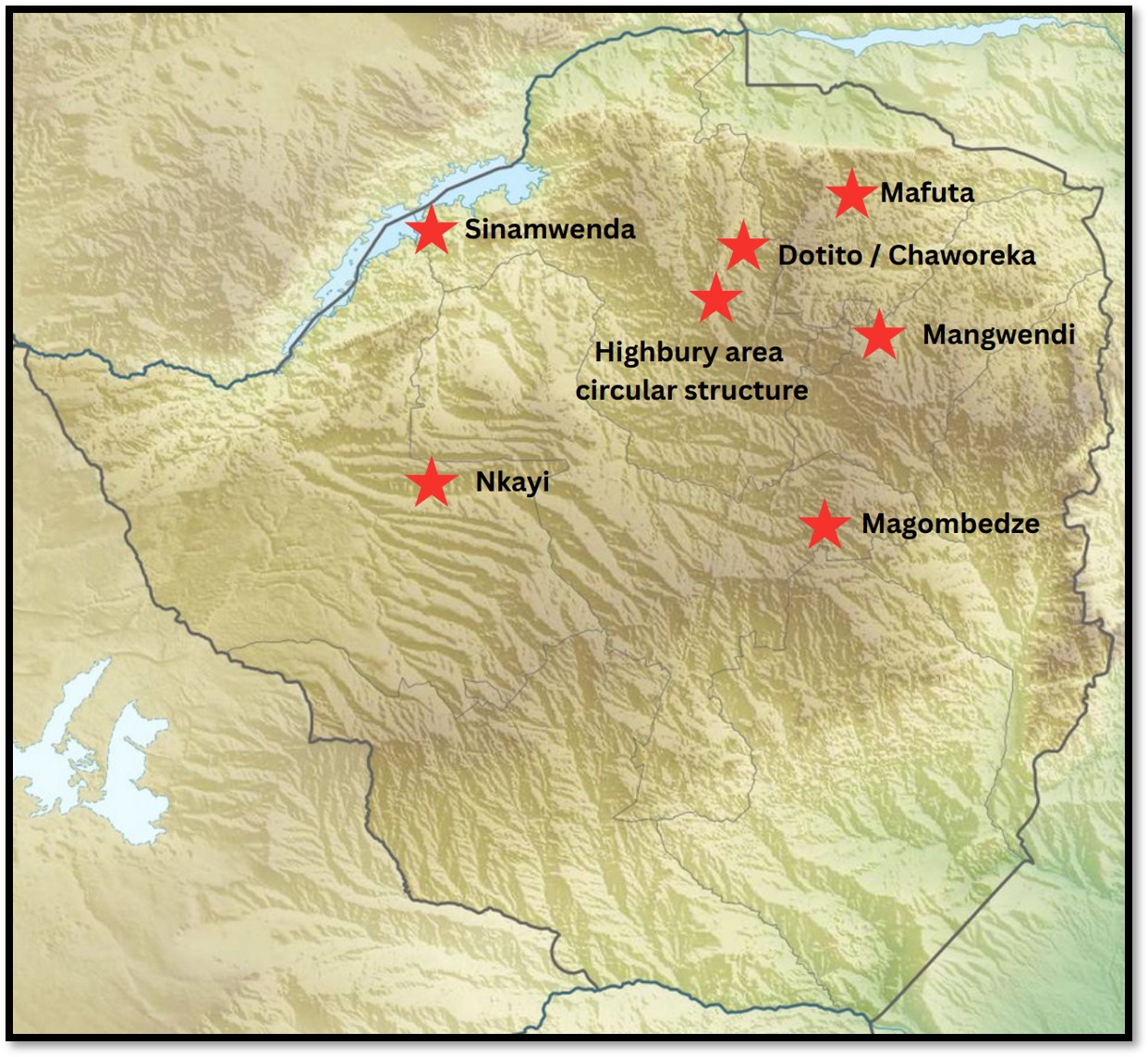
Graphic of known meteorite strikes in Zimbabwe
Science, Geology & Impact Anomalies
From a geological perspective, these space rocks offer an incredible look into the formation of our solar neighbourhood:
Compositional Diversity: The collection spans from primitive, un-melted stony chondrites to massive, highly dense iron bodies.
Ancient Impact Structures: Beyond individual meteorite recoveries, geologists continue to investigate large-scale circular anomalies across the country—such as the Highbury structure—searching for definitive evidence of massive, prehistoric impact craters that reshaped Zimbabwe's ancient geology.
Where to See Them
Zimbabwe's massive collection of over 15,000 geological specimens, rocks, and space debris is centralized at the Natural History Museum of Zimbabwe in Bulawayo.[2]
The Mennell Gallery: Named after the museum’s first curator, F.P. Mennell, this geology gallery houses the nation's meteorites and planetary pieces.
Key Exhibits: Alongside local fragments like the Nkayi meteorite chunk, the gallery features thousands of rare regional crystals, gems, and a realistic "walk-through" replica of a Zimbabwean gold mine.
Graphic of a meteorite entering the Earth’s atmosphere
1. Mangwendi meteorite (1934)[3]
Type: Brecciated Ordinary Chondrite (LL6,br)[4]
Weight: Total weight of 23.7 kg but the largest single block, a roughly rectangular block measures 24 x 22 x 18 centimetres and weighs 22.3 kilograms
Location: Murehwa District, Mashonaland East
Catalogue of Meteorites: (17° 39'S, 31° 36'E)
Date and time: The oldest recorded fall in Zimbabwe's database occurred on 7 March 1934 at 12.45pm.
Details: The Mangwendi Meteorite streaked across the sky in the afternoon. The fall was preceded by three loud detonations that were heard across a vast radius, including the villages of Arcturus, Macheke and Mutoko. The booms were immediately followed by a loud, rushing whirring sound. The meteorite broke into several pieces upon impact as it blasted into the right bank of the Shavanhohwe (Shawanoya) river in the Murehwa District. A second smaller stone weighing an estimated 8 to 10 kilograms is known to have split off and fallen roughly 25 kilometres away. This second fragment was unfortunately never recovered. The preservation of this historic space fall is thanks to the Rev. F. J. Gits, who ran St. Paul's Mission at Musami at the time and diligently tracked down the rock after hearing the blast.
Classification: recorded as an "LLG" brecciated chondrite, denoting a very low total metal and iron content. It is made of shattered rock fragments fused together under intense cosmic pressure
Mineral Profile: The rock is mostly comprised of olivine and orthopyroxene. It also features minor traces of troilite, albitic plagioclase, schreibersite, and native iron-nickel metal (kamacite)
Cosmic Age: Scientific testing estimates its cosmic ray exposure age at roughly 15 million years, mapping how long the rock drifted through open space before hitting Earth.
Current Status
Today, the main mass is safely preserved and curated internationally by the Museum of Natural History in London. Small sliced fragments are occasionally circulated among university geological archives or high-end private collections.
Visual Appearance: Polished laboratory specimens show a beautiful, light grey matrix. Scattered across this light background are fractured brownish-green crystals, visible ancient spherical chondrules, and occasional dark geological inclusions.
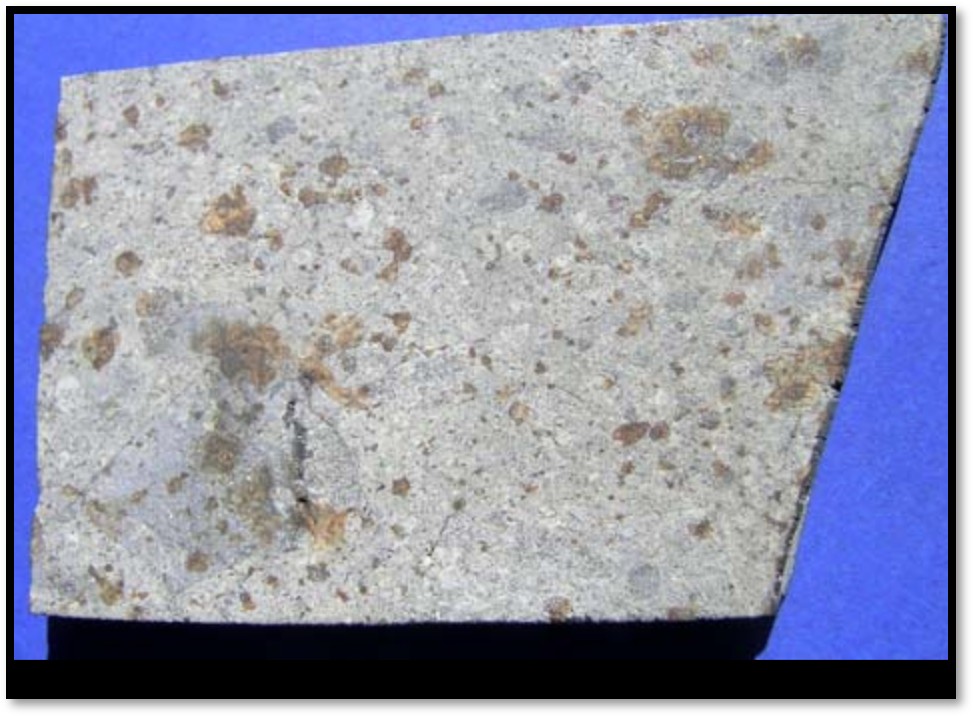
Mangwendi meteorite slice (24.68 grams)
2. Mafuta meteorite (1984)[5]
Type: Iron IID[6]
Weight: Total weight of 71.5 kg
Location: Mashonaland West
Catalogue of Meteorites: (16°54′09′′S, 30°24′26′′E)
Date and time: The meteorite was discovered on the ground in 1984.
Details: Unlike the others, the Mafuta Meteorite was not seen falling from the sky. On 1 December 1984, while clearing rocks from his fields with an assistant, Mr. Murray Alexander found an iron meteorite on Mafuta Farm, Makonde District, northern Zimbabwe. In 1993, Mr. Alexander agreed to have a slice cut for scientific studies. The cutting was done in Harare and a slice (about 9.5 × 4.5 × 1 cm) was sent to Vienna for further studies. It has a heavy, dense iron-rich mass that survived weathering for an unknown period before its discovery. It lacks a fresh, glassy black fusion crust with its outer surface showing signs of natural earth weathering and oxidation.
Classification: It is classified as an Iron Meteorite belonging to the chemical group IID (historically associated with or compared to group IIIAB in certain structural databases).
Mineral Profile: As an iron meteorite, Mafuta originated deep within the melted metallic core of an ancient asteroid that shattered billions of years ago. It consists almost entirely of a solid, crystallized alloy of iron and nickel, alongside trace inclusions of rare cosmic minerals.
Because it is an iron meteorite, specialized cutting and acid-etching of a cross-section would reveal a distinct Widmanstätten pattern—interlocking bands of kamacite and taenite nickel-iron alloys that can only form when molten metal cools incredibly slowly in the vacuum of deep space.
Current Status
A total of 221 g of sample is on deposit at the NHMV (inventory number M6694) Mr. M. Alexander of Mafuta Farm, Zimbabwe, holds the main mass.
Visual Appearance: It is a remarkably heavy and dense specimen, tipping the scales at 71.5 kilograms (157.6 pounds). Its high weight relative to its size is due to its material makeup. It is a solid block of space-faring metal rather than a stony crystalline rock.
3. Magombedze meteorite (1990)[7]
Type: Ordinary Chondrite (H6, brecciated)
Weight: 667 grams
Location: Gutu District, Masvingo Province
Catalogue of Meteorites: (19° 38'S, 31° 10'E)
Date and time: 2 July 1990 at 5.30pm
Details: This is an officially recognized meteorite that fell in southeastern Zimbabwe in the summer of 1990 after three separate detonations were heard near the village Magombedze, 54 km ENE of the town Gutu. Three larger fragments and several small chips of total weight 666.6 g were recovered. It is a relatively small specimen classified as an "H" group chondrite, meaning it possesses a high overall iron content compared to the Nkayi meteorite. It remains the only officially recorded meteorite from the Masvingo region.
Classification: It is classified as an Ordinary Chondrite (H3-5). The "H" denotes a high overall iron and metal content. The Cosmic Hybrid (3-5): The "3-5" designation is rare. It means Magombedze is a literal mashup of two different environments from its parent asteroid. The white clasts are H5 material (deeply altered by ancient asteroid heat), while the dark surrounding matrix is H3 material (primitive, unaltered rock preserving original brown cosmic glass and distinct chondrules up to 2mm in size)
Mineral Profile: , olivine Fa19, pyroxene Fs16, has light-dark texture, Glenn J. MacPherson, chemical analysis 26.42% total Fe, 9.66% FeO. It contains equilibrated mafic silicates like pyroxene and olivine, alongside variable plagioclase feldspar and features highly reflective grains of space-born iron-nickel metal, specifically low-nickel kamacite, and the iron-sulphide mineral troilite.
Scientists also found trace carbon-rich clasts containing ancient phyllosilicates (clay minerals that suggest water was present early in the asteroid's history)
Rarity: It is the least massive of only five witnessed ordinary chondrite falls in total planetary history to be classified as exactly "H3-5".
Current Status: The main mass of the meteorite was secured by local geological authorities and is permanently preserved with the Geological Survey Department in Harare, Zimbabwe. However, tiny sub-gram slices were distributed internationally for scientific research; for instance, a 0.59-gram specimen is curated by the Smithsonian National Museum of Natural History in Washington, D.C.
Visual Appearance: Visually, the interior of Magombedze is fascinating. It features a stark light-dark brecciated structure. This means the rock is a natural collage, consisting of distinct white planetary fragments (clasts) cemented inside a much darker, fine-grained surrounding matrix
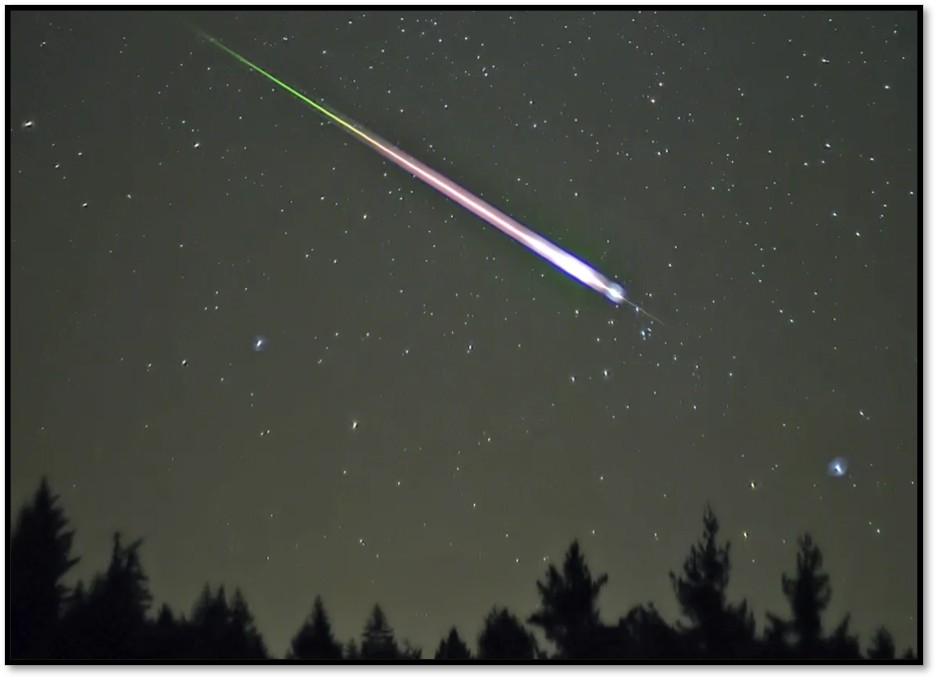
A meteor during the peak of the 2009 Leonid Meteor Shower. (Image credit: Navicore (Own work), CC BY 3.0 via Wikimedia Commons)
4. Dotito / Chaworeka meteorite (2005)[8]
Type: Iron-Nickel / Metallic-rich Stony
Weight: Total weight of 4.1 kg
Location: Mashonaland Central, Chaworeka Village, Dotito Communal Lands, Mt. Darwin
Catalogue of Meteorites: (16°54′09′′S, 30°24′26′′E)
Date and time: The meteorite fell on Monday, 22 August 2005, at approximately 5:00 pm local time.
Details: Villagers in Chaworeka heard a loud noise resembling a helicopter before a 4.1 kg white-speckled black stone slammed 15 cm deep into the earth near a residential home. Its arrival caused quite a stir among the local population due to the spectacular sounds and mystery surrounding it. was quickly recovered by police forensics before being placed in the National Museum
Classification:
Mineral Profile:
Current Status
Visual Appearance:
5. Nkayi meteorite (2009)[9]
Type: Ordinary Chondrite (L6, S5, W0)[10]
Weight: 100kg
Location: It landed in Madlilika Village within the Mjena area of Lukampa, located in the Nkayi District on the eastern side of the Matabeleland North province.
Catalogue of Meteorites: (18°56’S, 28°36’E)
Date and time: The meteorite fell on Sunday, 1 March 2009, at approximately 5:00pm local time.
Details: Witnesses reported a massive fireball exploding over the countryside, accompanied by a loud, thunderous booming noise as it breached the atmosphere. It is highly valued by collectors due to the dramatic nature of its arrival and its scarce availability on the open market.
Classification: The Nkayi specimen was officially analysed and classified by experts at Arizona State University (ASU) It is an ordinary chondrite, L6, S5, W0. They contain tiny, round mineral droplets called chondrules that formed billions of years ago.
Mineral Profile: The meteorite is largely recrystallized with sparse chondrules. Probe section shows three BO chondrules, one to 2.5 mm. Plagioclase, to 100 μm, is abundant. Chromite irregularly shaped, to 500 μm. Scattered Ca-phosphate with up to 5 wt% Cl, relatively abundant, for example a 3 × 3 mm area contains five grains. Kamacite irregularly shaped to 1 mm, with a frosty etch. Rare, weakly developed Neumann bands. Some grains polycrystalline. Troilite exhibits mosaic texture - finely polycrystalline, typically 10 μm (crossed polars), with scattering of fine silicates giving the grains a dusty appearance. Many of the composite metal-sulphide grains show complex finely intergrown mixture of troilite and metal. Some metal grains show zoned tetrataenite-taenite-kamacite/plessite textures. Opaque, fine-grained melt pockets adjacent to troilite rare. Native Cu not found.
Current Status: Following the fall, the main 100 kg mass was recovered by local authorities and held by the Zimbabwean government. Officials removed a 15-kilogram chunk to send away for testing and scientific analysis. A South African dealer later acquired this 15 kg portion, which was subsequently purchased by well-known American meteorite hunter Michael Farmer. Because the vast majority of the original mass remains securely held by the government, very little material is in public circulation, making micromounts and fragments of Nkayi highly sought after by private collectors
Visual Appearance: The surface is covered in a thick, matte-black fusion crust. This crust features regmaglypts—shallow, thumbprint-like indentations caused by the intense heat and ablation of the air as the meteor tore through the sky. Interior: When broken or cut open, the inner matrix reveals a stark contrast to its dark shell, showing a uniform, light grey interior coloration.
6. The Sinamwenda Crater
Situated in western Zimbabwe, this is a smaller, 220-metre-wide crater. Scientists confirmed its extra-terrestrial origin by identifying "shocked quartz" in the crater rim—sandstone that has been physically altered at a microscopic level by the intense shockwaves of an impact. Situated at coordinates 17°11′42″S, 27°47′30″E, roughly 4.8 kilometres south-southwest of the Sinamwenda Research Station. It was initially spotted on an aerial photograph in 1970 by Dr. Clive Stowe. Scientists verified its meteorite origin through the following geological and magnetic evidence:
Shock Metamorphism: The crater rim features unique microscopic traits; most notably grains of shocked quartz containing Planar Deformation Features (PDFs). These microscopic deformations only form under the extreme, sudden pressures generated by a cosmic impact.
Physical Deformation: The surrounding rocks consist of flat, undisturbed Triassic sandstones, but the crater rim itself displays steep, overturned rock bedding and heavily striated joint surfaces from the intense energy of the blast.
No Alternative Geological Causes: Ground magnetic surveys of the structure showed absolutely no magnetic anomalies. This lack of magnetic fluctuation rules out underground volcanic pipes, magma intrusions, or other internal earth processes that typically create circular features.
Meteorite Fragment: An iron meteorite specimen discovered near the site in 1970 is widely believed to be a remaining fragment of the actual 5-to-7-metre-wide projectile that caused the crater.
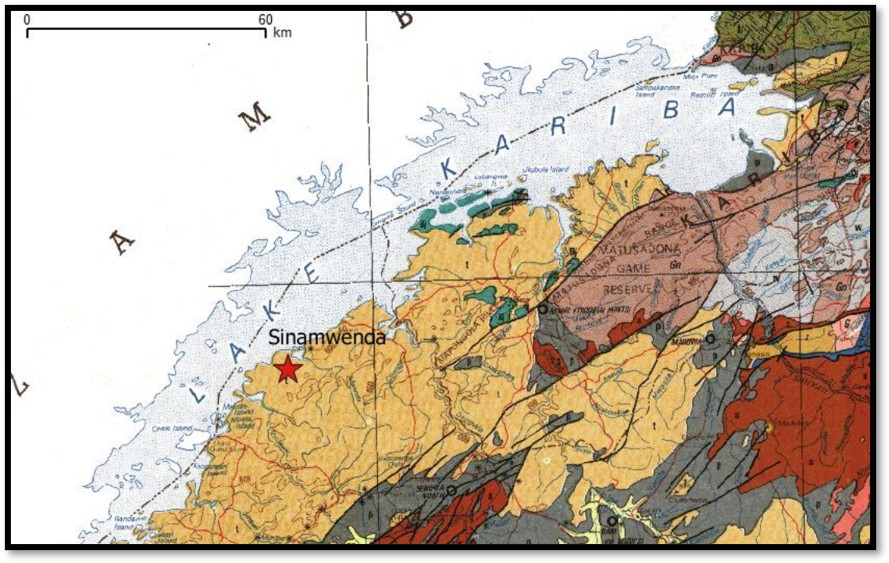
Graphic S. Master: location of the Sinamwenda Crater
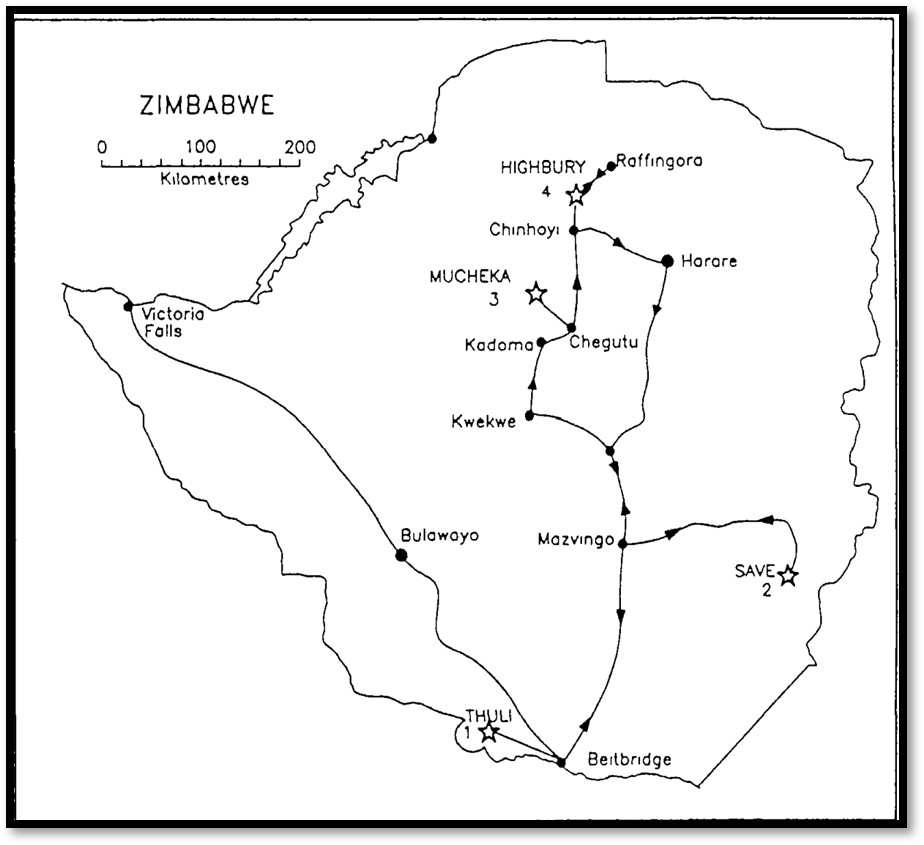
Graphic S. Master; 1993 Expedition sites
1993 Expedition to visit four suspected meteorite impact craters in Zimbabwe
The September 1993 expedition consisted of W.U. Reimold,[11] S. Master[12] C. Koeberi,[13] D.J. Robertson[14] and planned to visit four structures selected either because of their circular outlines or because they had unusual aeromagnetic anomalies.
Thuli structure
The first, a 1.1km diameter structure at 21 degrees 58'50"S /29 degrees 21'15"E was identified as a well-preserved volcanic caldera. Its geology is complex due to weathering and the magnetic traverses are consistent with the model of a volcanic pipe.
Save structures (on Masapas Ranch)
These 600 and 800 metre-wide craters near the Mozambican border closely resemble young, well-preserved impact craters. However, detailed geological traverses revealed only volcanic rocks intruded into sandstone forming the sharp rim crests and the researchers suggest they could represent feeders for the regionally abundant Karoo volcanics.
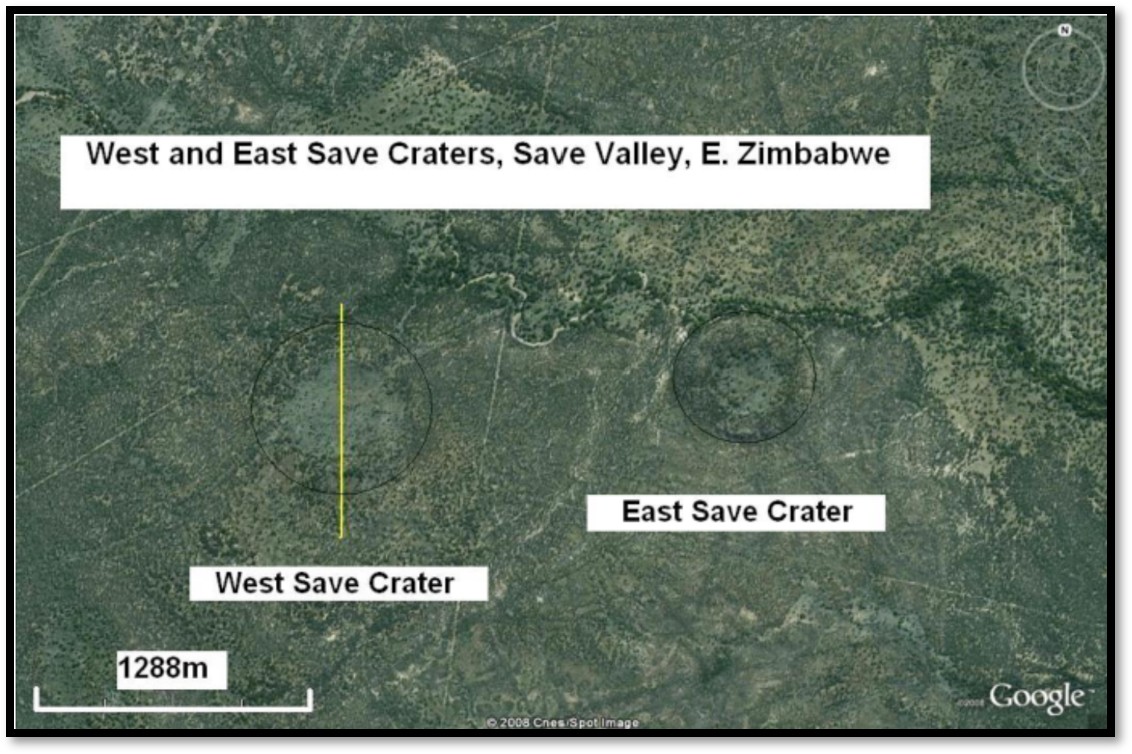
Photo S. Master: West and East Save Craters
The Mucheka aeromagnetic anomaly
This is most prominent aeromagnetic anomaly in Zimbabwe at 23 degrees 54'30"E/17 degrees 48'30"S with a gradient of -800 gamma from the periphery towards the centre. However In the absence of any exposures other than Archean basement, the cause of this anomaly is still unknown and none of the basement rock specimens obtained yielded any evidence for shock metamorphism.
Highbury area circular structure
In 1985 German geologists reportedly noted a circular structure in the Highbury area centred on 17 degrees 05'S / 30 degrees 09'E on Landsat images, but no follow-up ground studies had been reported. A 20 km wide circular structure is visible on satellite image as well and the regional geological map revealed the presence of a slight elevation near the centre of this otherwise flat area.
A subsequent paper revealed the following evidence of an actual meteorite strike in the distant past, possibly over a billion years ago. This was calculated by using zircon U-Pb dating on the Munwa Granophyre, the impact melt-rock left behind by the collision.[15]
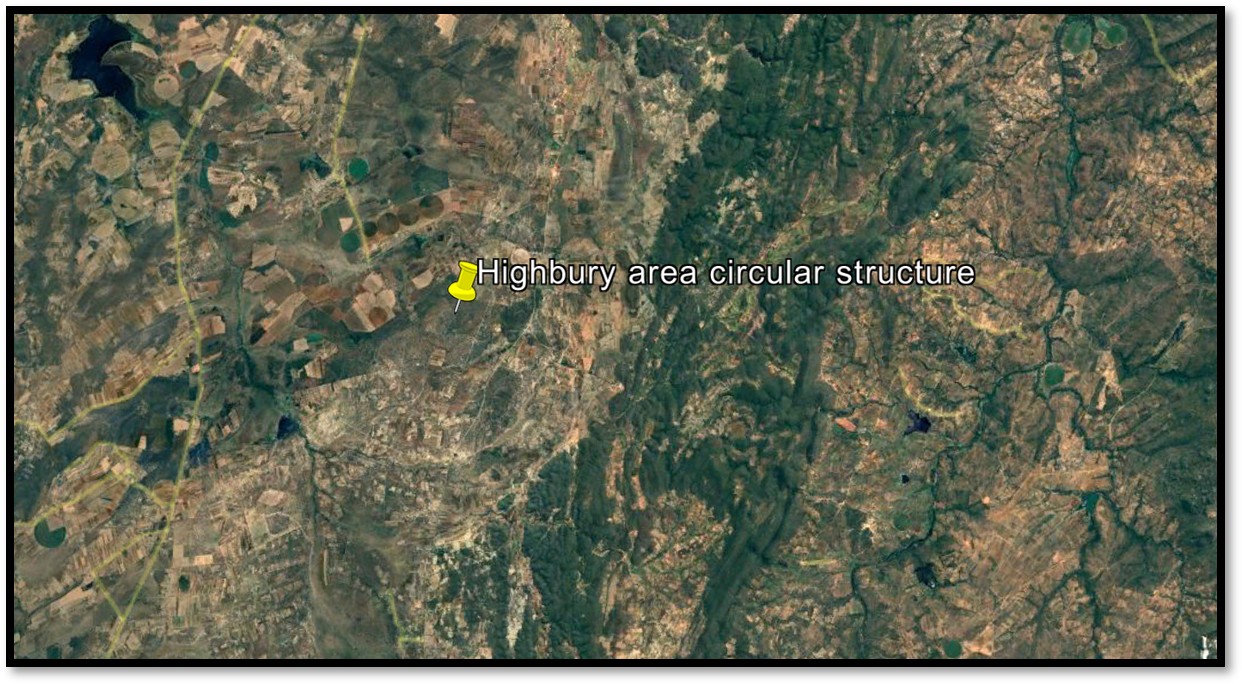
Google Earth image of Highbury area circular structure 30 kms north of Chinhoyi
Impact-melt rock: Samples taken at the time of the expedition have since identified the presence of the Munwa Granophyre, which is interpreted as a downwardly injected impact melt-rock formed during the catastrophic collision.
Geophysical Anomalies: Gravity and magnetic surveys reveal a distinct central uplift (about 150 meters high) surrounded by concentric gravity lows, matching the structural profile of an eroded large-scale impact crater.
Shocked Rocks: The surrounding Paleoproterozoic metasedimentary country rocks show evidence of severe fracturing and brecciation associated with an explosive cosmic impact.
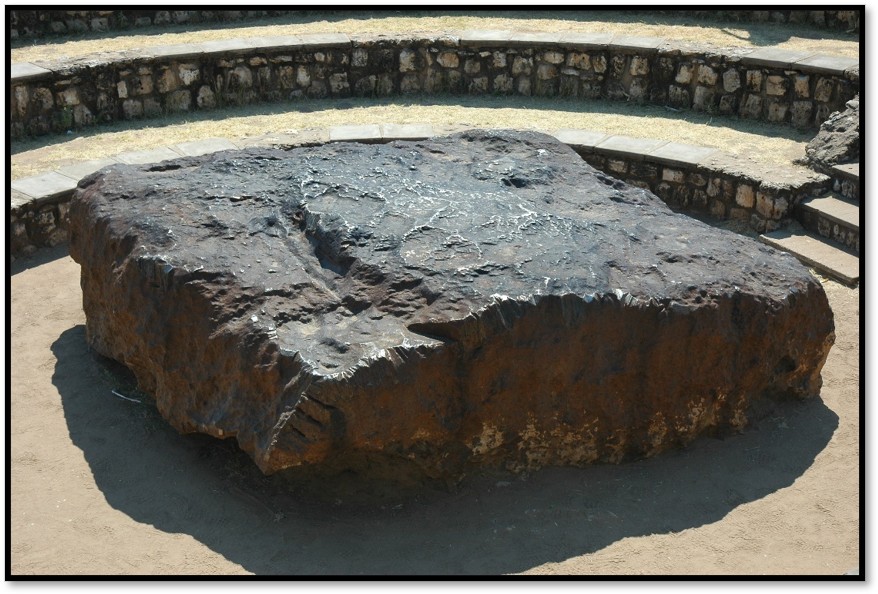
Wikipedia: The 60-tonne (66-short-ton; 130,000-pound), 2.7 m (8 ft 10 in) Hiba meteorite in Naminia is the largest known intact meteorite.
Other events
The Bulawayo Meteor (1944)
Though there is no known specific landing site for the 1944 meteorite event over Bulawayo historic accounts from the Caltech Meteorite Archives [16] document a large meteor (estimated at 50–100 metres wide) that roared over Bulawayo. It produced a massive sonic boom that rattled windows across the city—widely considered by historians to be one of the first times a sonic boom was ever formally recorded by humans before the invention of supersonic aircraft!
The website was set up by Dr. Phil Appleton (apple@ipac.caltech.edu) as a record of what his father and others saw and describes the event as follows:
“The meteor was seen by my father Mr. Norman Appleton who current lives in England. A complete description of his observations of the meteor is found on the link below. We have determined that the event was reported by three observers and that it took place on November 1st, 1944, between 3pm and 4pm local time. Please email me (Philip Appleton) on apple@ipac.caltech.edu if you would like to contact the artist, or if you have new information to contribute the story of this amazing event.
Based on his observations, we believe that the object was approximately 50-100 m in size and may have been transitioning from supersonic to sub-sonic at the time of observation. Evidence that it was subsonic comes from the fact that the trail does not show the usual bow-shock appearance of supersonic object (in this image), and that the sound he heard (which lasted several minutes after the meteor had crossed overhead and travelled almost to the horizon) was that of a powerful roaring sound like thunder. However, another image publish in a newspaper showed a V-shaped pattern indicating that it may have been supersonic for some of the time.
The city of Bulawayo is one of the larger cities in modern Zimbabwe and the meteor seemed to be travelling south at a constant altitude (taking it over South Africa). The event was witnessed by the residents of Bulawayo (the event was originally referred to as an example of "Ball Lightening" in a newspaper report the next day) who heard a loud bang which rattled windows in the city , likely the first time a sonic boom had been documented before the first supersonic aircraft had flown! The event was also documented by several newspaper reports and in an RAF Met. Office "Weather" report.”
Norman Appleton's own description of what he saw can be viewed at: https://web.ipac.caltech.edu/staff/apple/statement.html
The Harare Sonic Boom (2001)
On 6 February 2001, a large meteor disintegrated in the atmosphere northeast of Harare. It didn't leave a verified crater, but it produced a blinding flash of light brighter than a full moon and a massive sonic "bang" that shook the capital and its surrounding suburbs.
The event happened in the early morning hours around 1:30am – 3:00am) in February 2001. A massive explosion-like sound and physical tremors shook homes and caused panic across the capital of Zimbabwe. Mystery surrounded the huge explosion heard in most parts of Harare in the early hours of Tuesday morning. The police admitted that they had failed to pinpoint the location of the explosion but one mines expert accused the government of trying to cover up what he said could have been a bomb that went off accidentally.
Harare residents, some from as far-flung areas as Ruwa, 30 km away, said a huge din woke them up in the early hours of Tuesday but both the police and the army this week said the explosion still baffled them.
According to the Astronomical Society of Southern Africa, the sound was a high-altitude sonic boom created when a bolide (a very bright, exploding meteor / fireball) entered the Earth's atmosphere and disintegrated.
The Meteor Fireball & "UFO Mania" (1994)[17]
On 14 September 1994 what passed for a brilliant meteor fireball passed silently over Southern Africa. In fact, it was the booster rocket from a Zenit-2 satellite from the Cosmos 2290 satellite launch re-entering the atmosphere and at the same time disintegrating into burning streaks across the sky.
This celestial display triggered massive cosmic speculation in Zimbabwe. Just two days later at 10am on 16 September 1994, the Ariel School encounter occurred in Ruwa, where dozens of schoolchildren at their mid-morning break claimed to see extraterrestrial beings. At the time, the school's adult staff were inside attending a meeting. The encounter lasted around fifteen minutes. The woman responsible for operating the school's tuckshop was the only adult in the immediate vicinity of the students. Following the event, numerous children approached her, displaying varying degrees of what she later described as fear and curiosity.
The event may have been linked to the psychological atmosphere created by the fireball created by Russian booster rocket.
References
W.U. Reimold, S. Master, C. Koeberi, D.J. Robertson. The 1993 Zimbabwe Impact Crater and Meteorite Expedition. https://ui.adsabs.harvard.edu/abs/1994Metic..29R.521R/abstract
T. Gumede, D.J. Robertson, S. Master. Geophysical Studies of the Highbury Meteorite Impact Structure, Zimbabwe. Publisher: European Association of Geoscientists & Engineers,
DOI: 10.3997/2214-4609-PDB.221.029. https://www.academia.edu/111309023/Geophysical_Studies_of_the_Highbury_Meteorite_Impact_Structure_Zimbabwe?email_work_card=thumbnail
S. Master. The Sinamwenda Impact Structure, Western Zimbabwe. Geological Society of Zimbabwe Annual Summer Symposium, Kariba, 20 November 2015. https://www.geologicalsociety.org.zw/sites/default/files/documents/Sinamwenda%20Impact%20Structure%20Field%20Excursion%20Guide%202015%20FINAL%20VERSION_0.pdf
Zimbabwe Independent newspaper. Zimbabwe: Big 'Bang' Traced To Meteor. 9 February 2001. https://allafrica.com/stories/200102120347.html
Notes
[1] Over 14,000 meteorites have been recovered in the Sahara Desert according to the Washington University in St Louis website https://sites.wustl.edu/meteoritesite/items/some-meteorite-statistics/
[2] See the article Natural History Museum of Zimbabwe at Bulawayo under Bulawayo on the website www.zimfieldguide.com
[3] Meteoritical Bulletin database: https://www.lpi.usra.edu/meteor/metbull.php?code=15405
[4] The ‘LL’ stands for "Low Iron, Low Metal," meaning it holds a much lower overall iron signature (~21 wt%) compared to other common chondrite rocks. The "6" indicates high thermal metamorphism inside its parent asteroid before breaking off.
[5] Meteoritical Bulletin database: https://www.lpi.usra.edu/meteor/metbull.cfm?sea=mafuta&ants=&nwas=&falls=&valids=&stype=contains&lrec=100&map=ge&browse=&country=All&srt=name&categ=All&mblist=All&rect=&phot=no&strewn=no&snew=0&pnt=Normal+table&sfor=names&code=15384
[6] An iron meteorite belonging to chemical group IID
[7] Meteoritical Bulletin Database: https://www.lpi.usra.edu/meteor/metbull.php?code=15387
[8] The Dotito meteorite is not recorded in the Meteoritical Bulletin database, the official global archive maintained by the Meteoritical Society Dotito stone because it was never officially analysed by meteoriticist or submitted for global peer review and therefore remains unlisted in the official scientific
[9] Meteoritical Bulletin Database: https://www.lpi.usra.edu/meteor/metbull.cfm?sea=nkayi&ants=&nwas=&falls=&valids=&stype=contains&lrec=100&map=ge&browse=&country=All&srt=name&categ=All&mblist=All&rect=&phot=no&strewn=no&snew=0&pnt=Normal+table&sfor=names&code=61585
[10] It is categorized as an The "L" denotes that it has a relatively low iron content compared to other chondrites, and the "6" indicates a high level of thermal metamorphism, meaning the original textures inside the asteroid were highly altered by heat before it broke apart. The S5 shock level (indicates it endured severe shock waves from collisions in space) and a W0 weathering level (meaning it was recovered so quickly that it suffered virtually no rusting or deterioration from Earth's environment).
[11] University of Witwatersrand, Johannesburg, South Africa
[12] Ibid
[13] University of Vienna, Vienna, Austria
[14] Ibid
[15] Geophysical Studies of the Highbury Meteorite Impact Structure, Zimbabwe
[16] https://web.ipac.caltech.edu/staff/apple/meteorcredit.html
[17] Wikipedia: Ariel School UFO incident