
The Rozvi State: An outline of its Origin, Development, and Historical Importance
The Rozvi State was the dominant pre-colonial power on the Zimbabwean plateau from 1680 - 1830. Much is not known but this article attempts to explain its origin and its demise.
- Entry fee
- entrance fee to sites
Introduction
The Rozvi[1] State was the dominant pre-colonial power on the Zimbabwean plateau from circa 1680 until the 1830’s and was established through a highly organized military campaign that successfully expelled the Portuguese from the interior.[2] Derived from the Shona word kurozva (meaning "to plunder" or "destroyers"), the name "Rozvi" reveals the military reputation of a state that reshaped the geopolitics of Southern Africa for 150 years.
However, despite its significant impact and influence in the Zimbabwe region little is known about the Rozvi and much is owed to the combined efforts of Dr S.I.G. Mudenge and D.N. Beach who did much of the early historical research into the Rozvi State using records from the Portuguese archives and oral traditions.[3] Innocent Pikirayi writes, “The Rozvi seem to have acquired a historiography without a history. Our view is drawn more from the interpretations and perceptions of historians and archaeologists than from what actually transpired.”[4] The period 1780 – 1830 was a complex period of changing power balances, alliances and conflicts of enemies and allies between the Rozvi State, Mutapa Empire and the Portuguese. Pirikayi in more recent times has added considerably to our knowledge of this enigmatic regional power.
The terms Empire, State and Dynasty that I have used in relation to the Mutapa Empire, Rozvi State and Torwa Dynasty should be viewed with extreme caution. These were useful for cartographers and Jesuit priests to label vast areas of internal Africa, about which they knew very little and relied solely on second and third-hand accounts. In reality, considering communication and transport links were so limited, they must have been loose confederacies at best.
The Mutapa Empire
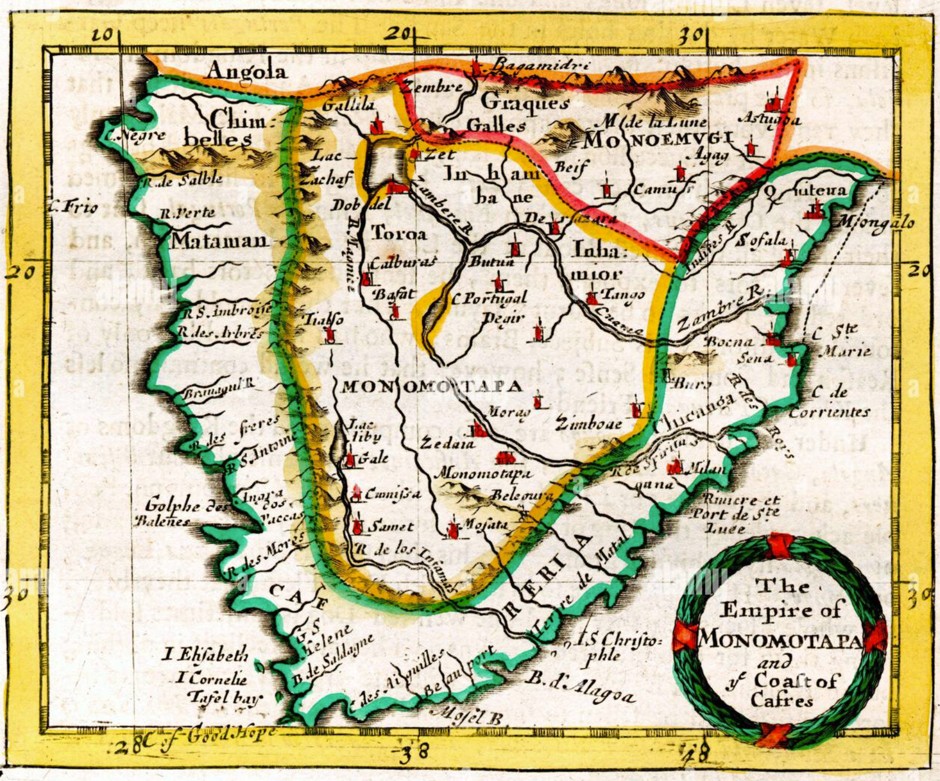
The Mutapa Empire[5] was located in the northern part of the Zimbabwe Plateau, south of the Zambezi, its territorial limits have been exaggerated by earlier cartographers and chroniclers, who misled historians into thinking that it was an empire stretching from the Indian Ocean to the Kalahari Desert. In fact, from the early sixteenth century, it comprised the northern limits of the Zimbabwe Plateau and the adjacent Zambezi Valley lowlands. Kingdoms such as Manyika, Barwe, Uteve and Danda are thought to have severed from the state in the seventeenth Century. By the nineteenth century the Mutapa Empire it was confined to Dande and Chidima,[6] in the Zambezi Valley.
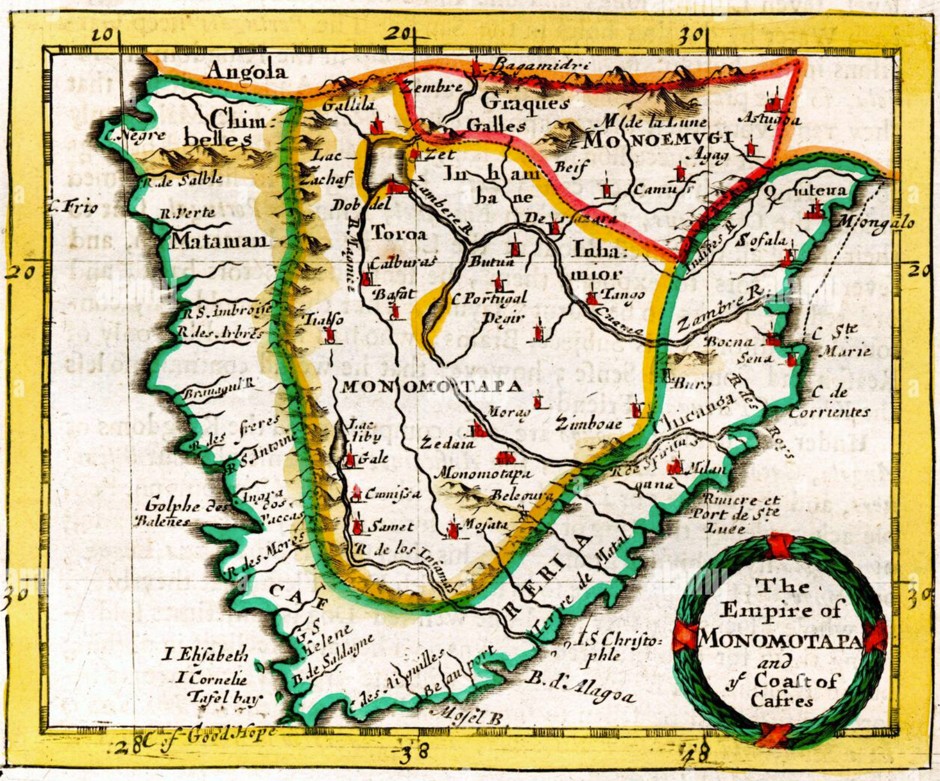
This map The Empire of Monomotapa and of Coast of Cafres was first published in 1688 as a miniature copper-plate engraving in Robert Morden's famous geographical text, Geography Rectified: or A Description of the World. It shows the kingdom of Monomotapa (aka Mutapa), although it inaccurately shows the kingdom's spread over a far larger area than it actually controlled around the Zambezi River.
Much of the evidence of the Mutapa Empire comes from the written records of the Portuguese who entered the Zimbabwe plateau at the beginning of the sixteenth century and compiled eyewitness as well as second-hand accounts of the Mutapa Empire. However, their documents focus mostly on court and trade politics and are inherently biased as they were written for the Portuguese king and bureaucrats in Lisbon. Oral traditions are important and have been used. Since the 1980’s much archaeological work has been carried out in the northern plateau and Dande by Zimbabwean archaeologists to identify the settlements connected with the Mutapa Empire.
The decline of the Mutapa Empire in the 17th century was caused by a combination of internal fighting that led to a succession of civil wars which destabilised any central control, split the Mutapa forces and caused vassals to secede. The interference of Portuguese traders who supplied arms to the rival factions during succession disputes created political openings that the Portuguese aggressively exploited to weaken the Mutapa’s authority. As a result the Portuguese and vassal chiefs (such as those of Kiteve and Manyika) frequently refused to pay tribute[7] to the Mutapa, eroding his revenue and authority.
Portuguese traders and military forces infiltrated the Mutapa Empire, severely weakening its central leadership and sovereignty. Once invited into internal conflicts, the Portuguese added intrigue to ferment internal conflict to undermine the Mutapa’s authority. Mutapa rulers including Gatsi Rusere (reigned 1589 – 1623) made critical errors, such as executing key generals, which triggered widespread civil conflict.
In 1599 a Mutapa general named Chicanda rebelled for the second time and Gatsi had to call on the Portuguese at Tete who sent an army of 2,000 (mostly local native militia but including 75 Portuguese musketeers) to crush Chicanda. Another challenger, Matuzianhe rebelled and invaded Gatsi’s capital, and once again the Portuguese came to his aid in return for control of the Mutapa gold mines and the establishment of a small garrison at Massapa in 1610.
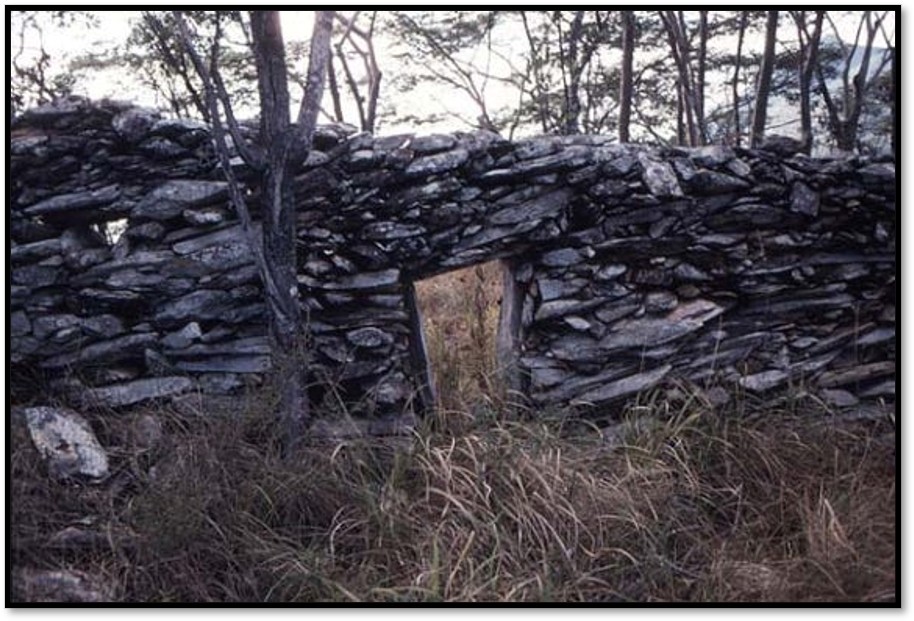
Credit I Pikirayi: Portuguese loop-holed fort built on Mt. Fura near Baranda (Massapa) in northern Zimbabwe to control the gold trade during the civil wars of the 1600’s[8]
Gatsi’s son Kapararidze succeeded as Mutapa, but was challenged by Mavhura, son of Negomo Chirisamhuru (reigned 1560 – 1589) and this was exploited by the Portuguese who initially supported Mavhura. However when Kapararidze (reigned 1623 – 1629) executed a Portuguese envoy they invaded with a large army including 250 Portuguese musketeers and installed Mavhura as the next Mutapa.
Now in control, the Portuguese intervened militarily in toppling any leaders that were uncooperative to their installed puppet Christian convert Mavhura Mhande Felipe. The Treaty of 1629[9] forced the Mutapa Empire into vassalage compelling Mavhura to cede control of the gold mines and trade routes to them, Portuguese traders were exempt from local laws, all the Swahili traders were expelled and the entire court had to convert to Catholicism.
The people of the Mutapa Empire rise in revolt
In 1630-31 there was a mass revolt against the Portuguese. 300+ traders and their militia were killed including the Dominican priests at the feiras. Tete and Sena were besieged and the revolt spread as far as Quelimane on the coast. It was ultimately crushed by a Portuguese army of over 12,000 who defeated Kaparidze’s forces and re-installed Mavhura Mhande Felipe as Mutapa.
The Treaty of 1629 had created economic and social chaos that directly triggered the rise of the Rozvi State. By reducing the Mutapa Empire to a puppet regime, local rulers saw the Mutapa as a Portuguese lapdog and began looking for a stronger leader to protect their interests. It also unified a fierce anti-Portuguese opposition.
The Mutapas who succeeded Mavhura Mhande Filipe (reigned 1659 – 1652) included Siti Kazurukamusapa (reigned: 1652–1663) and then Kamharapasu Mukombwe (reigned: 1663 – 1692) but by the late seventeenth century, the accumulated weaknesses left the Mutapa Empire so fragile that it was easily defeated and dominated by the rising Rozvi State under Changamire Dombo, which also swept in to expel the Portuguese from the northern plateau.[10]
An anonymous Portuguese writer in 1683 in a historical text commonly known as the Description of the Rivers of Cuama wrote: ““Mocaranga (Mutapa) has very rich mines, but the little government, and the great domination of the Portuguese with whom the natives used to live together, has brought it to such an end, that it is depopulated today and consequently without mines. Its residents ran away, and the king appointed them other lands for them to live as it pleased him. The larger part of this kingdom remained without more people than the Portuguese and their dependents and slaves. It now looks the same that Lisbon will look with three men, but not to look completely deserted: the wild animals came in instead of the residents, and it has so many that even inside the houses the lions come to eat people.”
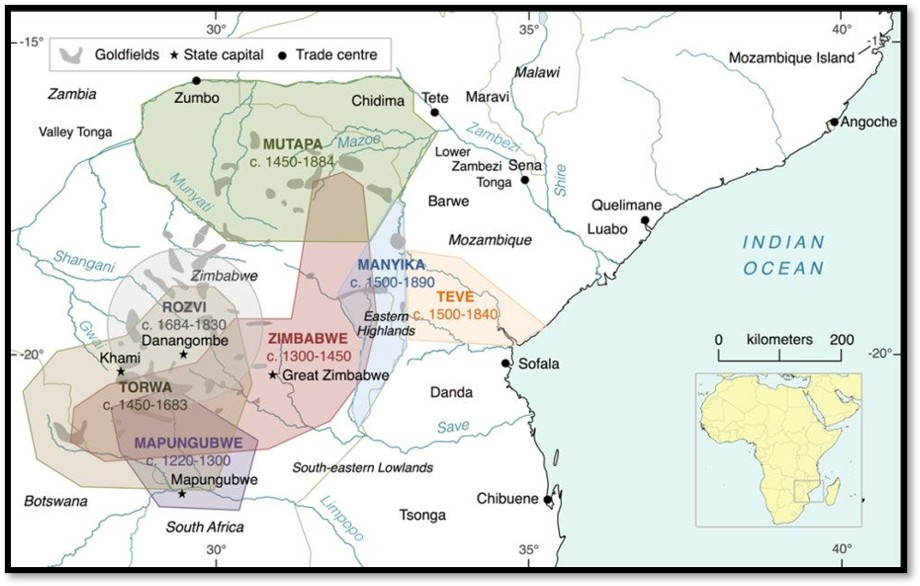
Credit Isaac Samuel: Map showing south-eastern Africa’s political landscape from the 13th-17th century
Do we know how the Rozvi State developed?
Prior to the late 1600’s, the Rozvi do not appear to have existed as a distinct ethnic political group. The population who would become known as the Rozvi belonged to the native Karanga (Shona) people. Pikirayi writes that their original home area is located between the Nyadire and Mazowe rivers in northeast Zimbabwe.[11]
Early in the 1670’s it is believed that the state's founder, Changamire Dombo I, began his rise as a provincial leader within the northeastern regions of the declining Mutapa Empire after the Mutapa Kamharapasu Mukombwe (reigned 1663 – 1692) rewarded him with land and cattle for earlier military victories against foes opposed to Mukombwe.[12]
One of Dombo’s duties was to collect tribute on behalf of Mukombwe from Portuguese traders who traded for gold at the Manyika market at Masi Kwesi (Manica) When they refused, Dombo’s forces attacked the Portuguese settlement there until they agreed to pay.[13]
He used the king's royal cattle herds grazing on these northern plateau pastures to accumulate wealth, bribe local chiefs and recruit his private army, the Vhanyai. When Dombo first broke away from Mutapa, his early military movements and initial Rozvi State bases were established in the northern/north-eastern edge of the plateau.[14]
In response to the aggressive Portuguese encroachment by traders and military forces that severely weakened the Mutapa Empire, Dombo consolidated a highly disciplined, independent Shona fighting force of 2,000 to 4,000 men on the northeastern plateau by the 1680’s and it is believed the Rozvi State's beginning is tied to this specific political development.
His wealth in cattle funded his army and attracted followers and when Mutapa Mukombwe attacked him in 1684, Changamire Dombo triumphed and seized large areas of Mutapa land.[15]
The Rozvi army overthrows the Torwa Dynasty (1680’s–1690’s)
From the 1680’s Dombo transitioned his forces from a regional militia into a conquering army. He marched his army southwest, ransacking Khami and deposing its residents before doing the same at Danamombe (Dhlo Dhlo) Naletale, Zinjanja (Regina) and Manyanga.[16] He conquered the existing Torwa Dynasty that ruled over the Butua[17] in southwest Zimbabwe from 1450 to 1680; but rather than destroying it, he built the new Rozvi State directly upon the Torwa’s stable political and structural foundations[18] “where he not only founded a new ruling dynasty, but established his family and followers as a new aristocracy.”[19] Many of the Torwa sub-rulers thereafter identified themselves as Rozvi.[20]
The Rozvi utilized existing Torwa dry-stone structures as their own and turned them into administrative centres. Despite living separate from the Mutapa Empire, the people of the Torwa Dynasty spoke the Kalanga dialect of the Shona language. Smaller chieftaincies in the region were permitted to remain largely independent having recognised the authority of the Rozwi Changamire’s. Key administrative capitals included Khami, Manyanga, Danangombe, Naletale and Zinjanja.
Mazarire argues that “because of its efficient centralized nature, Rozvi chiefs or mambos elaborated the Mwari cult for their political purposes, it even served in some instances as their secret service.”[21]
The administrative centres are characterised by being built on level platforms of dry-stone retaining walls with decoration on top of which were built pole and dhaka thatched huts. The ruler, his family and court officials lived in the hill complex at Khami, ordinary citizens lived outside a boundary wall with at least 7,000 people living here.[22] Khami had been previously destroyed in the 1640’s during a civil war involving a Portuguese warlord and his militias and the Torwa capital moved to Danamombe and Naletale some 150 kilometres to the east.[23]
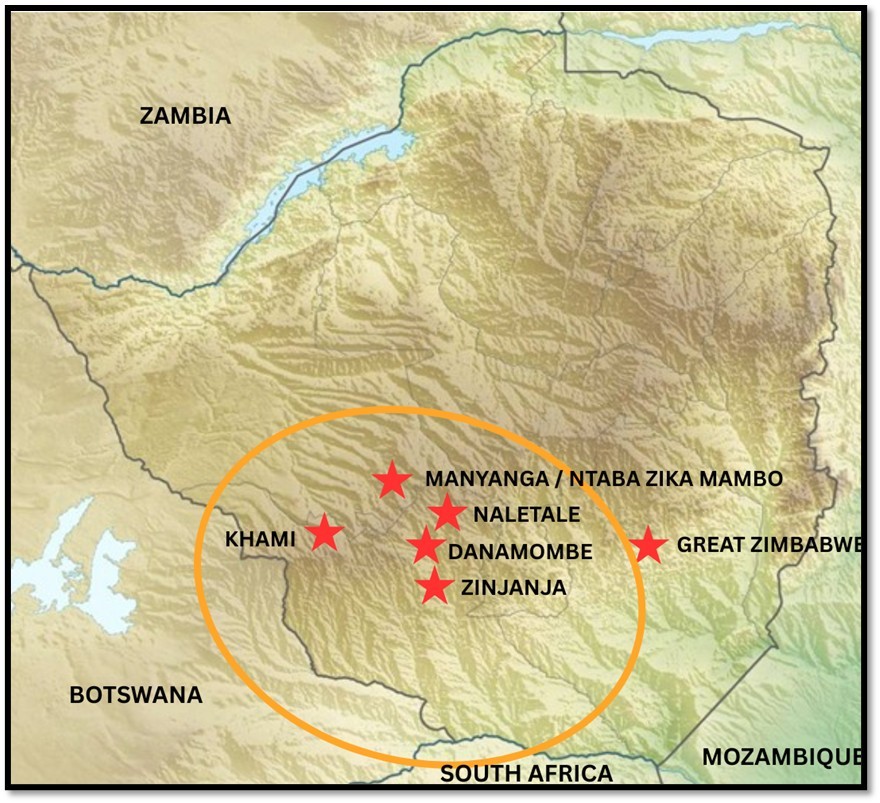
Present-day Zimbabwe map showing location of the larger Torwa settlements. The orange circle shows the approximate extent of the Torwa Dynasty
An agro-pastoral economy
Both the Torwa and Rozvi economies were similar consisting of agro-pastoral activities with some external trade and mining though they were less dependent than the Mutapa Empire.[24] Tribute collected from vassal chiefs consisted of cattle[25] and grain, chiefly millet and sorghum and also gold and ivory. Gold mining continued under the Rozvi and was exchanged for imports including glass beads, Indian textiles, ceramics and firearms.
Limited trade was carried on throughout the Rozvi era, even after the battle of Maungwe and the withdrawal of the Portuguese, through Zumbo. The Rozwi even helped defend the town during the Mutapa Empire succession wars. In 1743 the vicar of Zumbo, Pedro de Tridade, requested help and the Rozvi sent an army of 3,000 warriors to defend the town and push Casiresire's forces back. Again, after being ousted by a rival named Changara in the succession wars of 1769, Ganyambadzi gathered regional allies and launched a siege against Zumbo in 1772 that was only relieved with Rozwi military assistance.
Rozvi centres
Radiocarbon dates from Danamombe suggest occupation was between 1650 – 1815[26] and that the surrounding area comprised about 5,000 people.[27] The imported ceramics, glass beads and shell disks indicate continued trade with Portuguese and Swahili traders. Bronze wire and copper bangles, iron slag and pottery indicate local manufacture.
Khami
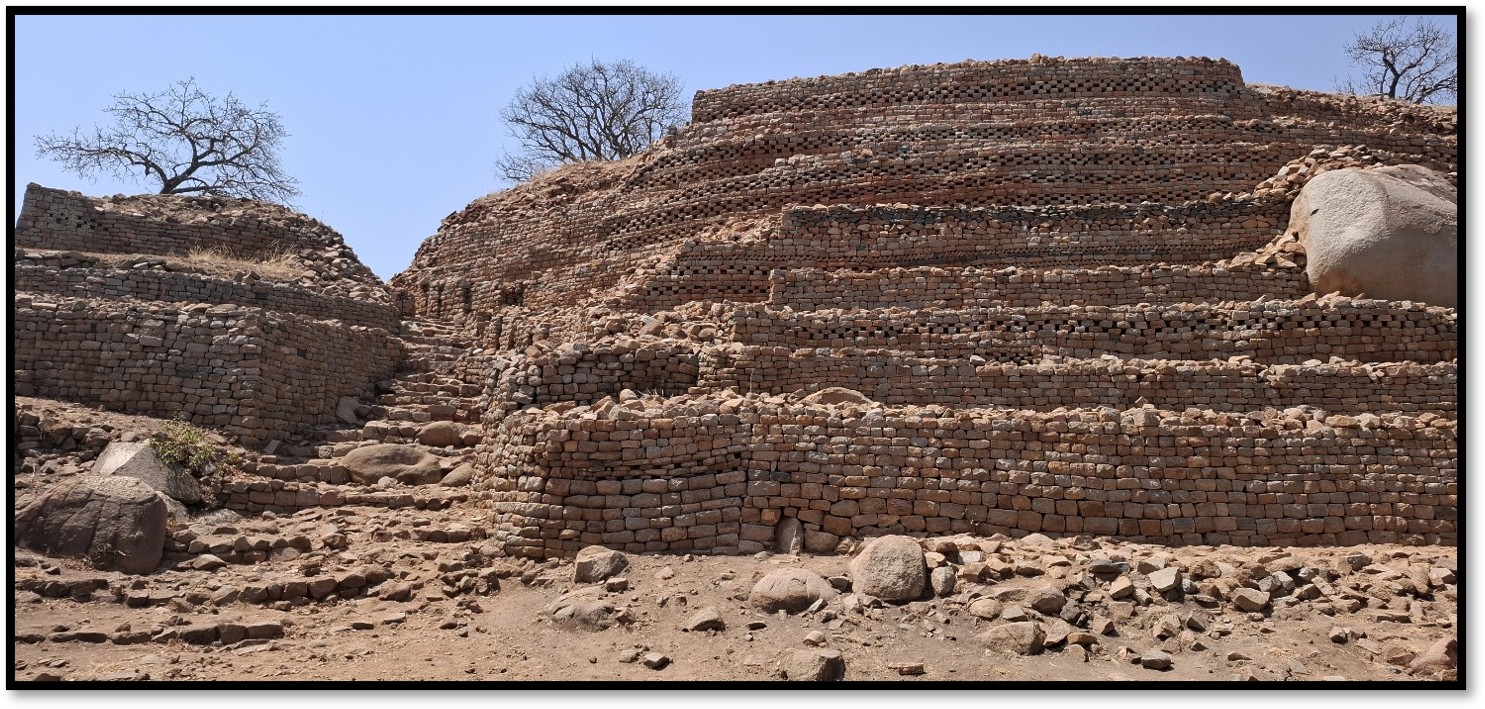
Author photo: for details see the article Khami – capital of the Torwa Dynasty under Bulawayo on the website www.zimfieldguide.com
Danamombe (formerly Dhlo Dhlo)
For details see the article Danangombe Monument (formerly Dhlo-Dhlo Ruins) under Matabeleland South on the website www.zimfieldguide.com
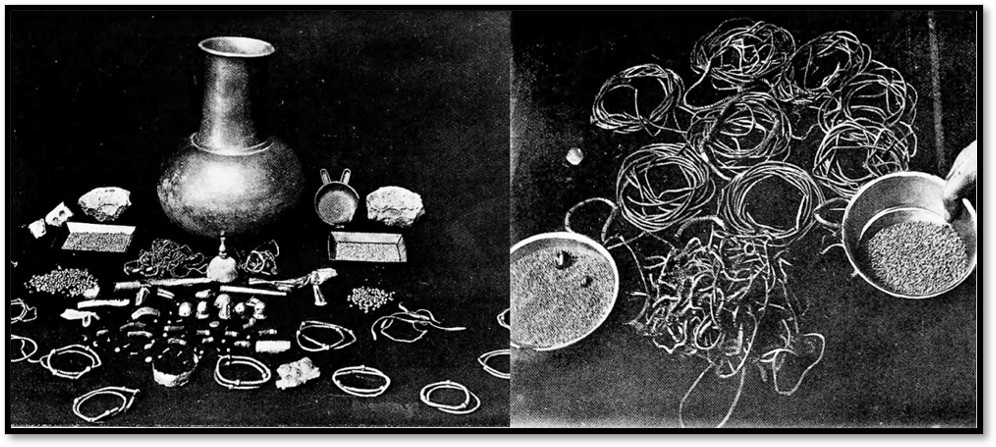
Gold objects and jewellery stolen from the ruins of Danangombe and Mundie (from: The ancient ruins of Rhodesia by Richard Hall)
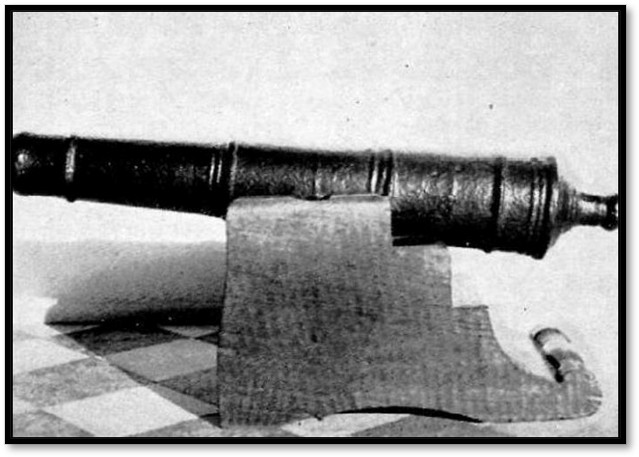
Muzzle loading cannon called Falcão (Falcon) from the Portuguese settlement of Dambarare found at Danangombe after it was taken by Changamire’s forces
The gold objects show that mining was still undertaken and the Portuguese cannon show that a wide-ranging network still existed.
Naletale
The walls of Naletale are profusely decorated with checkered, herringbone, dentelle and other patterns.
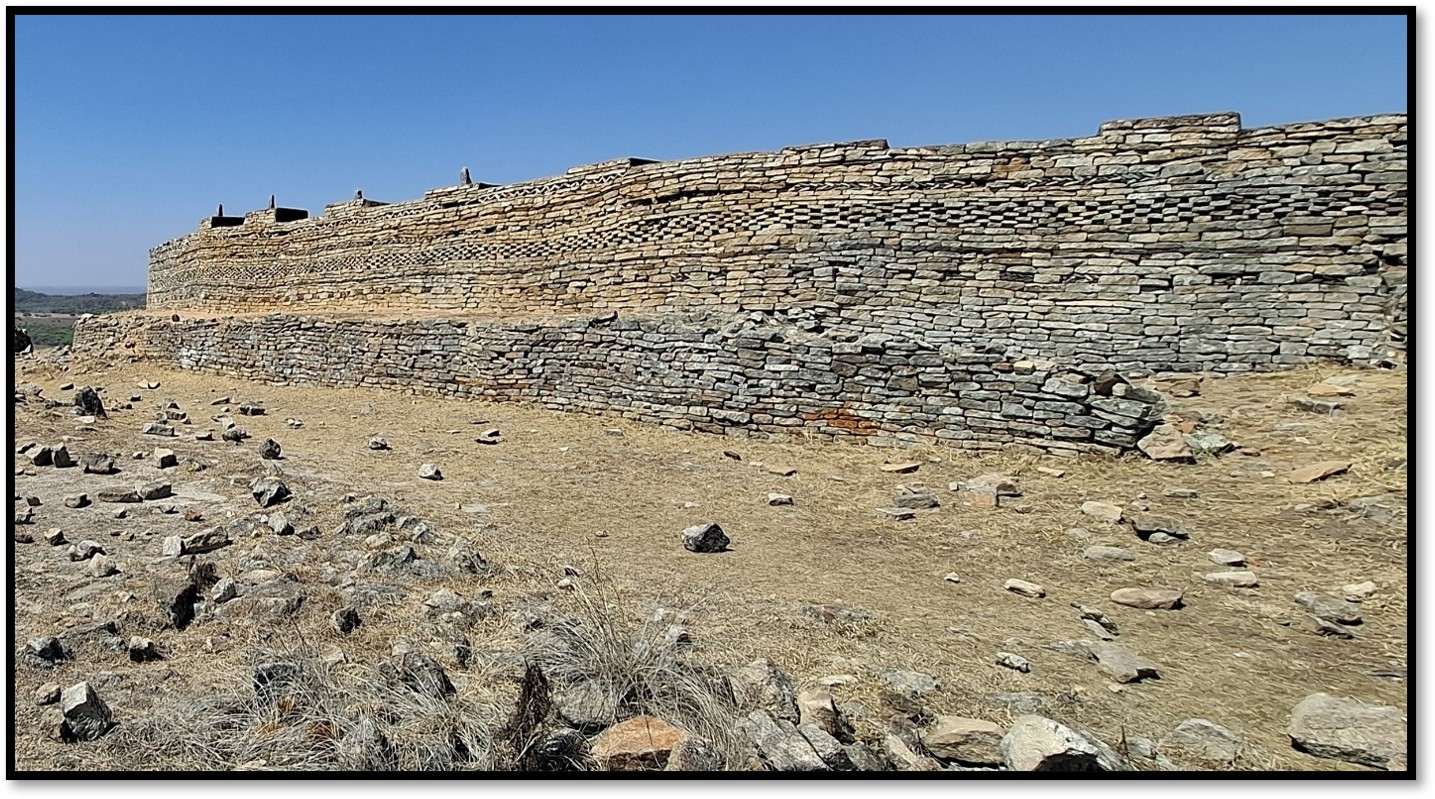
Author Photo: for details see the article The Naletale Monument (or Nharatare “straight-line “or Nhandare “stadium”) under Midlands Province on the website www.zimfieldguide.com
Zinjanja
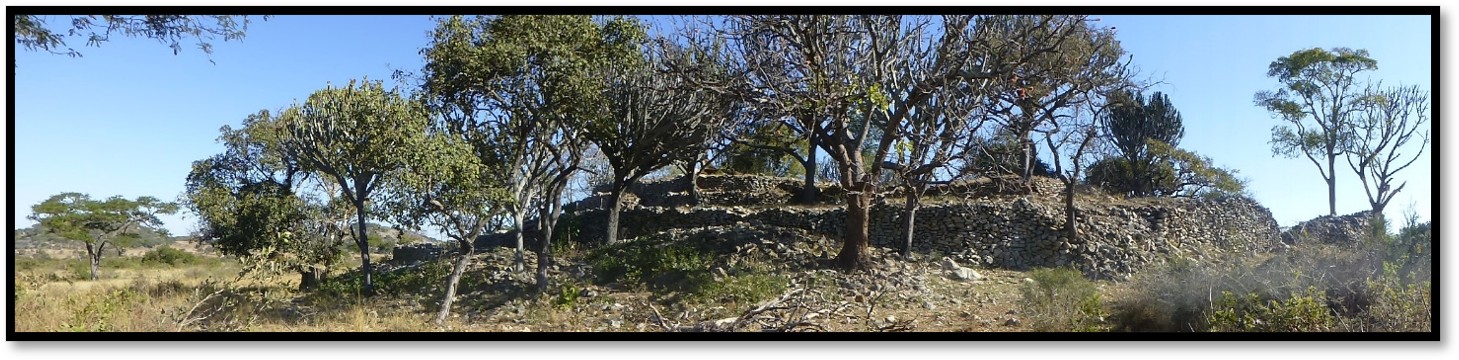
Author photo: for details see the article Zinjanja Monument (formerly Regina Ruins) under Matabeleland South on the website www.zimfieldguide.com
Manyanga
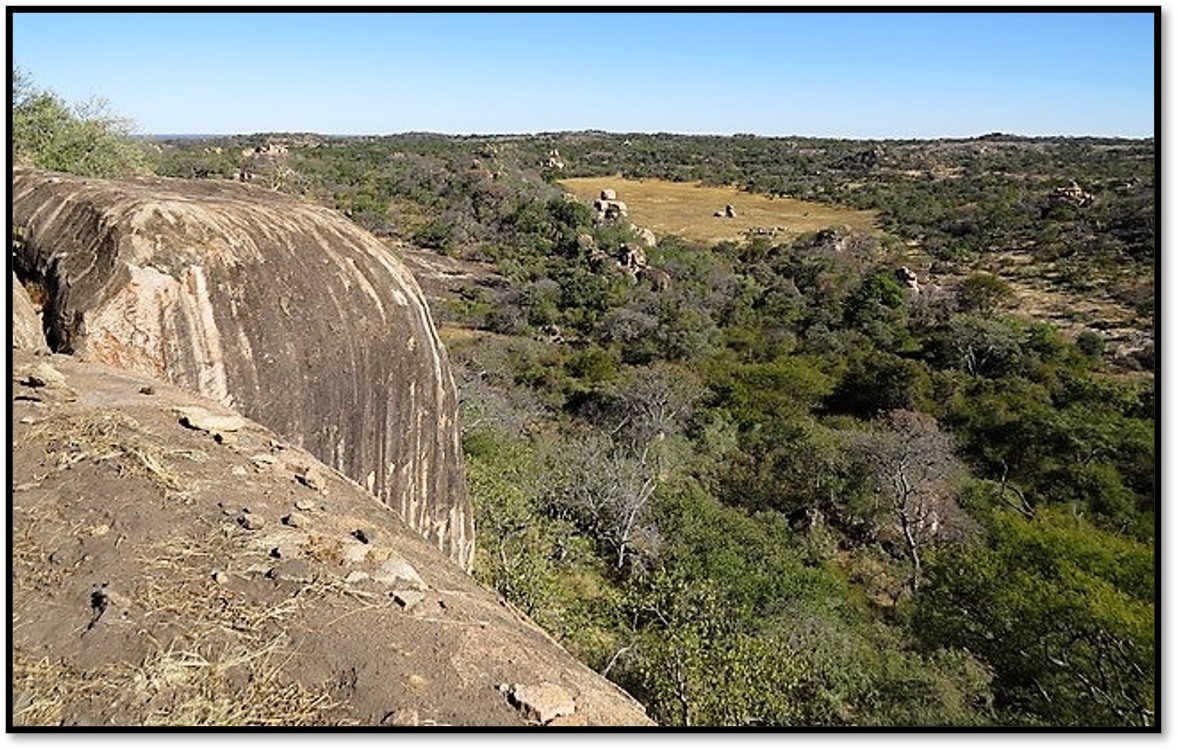
Photo Credit Rob Burrett: for details see the article Manyanga (formerly Ntaba zika Mambo) Monument ruins under Matabeleland North on the website www.zimfieldguide.com
The military tactics used by Changamire Dombo I against the Portuguese
Between 1684 and 1695, the Rozvi military launched military campaigns that drove the Portuguese traders and their militia out of their inland marketplace settlements (feiras) along the Zambezi River valley, securing the plateau for native rule.
Before beginning a battle Dombo used an extensive network of scouts and spies to monitor Portuguese movements around their trading posts (feiras) and private estates (prazos) This intelligence allowed him to ambush them at an appropriate time, such as his total destruction of the major Portuguese settlement at Dambarare in 1693, when after the death of the Mukombwe, Dombo combined forces with Nyakaunembire in a succession dispute.
The Rozvi army cut off all trade routes and communication between the Portuguese interior settlements and the coast, starving them of supplies and information before launching their assaults. Smaller Portuguese trading posts, such as Chitomborwizi at the headwaters of the Angwa river, were assaulted first in the early 1690’s.[28]
Because Dombo could not match the Portuguese firepower directly, he used other tactics. Long before the Zulus under Shaka used the "bull-horns" or crescent formation on the battlefield, Dombo used this tactic with the main force (the chest) engaging the Portuguese enemy head-on, while two fast-moving wings (the horns) swept around the flanks to completely encircle them.
The smoothbore arquebusses with matchlock mechanism used by the Portuguese and their African militia were slow for reloading and unreliable in wet weather when the burning piece of rope (the match) often went out. By overwhelming the enemy from all sides simultaneously, Dombo's warriors prevented the Portuguese from firing in volleys and disrupted their firing sequence.
Despite fighting against arquebusses, the Rozvi used their traditional heavy shields, spears and expertly synchronized volleys of arrows very effectively. Rapid close-quarters charges enabled them to engage in hand-to-hand fighting before the Portuguese militia could reload.
Dombo actively cultivated supernatural rumours that he was invulnerable and could magically turn Portuguese bullets into harmless water. This boosted the absolute confidence of his Vhanyai soldiers while creating fear in the hearts of the Portuguese militia.
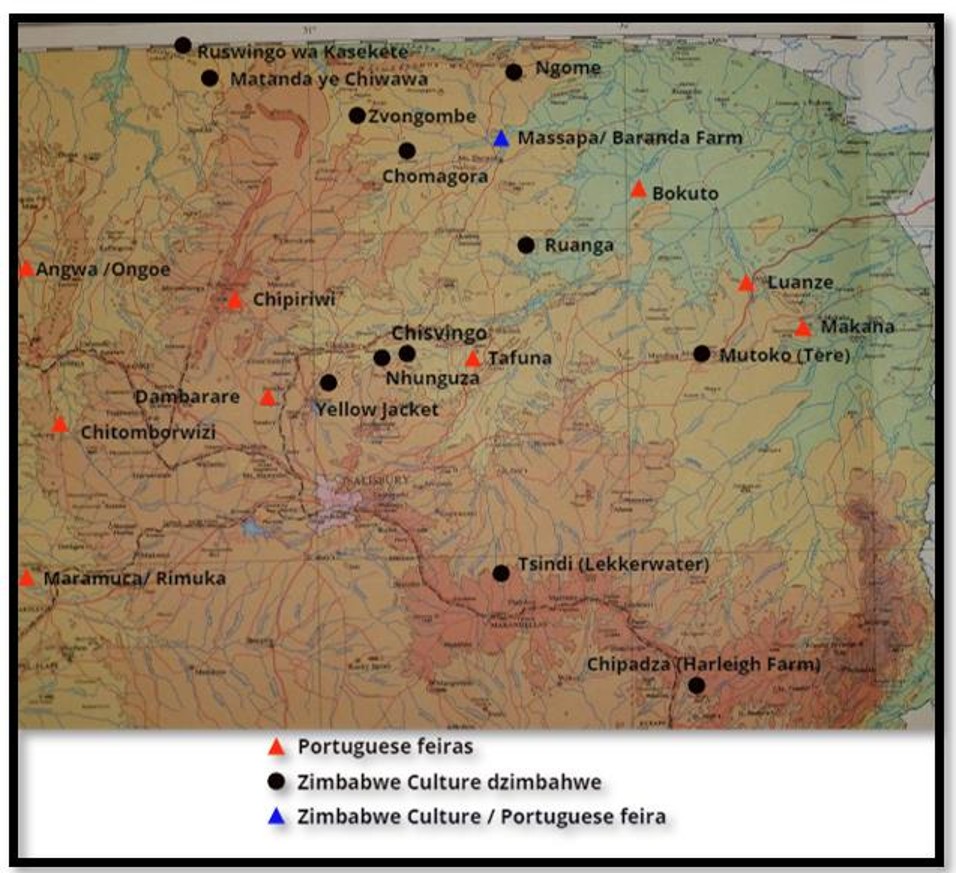
Portuguese feiras and trading settlements on the northern Mashonaland Plateau
The battle of Maungwe in June 1684
Recognizing Dombo as a threat to their commercial dominance, the Portuguese commander Caetano de Melo de Castro launched a pre-emptive military campaign to crush the rising Rozvi power.[29]
Maungwe was the first major direct military clash between Changamire Dombo I, the founder of the Rozvi State, and the Portuguese militia forces. The battle reputedly took place at Mhanda Mountain (Mhanda - Hondo yepaMhanda) along the border of what are now the Mutasa and Makoni districts within the Manicaland Province of eastern Zimbabwe. The battle was a fierce, multi-day engagement between completely different style of military forces.
. The Portuguese used infantry units mostly of local African militia supported by musketeers with seventeenth century firearms and portable artillery. In contrast, Dombo’s Rozvi warriors relied primarily on traditional shields, spears, bows and arrows.
· Although Dombo’s forces took heavy casualties from the Portuguese gunfire, they demonstrated intense defensive resilience and used the rugged plateau terrain to their advantage, repeatedly launching counter-attacks. Reports indicate that Dombo successfully routed or broke the Portuguese lines four or five times over the course of the fighting.
· After days of combat, both forces camped directly on the battlefield with the intention of resuming the fight before finally the Portuguese retreated to Tete. Dombo followed up his victory by marching east in 1695 to sack the Manyika feira, sealing off the entire northern plateau and Manicaland from the Portuguese.
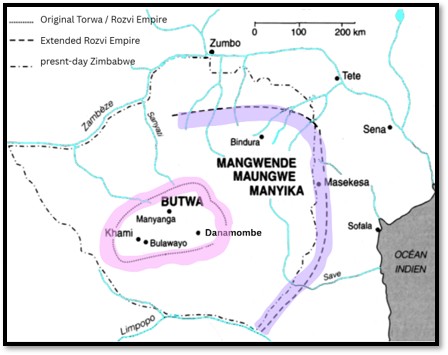
Extent of the Rozwi State: Adapted by the author from Wikipedia
Mudenge writes that the women who accompanied Dombo’s army were ordered to cut as much firewood as they could. At 1pm in the morning fires were lit all around the Portuguese and the militia and some of the Portuguese musketeers panicked and fled from the battlefield. Father Conceição wrote, “He (Dombo) was so wily and cunning that after being defeated by our arms, he vanquished us with his stratagems.”[30]
The fallout at Dambarare (1693) shattered the Portuguese presence
The Mutapa, Nyakaunembire, rejected Portuguese political and trade interference and invited the Rozvi State ruler, Changamire Dombo I, to help expel them. However, Dombo did not attack the Portuguese positions again until 1693. Mudenge believes that between 1685 and 1692 Dombo was consolidating his position in Butua.[31]
Dombo’s army launched a sudden offensive in November 1693 on Dambarare, which was then the most prosperous gold-trading centre on the Mashonaland plateau. The Rozvi army intercepted and killed all the Portuguese and Indian / Goan merchants before they could retreat behind the safety of their fortified walls. Contemporary accounts by Portuguese priest António da Conceição detail that Dombo’s forces burned down the church, flayed the captured Catholic priests alive, and exhumed graves. The remains were reportedly used as ‘war medicine’ to psychologically terrorise the Portuguese both within the region of present Zimbabwe and the Zambezi Valley.[32]
The absolute destruction of Dambarare sent shockwaves across the region. Fearing the same fate, Portuguese traders panicked and permanently abandoned nearby feiras, such as Ruhanje, Matafuna and the long-standing trading station at Massapa and with them their access to the goldfields. The Portuguese presence on the northern plateau collapsed and the survivors fled to the remaining centres along the Zambezi River, specifically Tete and Sena in modern-day Mozambique.[33]
The significance of the Portuguese withdrawal
While Maungwe was not a total annihilation of the Portuguese, it was a profound strategic victory for Dombo’s forces. In 1695 – 6 the Portuguese attempted to re-assert control and defeated Nyakaunembire’s forces and installed a puppet King, Dom Pedro on the Mutapa throne. Dombo’s successor, Changamire II / King Nyamanda (c. 1695–1723) restored Rozvi control in 1702 and again forced a Portuguese withdrawal from the interior.[34]
The Portuguese retreat did have major consequences:
· The battle proved to local Africans and their leaders that European firearms did not make the Portuguese invincible.
· The battle consolidated Changamire Dombo I’s political authority and he went on to establish his capital at Danamombe and the Rozvi State as the supreme military power on the northern plateau and Butwa.[35]
· Dombo used the momentum built at Maungwe to ally with the remaining Mutapa forces and in 1695 destroyed the remaining Portuguese trading posts such as Masi Kwesi (Manyika) and drove the Portuguese back to Tete and Sena.[36]
The Mutapa Empire is also reduced under the Rozwi
Not only did the Portuguese withdraw from the northern plateau but through civil wars brought by succession disputes the Mutapa title changed hands quickly a number of times. First Nyamhende (1694–1707) then Nyenyedzi Zenda (1707–1711) then Baroma Mugwagwa (1711–1712)
During the reign of Baroma Mugwagwa he was overthrown and expelled from the northern plateau and confined to Dande and Chidima located in the Zambezi River Valley between present-day northern Zimbabwe and Tete Province of western Mozambique: “thereby reducing the once large Karanga state to relative insignificance. These wars established a boundary between a region under Portuguese influence and the region controlled by the Rozvi. This boundary served the events of the nineteenth century and formed the rationale for the frontier demarcation when the boundary between Mozambique and Southern Rhodesia was drawn in 1891.” [37]
Administration and economy within the Rozwi Empire
The Rozwi Empire reached its peak within the eighteenth century from its centres at Danamombe (formerly Dhlo Dhlo) Khami, Manyanga, Naletale and Zinjanja (formerly Regina)
· The true economic wealth of the state came from large-scale cattle herding and successful agricultural crop production of millet and sorghum. Other pillars of the economy were gold and ivory. Mudenge writes that before the eighteenth century the bulk of the ivory came from the Mutapa Empire but during the eighteenth / nineteenth centuries it came mostly from the Rozvi State[38]
· Subjugated vassal states retained local autonomy but paid regular tribute to the central capital
· Political authority was deeply tied to Shona religious customs, gaining spiritual legitimacy through the powerful influence of mhondoro (ancestral spirit mediums)
Did the Rozwi State rely on external trade route through the Limpopo River Valley?
The short answer is no. The Limpopo River Valley was a major trade corridor for the Kingdom of Mapungubwe (c. 900–1300 CE) but trade routes had shifted northward centuries before the Rozvi State was established in the late 17th century. External outwards trade in gold and ivory was mostly through the Zambezi River Valley and via the trade centre at Zumbo, located on the confluence of the Zambezi and Luangwa rivers, and to a lesser extent through routes to the east through the Manyika kingdom onto coastal markets in Mozambique, specifically Sofala and Inhambane (Chibuene) on the Indian Ocean coast and Manyikeni just inland of the coast.
Native African traders, called vashambadzi, were used to transport gold, copper and ivory to border outposts like Zumbo, exchanging them for luxury imports. Stan Mudenge has shown that unlike the Mutapas who tried to monopolise trade, the Rozvi leaders did not hold a strict monopoly; ordinary citizens could trade externally as long as the regulations were respected.
Although Portuguese traders were banned from entering the interior and the Rozvi guarded their borders, the Rozvi were prepared to protect the Portuguese trading post at Zumbo during the Mutapa Empire’s succession crises.
The Changamire[39] lineage
Much of the chronology relies on oral traditions and Portuguese records, but historians recognise the following Changamire:
Early Dynasty
Changamire Dombo I (c. 1670’s–1695) -> Military Founder
Changamire II / King Nyamanda (c. 1695–1723)
Chirisamhuru I (1760’s)
Mid-Dynasty
Gumboreshumba, Gomo remvura, Rupandamanhanga and Nechagadzike
End Dynasty
Changamire Baswi (Early 19th Century)
Changamire Chirisamhuru II (Died c. 1830’s) -> Last Rozvi ruler killed at Manyanga in the Mfecane
Changamire Tohwechipi (c. 1830’s–1866) -> Led eastern guerrilla resistance
Decline and collapse of the Rozvi State in the period 1824-8
Initially a succession of catastrophic droughts in the region between 1795–1800 and again in 1824–1829 led to crop failures and widespread starvation and the depletion of cattle herds. This undermined the spiritual authority of the Changamire’s who were viewed as semi-divine figures responsible for rain-making.
Gradually Butua gold mines became exhausted or reached the water table prohibiting further mining.[40] The elephant numbers fell as increasingly firearms were purchased from Portuguese traders and they became ruthlessly hunted leading to a reduction in the ivory trade. In any case gradually the focus of trade throughout the region shifted from these product to the slave trade. The Portuguese colonies at Angola and Mozambique had a significant part in the global slave trade in the eighteenth and nineteenth centuries.[41] Many hundreds of thousands of slaves are estimated to have been shipped from West and East Africa to the sugar plantations in Brazil and Uruguay and the sugar-producing islands of the Indian Ocean and Madagascar.
Succession disputes between the Rozvi rulers destabilised the Rozwi State much as it did to the Mutapa Empire, perhaps population pressures played a part. Mazarire argues that there were also conflicts between the rulers and the Mwari religious leaders. One son moved northwest to the Hwange area building Bumbusi and Mtoa and establishing a new chiefdom amongst the Nambya and Tonga and became known as the Chireya Dynasty.[42] Another moved south crossing the Limpopo river and established a new centre at Dzata in the Zoutpansberg adopting a Venda identity.
In addition to a partial economic decline the empire had grown too big for efficient central administration. Weakened by famine and internal succession feuds among the ruling elite, the Changamire’s lost control over regional vassals, such as Manyika and Uteve, who stopped paying tribute and declared their independence
Finally during the Mfecane / Difaqune several migrating Nguni groups launched aggressive raids into Gazaland and across the Limpopo river causing widespread warfare and disruptive population movements. “With their tight military organisation, the Ndwandwe found the Tsonga and Karanga polities easy prey.”[43] The first Nguni assault led by Nyamazana caused Changamire Chirisamhuru to leave Danamombe and flee to Manyanga where he was killed.[44] Nyamazana’s relative, Zwangendaba settled in the Mazowe area for a short period and then crossed the Zambezi during an eclipse of the sun in 1835 and proceeded further north, reaching Lake Tanganyika in the late 1860’s.[45] Another group from northern Natal under Soshangane established the Gaza Empire around present-day Maputo incorporating the Shona-speaking groups of eastern Zimbabwe, such as the Manyika and the Ndau. Lastly the amaNdebele under Mzilikazi forced by the Boers from the Marico Valley migrated north in 1837 and settled in southwestern Zimbabwe incorporating the remaining local Rozvi groups in the process.
The last recognized Mambo, Changamire Tohwechipi, led a decades-long guerrilla resistance from his stronghold in the upper Save Valley and Mavangwe Hills and rallied the remaining Shona groups to launch counter-raids against the expanding amaNdebele Kingdom until his surrender in 1866.
The historical Importance of the Rozvi State
For nearly a century and a half the formidable military organization of the Rozvi State allowed local Shona culture, architecture, and economic systems to flourish independent of foreign control thriving on indigenous agriculture and cattle herding. It had its development from a highly organised military rebellion against Portuguese political and trade encroachment in the late seventeenth century and became the dominant pre-colonial power in present-day Zimbabwe from 1680 to 1830.
Mazarire argues, “The collapse of the Rozvi state under pressures from various Nguni groups did not have a similar effect on the Mwari cult system because the Ndebele, who eventually conquered the Rozvi state, preserved the cult intact and adapted its provincial networks, and that of the Rozvi state, to their own tributary system.”[46]
References
G.C. Mazarire. The gadzingo: towards a Karanga expansion matrix in 18th and 19th century southern Zimbabwe. Critical African Studies, 2013 Vol. 5, No. 1, 4–16, http://dx.doi.org/10.1080/21681392.2013.775623
S.I.G. Mudenge. A Political History of Munhumutapa c 1400-1902. Zimbabwe Publishing House, 1988
https://en.wikipedia.org/wiki/Rozvi_Empire#/media/File:Empire-rozvi.png
M. Newitt. A Short History of Mozambique. C. Hurst and Co Publishers Ltd, 2017
Innocent Pikirayi. The Zimbabwe Culture : Origins and Decline of Southern Zambezian States. Altamira Press, 2001
Innocent Pikirayi. Palaces, Feiras and Prazos: An Historical Archaeological Perspective of African–Portuguese Contact in Northern Zimbabwe. September 2009
African Archaeological Review 26(3):163-185
F.W.T. Posselt. Fact and Fiction. Books of Rhodesia. Bulawayo 1978
Isaac Samuel. 14 May 2023. African History Extra. A history of the Rozvi kingdom (1680-1830) from Changamire's expulsion of the Portuguese to the ruined cities of Zimbabwe
https://www.africanhistoryextra.com/p/a-history-of-the-rozvi-kingdom-1680
Isaac Samuel. 14 August 2022. African History Extra. The kingdom of Mutapa and the Portuguese: on the failure of conquistadors in Africa (1571-1695) https://www.africanhistoryextra.com/p/the-kingdom-of-mutapa-and-the-portuguese
Notes
[1] Rozvi is also spelled Rozwi and Barozwi. Prior to the rise of Changamire Dombo there was no distinct ethnic group called Rozvi. They came from the native Karanga (Shona) population and it was the Portuguese who coined the term ‘Rozwi’ from the Shona word kurozva (to destroy, plunder, or manipulate through magic)
[2] Many references refer to ‘European colonial forces’ as though the Portuguese maintained large standing armies on the Zimbabwe Plateau. This is far from correct as in reality the feiras (trading posts or markets) at Angwa (Ongoe) Bocuto, Chitomborwizi, Dambarare, Luanze (Ruhanje) Makaha, Maramuca (Rimuka) Masi Kwesi (Manyika) Massapa (Fura) Matafuna, Mazofe, Piringani (Ditchwe) had just a few traders in residence and some had none at all for most of the year. Alluvial gold was panned in the winter season by the Shona when the rivers were low and traded at the start of rains when large caravans led by the mixed-race culturally fluid and bilingual Vashambadzi were sent by the Tete and Sena traders into the interior to trade for gold and ivory
[3] Stan Mudenge was a professional historian focusing on African history in general and specializing in pre-colonial Zimbabwean history. He published several books of which his best known was A political History of Munhumutapa c1400-1902 and rejected the thesis of several historians who argued that external trade provided the stimulus for the growth of African states
[4] The Zimbabwe Culture, P28
[5] The Mutapa Empire is also known as Monomotapa, Moenemugi, Munhumutapa and Mwene Mutapa
[6] Chidima served as a transit point on the southern bank of the Zambezi river between the Zumbo feira and Tete
[7] The main tribute was the curva {Kuruva) originally paid by Swahili traders and later by the Portuguese after they side-lined the Swahili
[8] Palaces, Feiras and Prazos: An Historical Archaeological Perspective of African–Portuguese Contact in Northern Zimbabwe
[9] Key Terms of the 1629 Treaty
· Declaration of Vassalage: Mavura formally acknowledged himself as a vassal of the King of Portugal, forcing the empire to pay an annual tribute of gold.
· Loss of Mineral Rights: The Portuguese gained unrestricted access to prospect for and exploit all gold, silver, and copper mines across the empire.
· Expulsion of Rivals: The Mwenemutapa was forced to expel all Muslim traders (Swahili-Arabs) from the territory, granting the Portuguese a complete commercial monopoly.
· Religious Freedom: Catholic missionaries (primarily Dominicans) received total freedom to preach, build churches, and convert citizens anywhere within the empire.
· Diplomatic Subservience: The emperor agreed to show deference to the Portuguese captain at Masapa, requiring the ruler to stand in the captain's presence while the captain remained seated.
· Extraterritoriality: Portuguese settlers and traders inside Mutapa territory were made exempt from local laws, answering only to Portuguese judges.
[10] See the article The decline of the Mutapa state c.1623 – c.1902 under Mashonaland Central on the website www.zimfieldguide.com
[11] The Zimbabwe Culture, P209
[12] A history of the Rozvi kingdom (1680-1830) from Changamire's expulsion of the Portuguese to the ruined cities of Zimbabwe
[13] History of Mozambique, P55
[14] Hurungwe is sometimes mentioned, but confusingly the Hurungwe district (formerly Karoi district) in present-day Zimbabwe encompasses the north-western region.
[15] A Political History of Munhumutapa c 1400 – 1902, P210
[16] A history of the Rozvi kingdom (1680-1830) from Changamire's expulsion of the Portuguese to the ruined cities of Zimbabwe
[17] Butua was named by the Portuguese, ‘Guruuswa’ (tall grass) was the local name
[18] The Zimbabwe Culture, P210-12
[19] A Short History of Mozambique, P12
[20] Ibid, P209
[21] The gadzingo: towards a Karanga expansion matrix in 18th and 19th century southern Zimbabwe, P5
[22] K.R. Robinson. Khami Ruins. Report on Excavations undertaken for the Commission for the Preservation of Natural and Historical Monuments and Relics, Southern Rhodesia, 1947-1955
[23] D.N. Beach. Zimbabwe before 1900, P82. Mambo Press, 1984 / The Zimbabwe Culture, P211
[24] Mudenge rejects the ‘trade stimulus’ hypothesis that the wealth of the region came as a result of external trade. A Political History of Munhumutapa, P27
[25] Mudenge states of all the forms through which vassal rulers could pay tribute or give presents to the Mutapas, cattle were probably the most convenient and relatively easy to find. Portuguese documents also mention cattle being used to pay tribute. A Political History of Munhumutapa, P163
[26] The Zimbabwe Culture, P214
[27] Ibid
[28] The Zimbabwe Culture, P210
[29] Caetano de Melo de Castro (c.1660 – 1718) was an aristocrat and military commander. He was sent to Brazil as Governor-General of Pernambuco (1693–1699) and crushed a slave uprising. From 1702 – 1707 he was Viceroy of Portuguese India and in charge of military operations in Mozambique
[30] A Political History of Munhumutapa, P286
[31] Ibid, P287
[32] See the article Dambarare – an Afro-Portuguese Feira site under Mashonaland Central on the website www.zimfieldguide.com
[33] For more detail in the feiras see the article The Portuguese Feiras and trading settlements of the 16th – 17th century on the Northern Mashonaland Plateau and Manicaland under Mashonaland Central on the website www.zimfieldguide.com
[34] History of Mozambique, P57-8
[35] The Kalanga / Shona kingdom known as Butwa or Butua in the west of present-day Zimbabwe lasting from roughly 1425 to 1683 until invaded by the Rozvi and was famous for its gold and ivory trade
[36] The Zimbabwe Culture, P210
[37] A Short History of Mozambique, P36
[38] A Political History of Munhumutapa, P185
[39] The title Changamire (meaning Emperor or King) was used as a dynastic title by successive Rozvi monarchs. The name is probably a mix of Karanga and Arabic. ‘Emir’ meaning ruler in Arabic
[40] Only alluvial gold washed from rivers was not limited by technical factors. Mudenge writes that all the Portuguese records indicate that gold volumes decreased from the sixteenth to nineteenth centuries. A Political History of Munhumutapa, P173
[41] See the article To what extent did slavery exist in Mozambique, Tanzania and Zimbabwe? under Harare on the website www.zimfieldguide.com
[42] The Zimbabwe Culture, P216
[43] A Short History of Mozambique, P56
[44] Ibid, P218
[45] Ibid, P219
[46] The gadzingo: towards a Karanga expansion matrix in 18th and 19th century southern Zimbabwe, P5