
- Entry fee
- n/a
Background
Roger Summers proposes that pre-colonial gold mining in Zimbabwe dates back to at least the 7th century AD and peaked between the 11th and 15th centuries. Operating within powerful states such as Great Zimbabwe, the Torwa State, and the Munhumutapa Empire, the ancestors of the Shona people were master miners and metallurgists at the centre of an industry linking the Zimbabwean plateau to the Indian Ocean trade network. So extensive was this ancient industry that Summers estimates that over 95% of Zimbabwe’s modern large-scale gold mines[1] established after 1890 were built directly on top of pre-colonial workings.[2]
Hall and Neal[3] write that in September 1900 there were 114,814 registered gold claims; further that in the 1900 Report on Mining in Rhodesia (present-day Zimbabwe) issued by the British South Africa Company it was stated that almost all of the four hundred listed working gold properties were on old workings.
1. Historical Context & The Global Trade Network
Gold extraction was carried out during successive regional dynasties including those of the Great Zimbabwe, Munhumutapa, Torwa and Rozvi. Some of their characteristics included:
Trade routes: Mined gold was transported east to Swahili coast trading ports such as Sofala and Kilwa, where Swahili dhows carried it across the Indian Ocean.
Imports & local value addition: In exchange for gold, regional elites imported luxury goods; excavations at Great Zimbabwe have recovered Chinese Ming dynasty porcelain, Persian glassware and Indian Ocean glass beads. Locally, gold was fashioned into intricate jewellery and used to decorate elite and ceremonial items, such as the handles of axes and knives.
Standardized economy: Archaeological evidence from Great Zimbabwe shows that artisans cast gold into standardized ingots weighing approximately 327 grams, pointing to a tightly regulated domestic economy centuries before European arrival.[4]
Decline & colonial exploitation: By the 16th century, Great Zimbabwe was largely abandoned due to environmental shifts, with political power shifting to the Munhumutapa and Torwa dynasties. The severe disruption caused in the 1830s by the Mfecane is discussed below. Decades later, in the late 19th century, European hunters and concession-seekers used these conspicuous pre-colonial workings to map out and claim the region's mineral wealth.
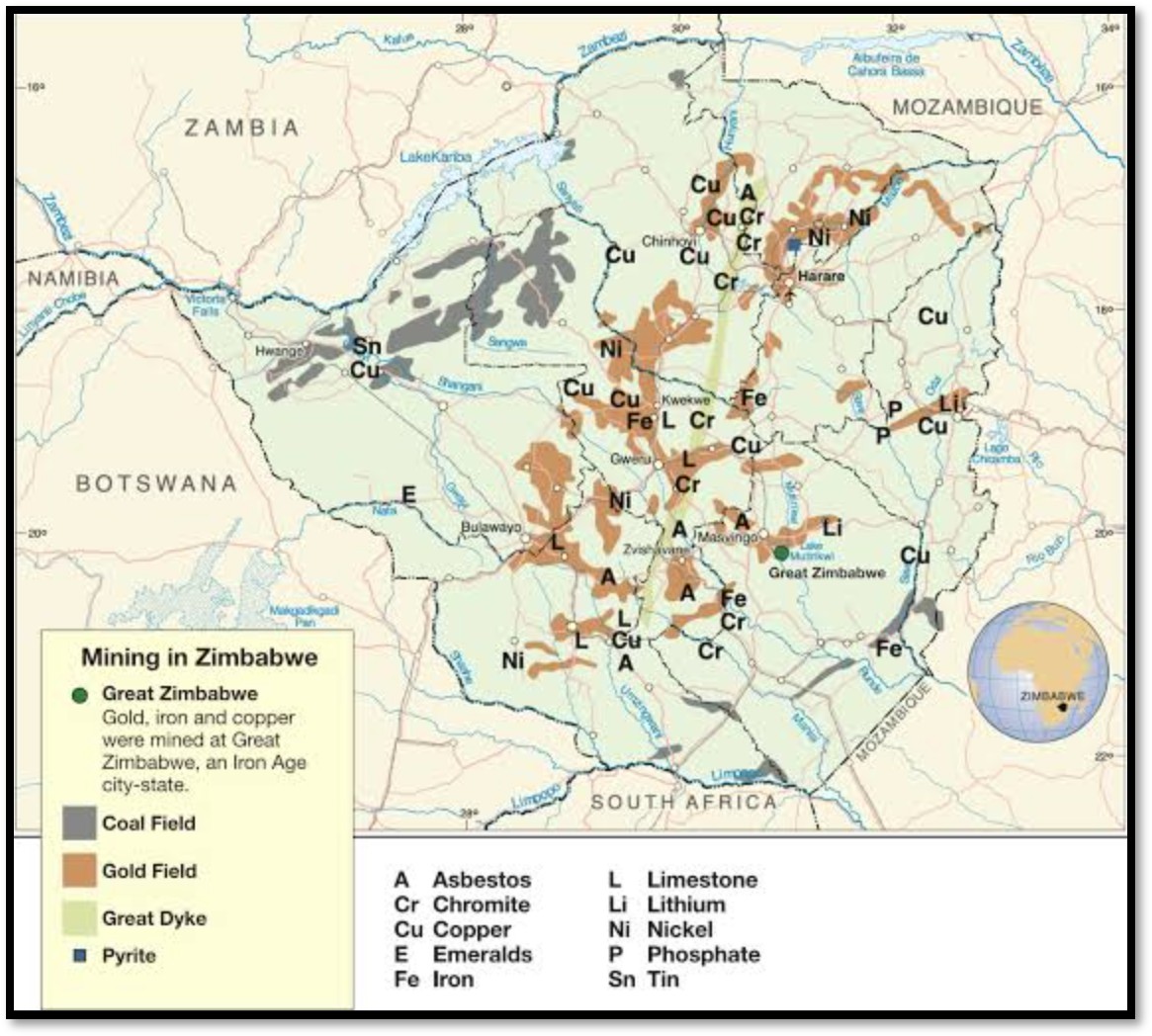
Gold fields of Zimbabwe are coloured brown
2. Pre-colonial Mines
In his important work Ancient Mining in Rhodesia (1969), archaeologist Roger Summers defines a pre-colonial mine[5] - or "old working" - as "any shaft, cutting, tunnel or stope which was made for mining purposes and which was in existence before 1890." A single working might consist of one large pit, a long narrow trench, or a cluster of closely associated excavations along the strike of a reef (workings on parallel reefs, even 15 metres / 50 feet apart, are counted separately)
The arrival of the Nguni groups (including the Ndebele, Ngoni, and Gaza) during the Mfecane severely disrupted the Rozvi, Torwa and Shona communities that operated the Zimbabwean plateau's goldfields. Deep-level reef mining - which required stable communities for labour, fire-setting and complex logistics largely ground to a halt as populations fled or were absorbed. However seasonal alluvial gold panning along rivers like the Mazowe continued into the late 19th century, alongside iron and copper working to supply weapons and agricultural tools.
Thomas Baines makes numerous mentions of seeing old gold workings when he travelled with Henry Hartley in 1869-72. Baines always referred to them as ‘old Mashona workings.’ But when he asked the Shona they, “appear reserved upon the subject” and “the presence of our Matabele [the guide Inyoka] perhaps frightens them.”[6] Where they came across the Shona working a gold reef their answers were evasive “When he asked who had burned the quartz, they evaded the question as if they thought they had been guilty of a crime.”[7]
On Thursday, 8th September 1870, George Wood bought a small quantity of gold from a Mashona, perhaps one-third of a quill. He asked where it was procured and the Mashona answered with surprise, “Is it not everywhere?”[8] Clearly the Shona were still carrying out some reef mining at that time as well as collecting alluvial gold for sale to the Portuguese.[9]
Between 1872-78 when Selous was hunting in Mashonaland, old men of the amaNdebele told him that when they first raided the country the Shona were working for reef gold in the “Amaguti” (i.e. in the deep holes) between the Umsweswe and Mupfure rivers, but he saw no evidence of active reef mining.[10] On several occasions Selous bought quills containing alluvial gold which had been panned from the Mazowe river, so it seems that Shona had ceased reef mining altogether by the 1880s but continued to wash gold from the rivers.
The Archaeological Survey (Table 1)
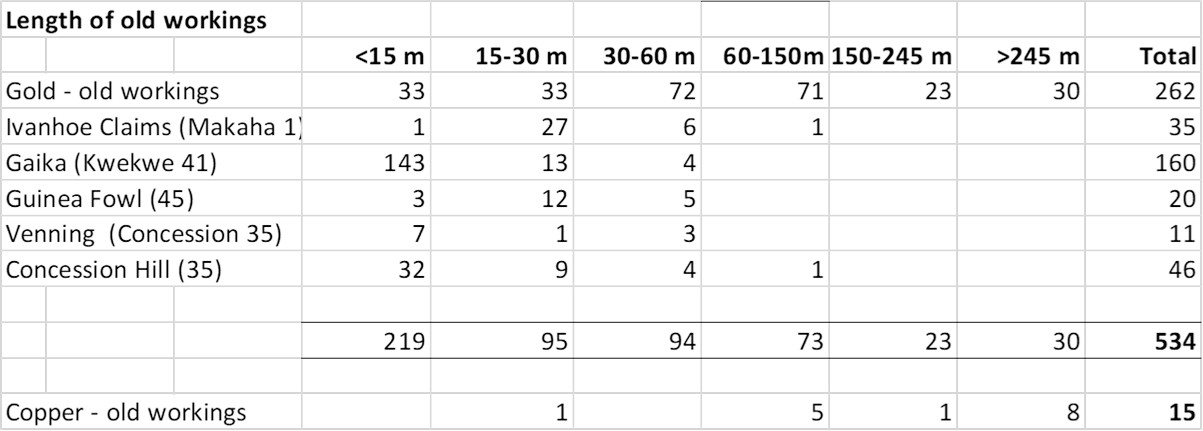
Begun by R. Summers and C.K. Cooke for the Historical Monuments Commission in 1959 with 221 sites, the survey had expanded by 1969 to 1,267 gold and copper old workings across 66 geographical areas—running roughly northeast to southwest from Makaha (near Mutoko) to Musina (near Beitbridge). These are included as Table 1 in his book Ancient Mining in Rhodesia.[11] Summers classified workings[12] into four main types:
Type 1: Open stopes
Type 1A: Open stopes with occasional shafts
Type 2: Shafts with underground stopes
Type 3: Alluvial workings
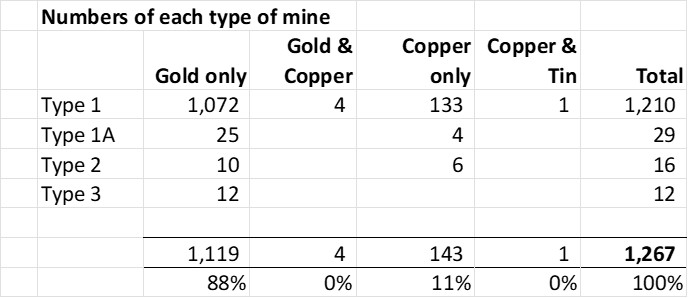
Why 1,267 Is an Underestimate
Summers demonstrated that the recorded survey significantly understated the true scale of pre-colonial mining:
Lower Gwelo (Area 46): 38 workings were listed in the survey, yet Geological Survey Bulletin No. 37 recorded 91 mines, with Summers estimating at least 80 were pegged on old workings.
Bulawayo & Bulawayo South (Areas 54 & 55): 35 workings were listed, compared to 514 claims in Bulletin No. 35 (of which Summers estimated roughly 250 were on old workings).
Tati & Vukwe (Areas 63 & 64): 56 workings were reported, whereas early British South Africa Company records noted roughly 200.
Based on these ratios and estimates from former Geological Survey Director Ben Lightfoot (including worked-out mines with no modern output), Summers concluded that the survey understated the total by a factor of three - placing the true number of pre-colonial gold mines at approximately 4,000.
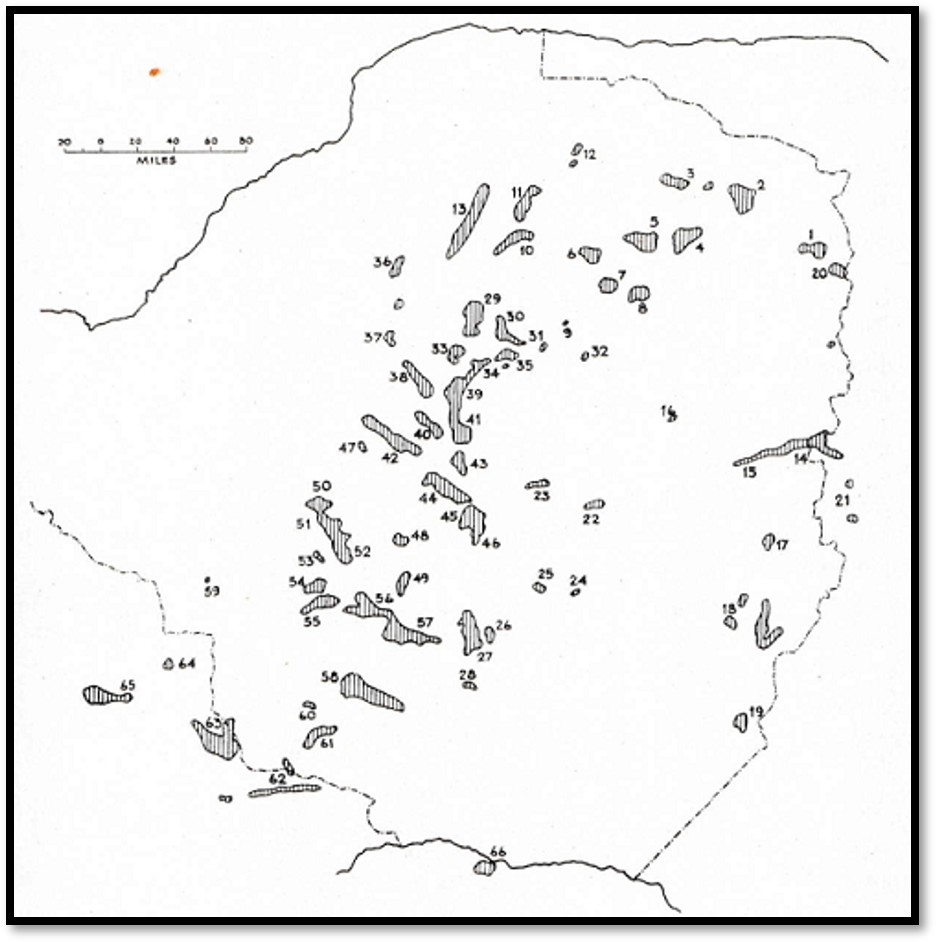
Areas of old workings in Zimbabwe
3. Geological Distribution & Dimensions
Table 1 data from Summers’ 1,267 recorded sites reveals clear patterns in where and how early miners operated:
Geological System / Formation | Gold Workings | Copper Workings | Total | Share of Total |
Bulawayan group (Basement) | 744 | 7 | 751 | 59% |
Shamvaian group (Basement) | 125 | 18 | 143 | 11% |
Granites (Varying ages) | 114 | 5 | 119 | 9% |
Sebakwian group (Basement) | 45 | 48 | 93 | 7% |
Unrecorded | 58 | — | 58 | 5% |
Post-Karoo (Jurassic) | — | 26 | 26 | 2% |
Deweras group (Later Pre-Cambrian) | 2 | 24 | 26 | 2% |
Pleistocene & Recent Alluvial | 16 | 4 | 20 | 2% |
Gneisses (Varying ages) | 4 | 9 | 13 | 1% |
Piriwiri group (Pre-Cambrian) | 8 | — | 8 | 1% |
Gairezi (Pre-Cambrian) | 1 | 3 | 4 | <1% |
Lomagundi group (Later Pre-Cambrian) | — | 2 | 2 | <1% |
Undifferentiated (Basement) | 2 | — | 2 | <1% |
Umkondo System (Jurassic) | — | 1 | 1 | <1% |
Messina System | — | 1 | 1 | <1% |
Total | 1,119 | 148 | 1,267 | 100% |
Note: Table figures reflect recorded sites in Summers’ Table 1; copper entries include sites just across modern borders such as Musina.
Within the gold belt areas the workings cluster along the contact zone between the granite and schist or in fairly well-developed linear patterns as at Mafungabusi (area 38), Sinanombi (area 40), and Lower Gwelo (area 42). Summers writes that the early miners clearly found the greenstones within the Bulawayan system the most productive for mining as they account for 59% of the old workings. Summers surmised that perhaps the miners liked quartz reefs with visible gold that were comparatively easy to follow and brittle enough to work without fire setting.[13]
Key geological findings
· Preference for the Bulawayan Greenstones: Early miners heavily favoured quartz reefs with visible gold in the Bulawayan system (59% of all workings), which were brittle enough to work easily. Although quartz veins are often narrow—requiring miners to extract barren host rock alongside the reef—they were far easier to process than sulphide-rich ores.
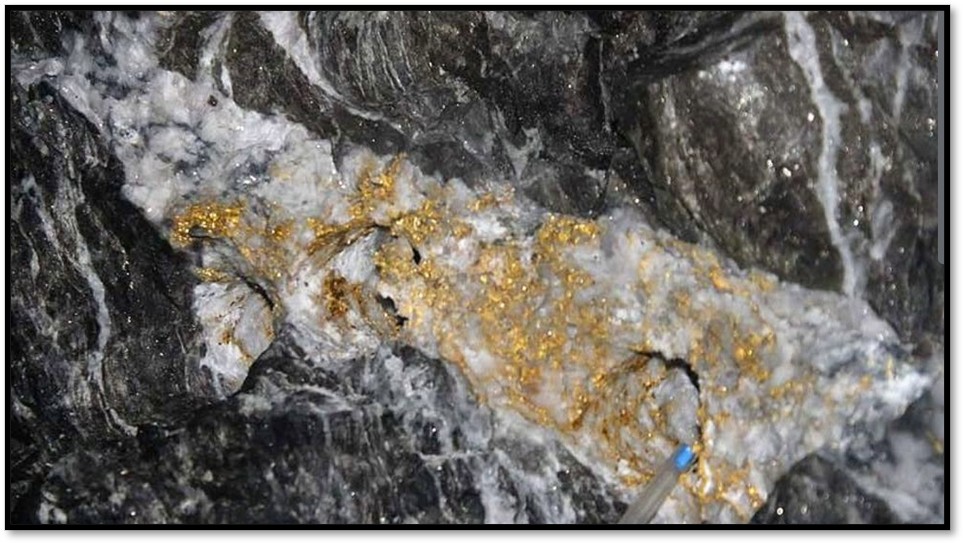
A very rich quartz vein with visible gold – the vein within host rock
· The Sulphide Barrier: Sulphide impregnations (iron, copper, arsenic, lead, and zinc) chemically mask gold, causing pre-colonial miners to miss major deposits like the Sherwood Star Mine. Where they did mine sulphide reefs - such as at Shamva or in the Chegutu district (Giant, Lone Star, Pickstone East) - they only worked the upper zones above the water table where natural oxidation had leached out the sulphides.
· Physical Dimensions: Summers writes that often descriptions of old workings use vague terms like ‘extensive’ or ‘shallow’, except where made by mining engineers who were careful to take accurate measurements.
Table 1 shows gold workings averaged 55 metres in length[14] (copper workings tended to be longer) and typically reached depths of 12 to 15 metres, though exceptional workings exceeded 30 metres vertically and 46 metres on the incline.[15] Across 378 surveyed workings, the average was 2.7 stopes per site (or 2.4 when excluding the massive Gaika Mine, which had 160 stopes across five workings).
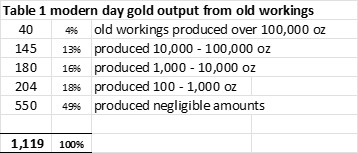
· Modern Yield Odds: Between 1891 and 1969, twenty mines produced over half of Zimbabwe’s gold, and over 40 old workings developed into major mines yielding over 100,000 oz. However, an old working was no guarantee of modern profit: prospectors faced roughly 3-to-1 odds against turning any profit, 8-to-1 against a reasonable profit, and 25-to-1 against finding a major deposit.[16]
Dating the pre-colonial gold mines
Summers, for the first time, was able to establish reliable dates for the mining industry. Two radiocarbon dates from Aboyne Mine[17]—AD 1170 ± 110 (SR-53) and AD 1300 ± 110 (SR-58)—alongside one from Geelong Mine[18] of AD 1170 ± 95 (SR-143), placed these workings between the twelfth and fourteenth centuries.
Alongside carbon-14 dating, Summers analysed pottery found within or very close to the mines to estimate when they were active. The earliest examples were Ziwa ceramics recovered from Golden Shower (area 8) and the Three Skids claims (area 4). Meanwhile, sherds of Woolandale pottery (Leopard's Kopje III, northern facies) were discovered at the Joy Claim (area 50), the Family Claim (area 57), Aboyne Mine (area 49), and village sites near the Sunace (area 53), Mamba (area 54), and Planet mines (area 55). On the Macardon Claim (area 58), a village site containing evidence of gold-working also yielded Mapungubwe pottery (Leopard's Kopje III, southern facies). Finally, Summers documented several imported goods associated with the mines, including early English coins, brass items from India, Chinese ceramics, and a Portuguese ivory statuette recovered from the Bay Horse Mine (area 29).
Summers believed alluvial gold mining had occurred since the 6th – 7th Century. However, both Huffman and Phimister believed there was no archaeological evidence to support alluvial mining before AD 1000 and both believed the gold trade between present-day Zimbabwe and the East African coast probably began about this time.[19]
4. Mining Engineering & Extraction Methods
Open Stopes (Type 1)
Most gold-bearing quartz reefs in Zimbabwe dip steeply (>70°). Miners cleared the surface outcrop and followed the vein downward:
Side Stoping: In soft schists, miners excavated from both sides of a 0.3–1.2 m reef, creating stopes around 3 m wide (later widened by weathering to 4.5–6 m) and piling waste rock ("ancient chips") along the edges.
Underhand Stoping: In hard rock, such as the Phoenix reef (area 41) at Kwekwe (dipping at 52° and steepening with depth), miners worked downward directly beneath their feet, extracting only the 0.3–1.2 m reef itself.
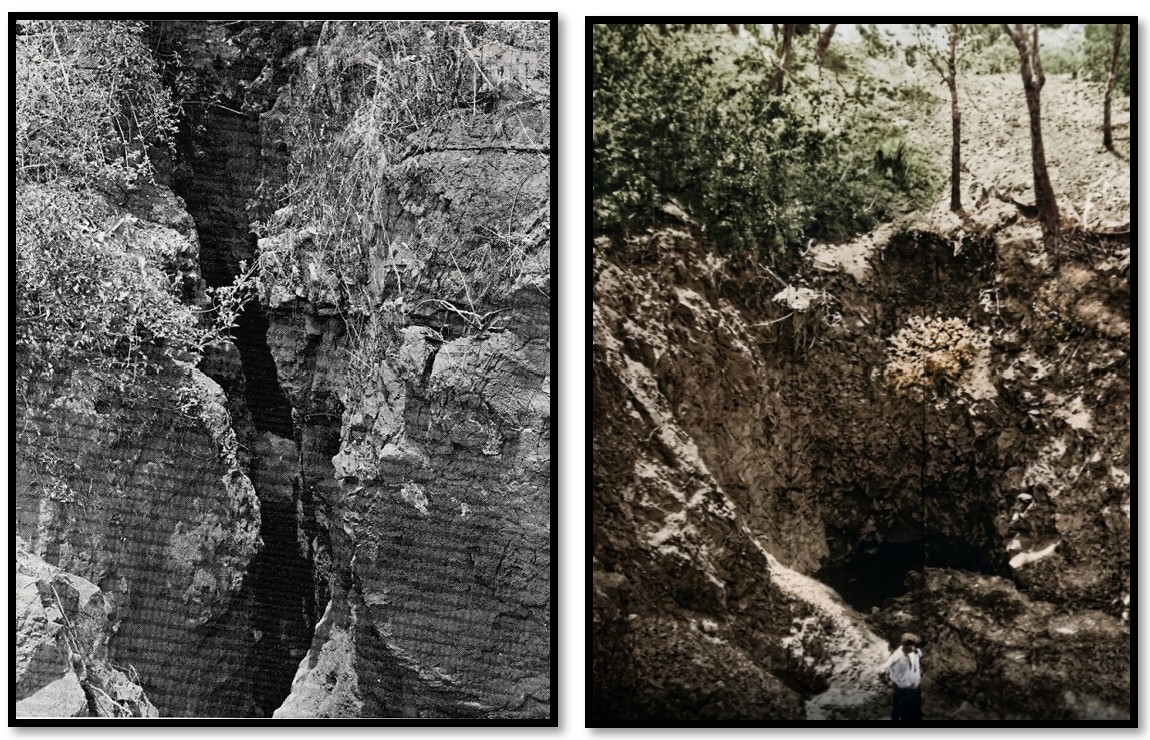
Summers: Old working stope, Gaika Mine (L) and Wanderers Mine (R)
Shafts & Underground Stopes (Types 1A & 2)
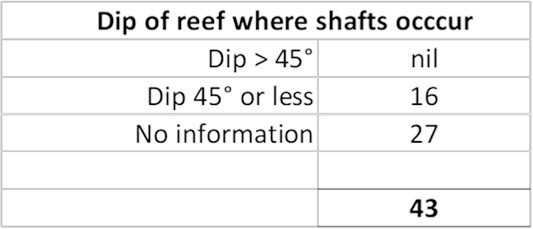
Contrary to early assumptions that shaft mining was confined to northeastern Mashonaland under Portuguese influence, at least 20 of 43 documented shaft sites occur in the Midlands and Matabeleland. Shaft usage was dictated by geology rather than geography: no pre-colonial shafts occur where reefs dip steeper than 45°.[20]
Where reefs were relatively flat, miners sank narrow vertical shafts (around 0.9 m wide and 6–24 m deep, occasionally reaching 30 m) to intersect the quartz vein, then drove underground stopes along it.[21]
Once a stope extended too far from the base, a new shaft was sunk—often in pairs to assist airflow. At the Alliance Mine in Shamva (area 4) 30 shafts were recorded.
Adits: Horizontal hillside tunnels (adits) were rarely used—only 10 gold and 6 copper examples are recorded as miners strongly preferred vertical shafts.[22]
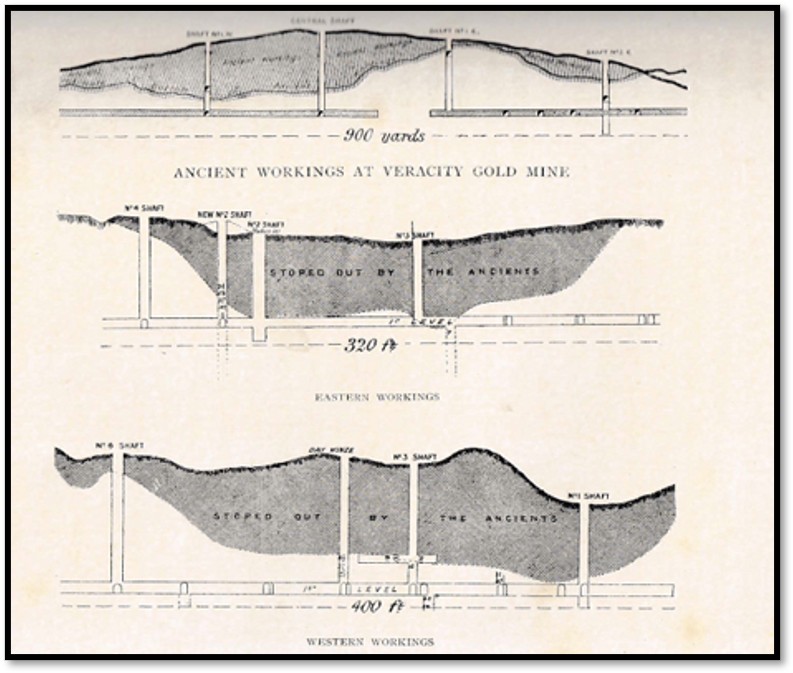
Cross-sections of stopes and shafts of old workings at Veracity and Ayrshire gold mines
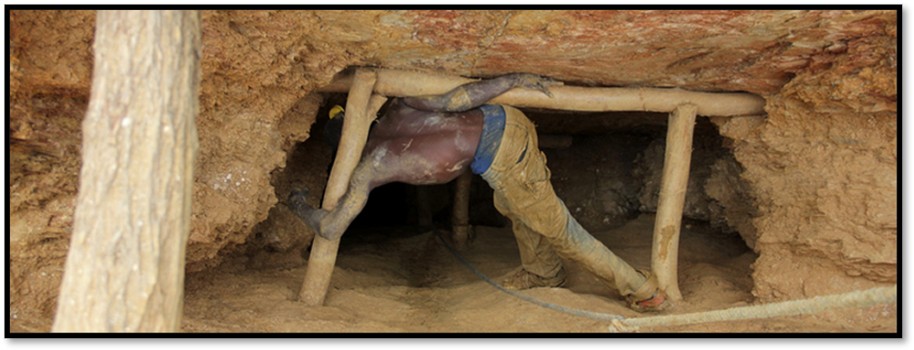
Photo Percy Musiiwa: an artisanal miner enters an underground stope – note the timbering
Alluvial Panning & Hushing (Type 3)
In hilly regions such as the Nyanga mountains, Ann Kritzinger has proposed that miners constructed water channels, settling tanks, and terraces to release sudden torrents of water for hydraulic mining ("hushing"), stripping away topsoil to expose subsurface mineral veins.[23] Alluvial gold was also panned along major riverbeds—including the Mazowe, Angwa, Ruenya, Ruia, and Nyamakwarara valleys—a practice documented by Portuguese chroniclers in the 1500s.
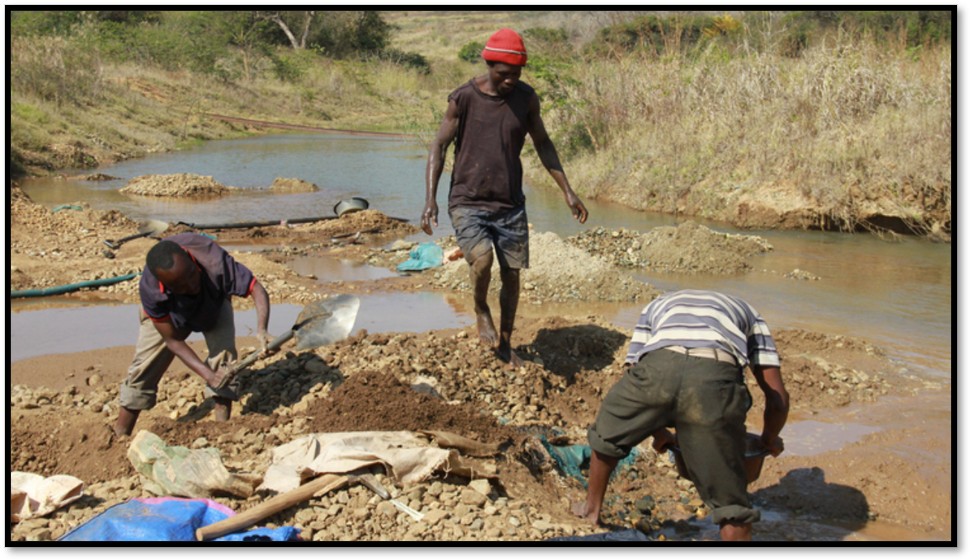
Photo Herald online: gold panners in the Mutare river, Manicaland
5. Tools, Pyro technology & Underground Safety
Fire-Setting & Rock-Breaking
Although Portuguese trader António Fernandes[24] reached the Mutapa court of Chikuyo Chisamarengu in 1511 and introduced gunpowder to the region, there is no evidence pre-colonial miners used explosives for rock-breaking. Instead, they mastered fire-setting, an ancient mining technique for fracturing rock faces:
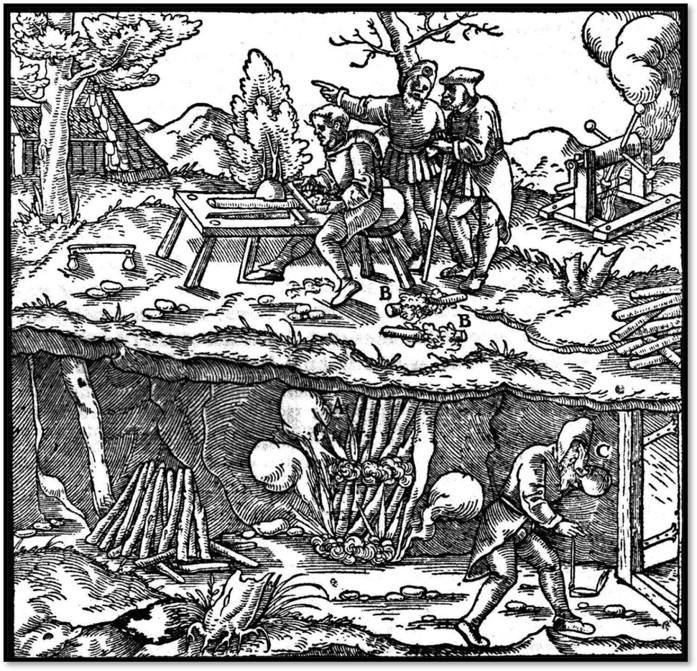
Wikipedia: Fire setting in Georgius Agricola (1556) from De Re Metallica
Selective Fuel: Charcoal analysis from mines like Geelong shows miners deliberately harvested dense, slow-burning hardwoods with high caloric output—such as Mopane (Colophospermum mopane), Rhodesian ebony (Diospyros mespiliformis), Msasa (Brachystegia spiciformis), and Wild Syringa (Burkea africana).
Thermal Shock: Fires were built directly against the quartz face (sometimes in clay troughs, as found near the Giant Mine) to superheat the rock. Miners then used small clay pots or wooden dippers (such as a spouted vessel recovered from the Odzi Mine) to direct precise jets of water onto the hot face, shattering the quartz through rapid cooling without wasting water.
Hand Tools: Most Zimbabwe pre-colonial gold is found in quartz that is hard, but brittle and can be shattered with fine-grained dolerite, or diorite hammerstones, or double-pointed iron gads hafted into tough wooden handles (like one found at Geelong Mine) and by soaking wooden wedges. Diamond-shaped iron hoes were used to scrape broken ore into baskets or leather bags for haulage of ore out of the mine.
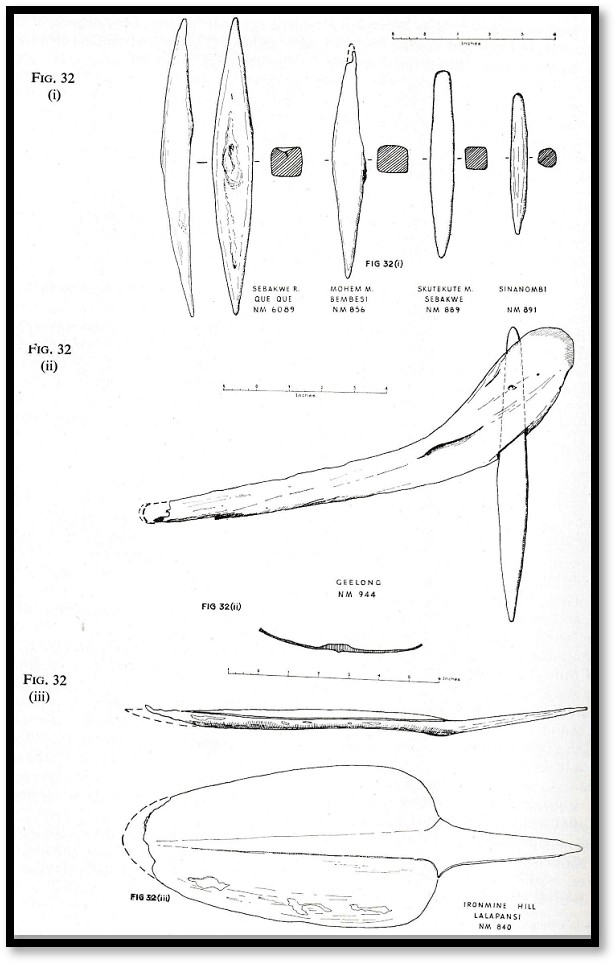
Summers: hand tools found in old gold workings
Ventilation & Backfilling
Burning wood or charcoal underground in a confined space rapidly consumes the oxygen and generated lethal mine gases including carbon monoxide (CO) and carbon dioxide (CO₂).
Convection Ventilation: Miners lit fires at the base of one shaft to create an updraught that drew foul air out through paired shafts—evidenced by large charcoal deposits found at the bottom of shafts at the Aboyne Mine at Insiza (area 49). Most likely the miners left the old workings once the fires had been lit. After some time the fire would die down and the miners would approach the heated rock to quench it with water before it cooled. Deep mines such as the Phoenix (38m), Magdalena, Geelong, and Nautch Girl were likely abandoned once they exceeded natural ventilation limits.
Strategic Backfilling: 17th-century Portuguese Jesuits Diogo do Couto and Manuel Barreto[25] claimed Shona miners backfilled mines to hide them from Europeans. Summers suggests that deliberate backfilling of stopes was to assist in removing the poisonous gases. The most efficient method would be to create a convection current at the foot of a shaft to draw out the poisonous gases, but would require two shafts, one for down and one for up-draughts.
Backfilling worked-out stopes with waste rock also served a vital engineering purpose: sealing off dead chambers to channel fresh air strictly into active working faces. Summers’ book has a photo of a shaft that appears to have been deliberately back-filled at Umkondo copper mine (area 18).[26]
6. Haulage and hoisting
F.C. Selous writes, “At the bottom of an old shaft, 120 feet deep, at Concession Hill, near the Zweswi (Umsweswe) river, Mr Cock, in 1891, found a bucket and rope made of Machabel[27] bark, besides some iron implements. Now, this bucket and rope, evidently intended to haul quartz up from the bottom of the shaft, being made of such perishable material as bark, could not possibly have been of any great antiquity, while the iron implements, axes, etc., were absolutely the same as those in present use amongst the Mashunas and showed no signs of age.”[28]
Baskets and leather bags either carried by a forehead strap, or slung over the shoulder, are likely to have been used as well, but none have survived. At the time of occupation in 1890, Shona and Karanga men were familiar with using a windlass, and Summers speculates that bark or hide ropes may have been used on primitive windlasses. It is also possible that they learned the technique in Kimberley, or on early Witwatersrand gold mines.
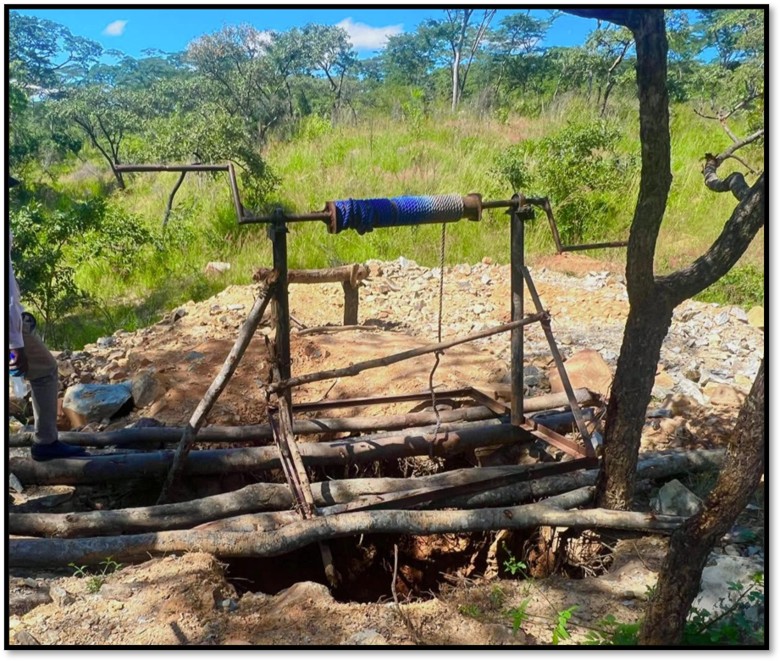
Shaft and windlass to a Zimbabwean artisanal gold mine
7. Cultural remains
Lorraine Swan in her paper Early Gold Mining on the Zimbabwean Plateau writes that smallworkers and miners “were unaware of or not concerned with the cultural importance of the relics in the mines…Hammer stones and iron gads would be separated, since they could cause a temporary breakdown of the mill, but bones and pottery would be crushed…Much archaeological material in the mines must have been destroyed in this way.”[29]
At the Gaika Mine in Kwekwe, the skeleton of a ~19-year-old female miner was uncovered in the 1940s beneath a collapsed rock pillar at 12–15m depth.[30] At the Aboyne Mine, a man who was killed in an underground rockfall accident was found together with blue glass beads and a sherd of Woolandale pottery. The skeletons of three more miners killed in a rockfall were recovered from inside the mine-shaft. Associated charcoal gave dates of AD 1170 ± 110 and AD 1300 ±110.
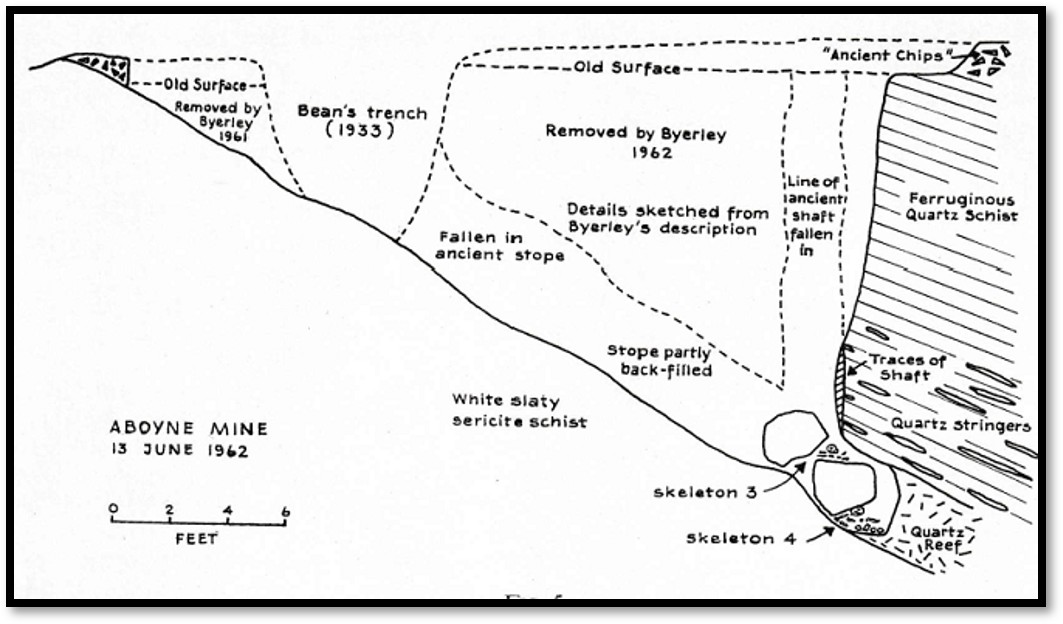
Summers: sketch showing the location of skeletons 3 & 4 at the Aboyne Mine
8. Water, lighting & ground support
· Seasonal Mining: Ground water was clearly a problem with pre-colonial miners. Padre Manuel Barreto noted that mines in northern Mashonaland were worked only during the dry season (August to October) before they flooded in November. Virtually all pre-colonial workings halted at the water table.
· Lighting: It would have been impossible to see at the bottom of the 38m deep, inclined shaft at the Phoenix Mine. Underground chambers were lit using primitive candles made from animal tallow, beeswax, or plant waxes with reed or fibre wicks.
9. Timbering & pillars:
· Timbering was widely used to reinforce pre-colonial mine shafts and stopes. In 1943, C. E. Parsons documented an 1899 discovery 110 feet (33.5m) deep in the flooded Gladstone mine at Enterprise (area 8). Because of the water, the original supports—featuring forked timbers bracing other pieces, a technique still used by local miners—were preserved with their bark and axe marks intact. Conversely, similar ancient timbering in the nearby, dry Aladdin mine had badly deteriorated.
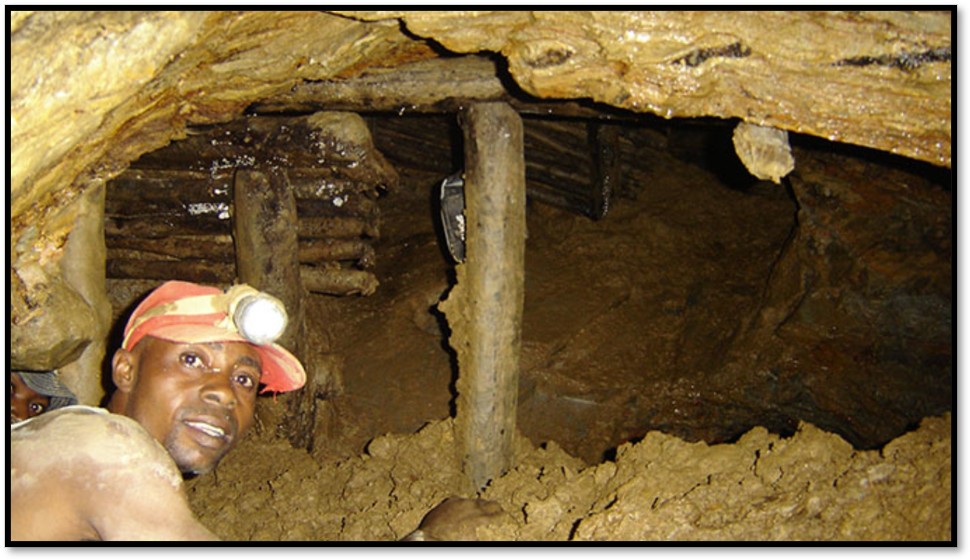
Photo Heraldonline.co.zw: note the timbering in an underground stope
· Pillars: Miners left unmined pillars of country rock or low-grade quartz to support cavern roofs (hanging walls) as documented at the Aboyne Mine. They also installed forked timber props—preserved in flooded workings at the Gladstone Mine (at 33.5m depth) and Honey Dear Mine—though collapses still occurred.
Without explosives, breaking hard quartz rock using iron gads, stone hammers and fire-setting required immense labour. When a section of the reef became too low in gold content to justify the effort, they simply mined around it. These unmined patches of low-grade rock naturally remained as pillars that happened to double as roof supports.
10. Milling, Recovery & Metallurgy
· Crushing & Milling: Roasted, brittle quartz was pulverized using dolly holes[31],[32] (cylindrical mortars 12–15 cm wide and up to 25 cm deep worn into dolerite or granite outcrops near streams) or smaller portable cup-and-ball stone mortars (under 10 cm wide, as found at the Nugget Mine). Once pulverized in the dolly holes, the crushed ore was carried to nearby rivers or streams to be panned, separating the heavy gold particles from the waste rock.[33] (Note: While Summers cited a Thomas Baines sketch of a heavy lever-operated "rocking stone" crusher, that particular illustration depicted an 1870 settler operation at Eersteling in South Africa rather than pre-colonial Zimbabwe)
Thomas Baines has an 1870 account, “G. Wood took me to a place in which he had seen a heap of quartz burned, and another heap, piled with wood among it, ready for burning. The crushing stones, like a painter's slab and muller, had also been lying in a hut near, but at the time of my visit these were removed and the calcines quartz also; but the other heap had been fired, and now they lay mingled with the charcoal, ready for crushing.
Mr George Wood, here referred to, was my constant companion for two years and he often used to tell me how he had seen the Mashunas extracting gold from quartz; and he further told me that, after crushing the roasted quartz, they used to melt the gold into little ingots in small crucibles made for the purpose…”[34]
When a sample of dolerite pieces from a milling site at Morven Mine (area 51), was crushed and panned, gold and iron was detected. Other milling sites, such as the Macardon Claims (area 58), and Tebekwe Mine (area 46), also revealed gold results.[35]
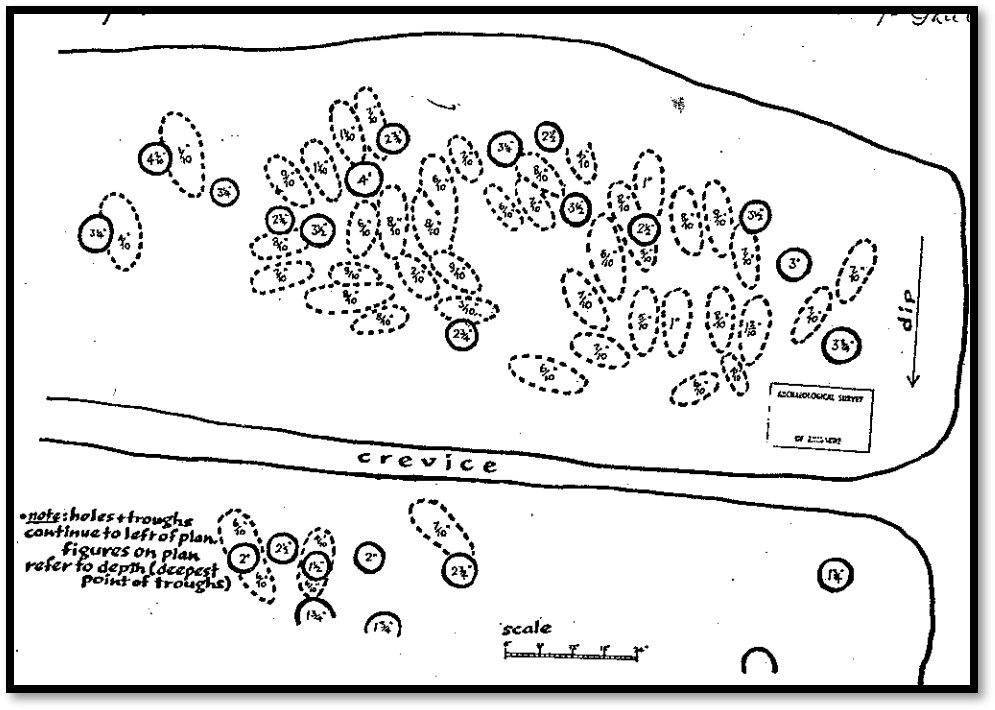
Plan of a milling site at the Morven Mine by A. Burchett from the Archaeological Survey of Zimbabwe[36]
Hall and Neal comment,[37] “In no ruin, so far discovered, have the ancient mortars, or crushing stones, or even gold quartz being discovered. But at the side of almost every river which passes in the vicinity of ancient workings, in any district throughout the country, and also along old river-beds from which the course of the river has been changed, may be found hundreds of mortar-holes bored into the level portions of the tops of the granite, diorite, or basaltic rocks along its banks, and often on prominent boulders in the river itself.”
They continue, “Alongside these mortar-holes are to be found large numbers of shallow hollows on the rocks where the quartz powdered in the mortar-holes was evidently reduced to the fineness required for washing…The ancient crushing stones are often found with small piles of quartz still lying beside them, and frequently little specks of gold may be discerned in the roughness of the surface of the depressions, and also on the round ball crushers. The ancient crushers are also mainly to be found near water or workings, and are generally in large numbers, as many as a hundred have been found together.” They give examples at the Sovereign Reef, Yellow Jacket Mine, Alton Claims (area 33).
· Gravity Separation: Chronicler António Bocarro (1594 – 1642) confirmed Zimbabwean pre-colonial miners did not use mercury amalgamation.[38] Instead, crushed ore was washed using grooved stone riffle-plates (sluices) and wooden panning trays known as zamba, or pandes.
Crucible smelting and refining
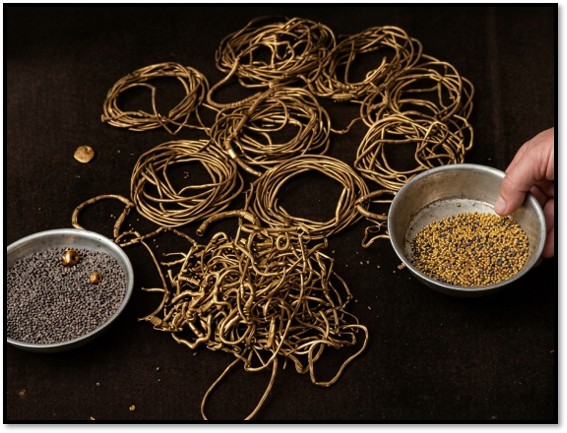
Before refining could begin, raw gold dust from alluvial panning, or crushed quartz reefs, had to be consolidated and there is plenty archaeological evidence of goldsmithing and metallurgy in pre-colonial Zimbabwe, particularly flourishing between the 11th and 16th centuries. Indigenous metalworkers did not just export raw gold; they refined, melted, and crafted gold locally into ingots, jewellery (coiled wire bangles, anklets, necklaces and gold beads) and ceremonial objects.
Excavations at Great Zimbabwe have uncovered specialized technical ceramics—including over one hundred alumina-rich clay crucibles—used to melt and refine gold prills into pure ingots and trade goods.[39]
Swan writes that few gold-smelting sites have been located. Theodore Bent recorded finding one at Great Zimbabwe, “Close underneath the temple in the fortress stood a gold smelting furnace made of very hard cement of powdered granite, with a chimney of the same material, and with neatly bevelled edges. Hard by, In a chasm between two boulders, lay all the rejected casings from which the gold bearing quartz had been extracted by exposure to heat prior to the crushing… Near the above mentioned furnace we found many little crucibles, of a composition of clay, which had been used for smelting the gold, and in nearly all of them still exist small specks of gold adhering to the glaze formed by the heat of the process. Also we found several water worn stones, which had been used as burnishers, which was evidenced by the quantity of gold still adhering to them.”[40]
Hall and Neal[41] recognize a distinction between gold and iron / copper furnaces and explain why it occurs.[42] They identify some of the differences, including that gold-smelting furnaces are sunk below the floor-level and they display “the presences of gold splashes on the nozzles of the blowpipes and on the layers of coatings in the furnaces; Of numberless pellets of gold lying about the furnace and evidently spilled liquid gold and of the flat cupel with gold showing in the flux.”[43]
They describe in detail the five gold-smelting furnaces found at the Mundie Ruins in Mberengwa (Belingwe)
· Gold furnaces – “All the ancient gold melting furnaces are merely round holes, sunk basin-like into the lower and original floors and are lined round inside with ancient cement of superior quality. These holes are about 12 inches in diameter and have an original depth in the centre of 12 inches (30 cm) The linings are thickly covered with specks of gold., which have evidently been spurted from the crucibles. When the first lining became worn by the heat, a fresh lining was smeared round inside on the top of the old lining and this in turn also became covered with specks of gold. This process was repeated several times till the depth was so reduced as to render the furnace useless.”
· Blow pipes – “Some of the blowpipes still have on their nozzles splashes of gold, which must have spurted out from the shallow crucibles used by the ancients. These blowpipes are about 10 inches (25 cm) in length, the larger end into which the mouth of the bellows was placed, being 3 inches (8 cm) in diameter., while the smaller end tapers down to a diameter of half an inch (1.3 cm)”
· Gold crucibles - The crucibles of the ancients are very shallow, and range in size from 2 to 8 inches in diameter (5 – 20 cm) These were made of granite and granite cement. Almost every ancient crucible shows gold visible in the flux. One ancient gold crucible discovered shows the marks of the pincers used to take it out of the furnace. The flux on the edges was depressed while it was in a molten state, and the gold in the flux shows how it was blunted by the tongs of the pincers.”[44]
Hall and Neal recorded ‘gold cakes’ (bun-shaped ingots) alongside crucibles and ingot moulds. The gold cakes weighed between 6 - 12 ounces (roughly 170 to 340 grams) - a range whose upper end closely matches the +/- 327g average volume calculated from surviving Great Zimbabwe crucibles in recent excavations.[45] The crucibles were made from alumina-rich clays capable of withstanding temperatures above 1,064°C (the melting point of gold)
To separate out any impurities, such as quartz sand or iron oxides, from the molten gold, natural fluxes (such as wood ash or borax-rich minerals) were added that allowed pure gold to pool at the bottom of the crucible.
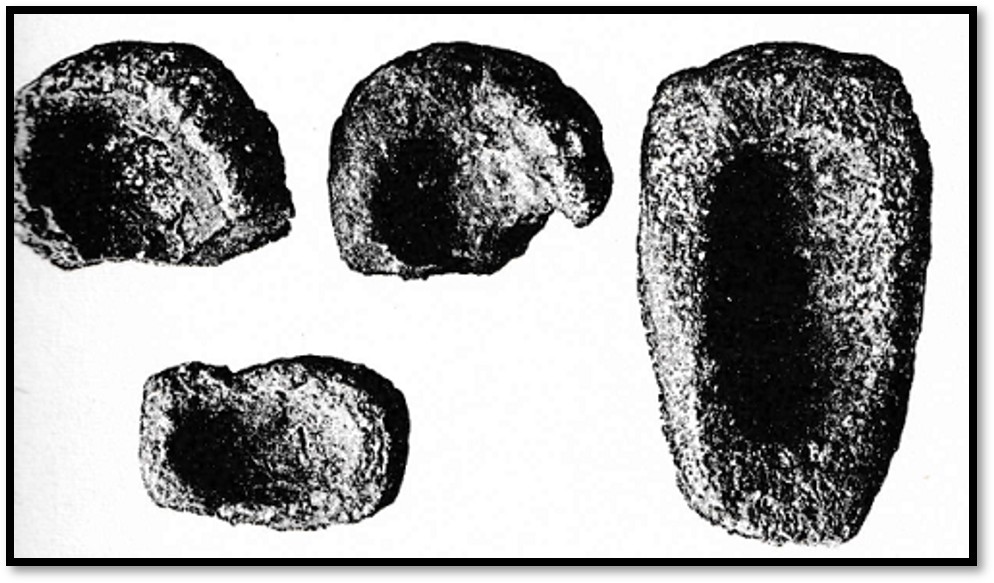
Gold crucibles excavated at Great Zimbabwe by Bent
11. Gold finished products
· Gold foil and tacking
Artisans at the gold-smelting sites mastered the complex techniques of hammering gold into ultra-thin foil sheets (often tacked over carved wooden cores with tiny gold tacks) drawing fine gold wire, and casting beads. Archaeologists have recovered iron hammers, chisels, and the wire-drawing equipment – the tools required to carry out these activities.
Examples are most famously seen in the Mapungubwe gold rhinoceros and sceptres.[46] By using a smooth stone or iron hammers on stone anvils, artisans beat small gold ingots into remarkably thin, uniform sheets (often less than 0.2 mm thick) frequently reheating the metal to prevent cracking. The foil was then pressed tightly over wood carvings, such as animal figures, headrest ornaments, or royal insignia to coat the object in gold. Tiny, wedge-shaped tacks were then driven through the edges of the foil directly into the wood to secure it firmly.
· Wire-drawing
Wire was made for coiled bangles, anklets, and necklaces by using perforated iron drawplates (Magwegwe) and iron tongs. A small gold bar was beaten into a thin, rough rod, then after tapering one end of the rod, it was threaded into a hole in an iron drawplate and the protruding tip was drawn through with heavy iron tongs. By pulling the gold through progressively smaller holes in the drawplate, the wire was reduced to a hair-thin diameter.
Because pulling metal makes it brittle, the wire would be periodically heated (annealed) over a charcoal fire and cooled to restore its softness before drawing it further. The finished wire was tightly wound around a core of twisted animal hair, or plant fibre, to create flexible, spring-like jewellery.
· Bead manufacture
Thousands of tiny, uniform gold beads have been excavated from elite burials and sites. They were made by either:
Wrapped strip method: Gold would be hammered into narrow ribbons, snipped off short segments and each piece bent around a thin wire until the ends met, forming a small ring.
Cast droplet method: A tiny, measured fleck of gold is put on a flat charcoal block or stone depression using a blowpipe until surface tension pulled the molten metal into a round droplet. Once cooled, each spherical bead was individually pierced using a fine drill.
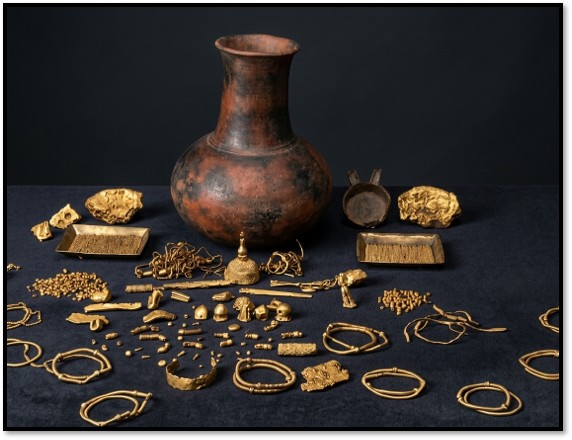
Hall and Neal: Gold ornaments and pottery found at Danamombe (Dhlo-Dhlo) and M’Telegewa Ruins. This photo and the one below have been AI colourized from the originals
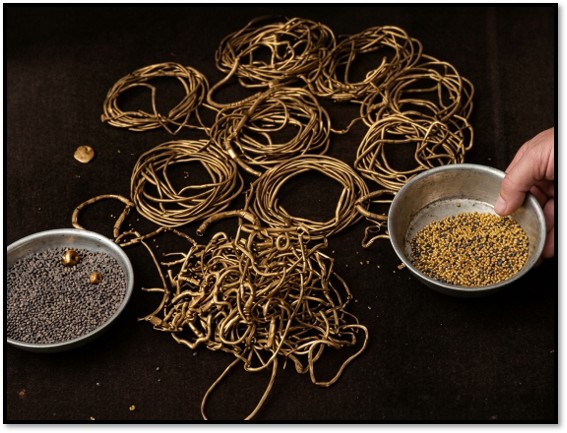
Hall and Neal: Gold beads and bangles found at Mundie Ruins, Mberengwa (Belingwe)
12. Copper and Iron workings
Alongside gold, Summers’ survey documented extensive base-metal mining:
Copper: Table 1 records 148 copper workings (including sites just outside modern Zimbabwe such as Musina and Selebi-Phikwe). Within Zimbabwe, major pre-colonial copper sites later became prominent modern mines, including Mhangura, Alaska, Shackleton, Inyati, and Falcon Mine, the country’s first major primary copper producer at Mvuma.
Iron: The major iron quarries recorded by Summers’ include Hwedza, Dorowa, Ntaba Inyoka, and Mulungwane Hills - several of which remained active into the late 19th century, supplying local blacksmiths with iron for agricultural hoes, mining gads, and mbira keys.
References
Roger Summers. Ancient Mining in Rhodesia. Trustees of the National Museums of Rhodesia. 1969
Ann Kritzinger. Gold Mining landscapes of Nyanga: Discovering Zimbabwe's Hidden Heritage. Time Horizons, 2017
Lorraine Swan. Early Gold Mining on the Zimbabwean Plateau: Changing Patterns of Gold Production in the First and Second Millennia AD. Societas Archaeologica Upsaliensis, Sweden as Volume 9 in the Studies in African Archaeology series (1994)
Thomas Baines. The Northern Goldfield Diaries of Thomas Baines 1869-1872. Volumes 1-3. Chatto and Windus, London 1946
F.C. Selous. Travel and Adventure in South-East Africa. Books of Rhodesia, Bulawayo 1972
J.T. Bent. The Ruined Cities of Mashonaland. Books of Rhodesia, Bulawayo, 1969
R.N. Hall and W.G. Neal. The Ancient Ruins of Rhodesia. Methuen & Co, London, 1902
Jasmine Vieri, Shadreck Chirikure, Paul Lane, , Marcos Martinón-Torres. Archaeological science, globalisation, and local agency: gold in Great Zimbabwe. Archaeal Anthropol Sci.
2023 Aug 3;15(8):127. Doi: 10.1007/s12520-023-01811-7
F. Bandama, A.J. Moffett, T.P. Thondhlana and S. Chirikure. The Production, Distribution and Consumption of Metals and Alloys at Great Zimbabwe. Archaeometry, 58(S1), 161-181. https://doi.org/10.1111/arcm.12248
Notes
[1] Summers’ book Ancient Mining in Rhodesia was published in 1969
[2] In her article Gold Mining landscapes of Nyanga: Discovering Zimbabwe's Hidden Heritage, Ann Kritzinger writes, “It has been estimated that terracing has been built intermittently across 7,000 sq. km of the Eastern Highlands” where she indicates that the terracing was used for gold recovery. A further quote in the article is, “Tendai Gungutsva believes it trapped gold in runoff on the mountains for his ancestors—just like riffled fabrics catch gold on sluices for him today.”
[3] The Ancient Ruins of Rhodesia, P56
[4] The evidence comes from a 2023 peer-reviewed study published in Archaeological and Anthropological Sciences by archaeologists Jasmine Vieri, Shadreck Chirikure, Paul Lane, and Marcos Martinón-Torres, titled "Archaeological science, globalisation, and local agency: gold in Great Zimbabwe".
Rather than finding actual 327-gram gold bars—most physical gold was looted by colonial-era prospectors in the late 19th and early 20th centuries—researchers deduced the standardized ingot weight by measuring the internal cavities of over a 100 clay crucibles excavated at the site.
[5] Summers’ term “ancient workings” has been dropped as too ambiguous and this article substitutes mine, or old working, or claim.
[6] Northern Gold Field Diaries, Vol 2, P482
[7] Ibid, P483
[8] Ibid, P474
[9] Northern Goldfield Diaries. Vol 3, P788-9
[10] Travel and Adventure in South-East Africa, P336-7
[11] Ancient Mining in Rhodesia, P38 – 79 (in Chapter 4)
[12] Each old working has the following details:
(i) Archaeological Survey Reference Number - This survey for the Monuments Commission was begun by R. Summers and C.K. Cooke in 1959 and listed 221 sites, but by 1969 had expanded to 1,267 sites
(ii) Site under present name where available, e.g. Grey Owl Mine
(iii) Type of working
Type 1 = open stope
Type 1A = open stopes and occasional shafts
Type 2 = shafts with underground stopes
Type 3 = alluvial workings
(iv) Number of workings
(v) Technical details – only given in about 400 cases
(vi) Geological formation
(vii) Known outputs between 1890 – 1960 – 0 = no output, 1 = negligible <100 oz, 2 = very small 100-500 oz, 3 = small 500-1,000 oz, 4 = small 1,000-5,000 oz, 5 = moderate 5,000-10,000 oz, 6 = considerable 10,000-50,000 oz, 7 = very considerable 50,000-100,000 oz, 8 = large 100,000-300,000 oz, 9 = very large 300,000-1,000,000 oz, 10 = exceptional > 1,000,000 oz
(viii) Cultural details both archaeological and historical
(ix) Informants – e.g. Mines Dept, Company Reports, Geological Survey Dept, National Museum
[13] Fire setting on gold reefs is an ancient hard-rock mining method that uses extreme heat and rapid cooling to fracture tough, gold-bearing quartz veins. Before the invention of gunpowder and dynamite, this technique allowed early miners to break up rock using simple hand tools such as iron gads

[17] Ancient Mining in Rhodesia, P28.
[18] Ancient Mining in Rhodesia, P100
[19] (7th vs. 11th Century)This later date of AD 1000 clearly challenges Summers early estimate of a 7th Century start for gold-mining on the Zimbabwe plateau
[21] Ancient Mining in Rhodesia P110-111
[22] An adit is a horizontal or near-horizontal tunnel usually dug into the side of a hill, ridge, or mountain to access an underground mine.
[23] For details see the article Gold-mining landscapes of Nyanga: Archaeology new research by Ann Kritzinger. It should be mentioned that this theory is still debated by archaeologists
[24] See the article Antonio Fernandes, probably the first European traveller to Zimbabwe in 1511 – 12 under Mashonaland Central on the website www.zimfieldguide.com
[25] Padre Manuel Barreto (S.J.) wrote Informação do Estado e Conquista dos Rios de Cuama, vulgar e verdadeiramente chamados Rios de Ouro ("Report on the State and Conquest of the Rivers of Cuama, commonly and truly called the Rivers of Gold") It was written for the Portuguese Viceroy of India, the report is one of the most important 17th-century primary sources on the Zambezi Valley (then known as the Rios de Cuama) in modern-day Mozambique and Zimbabwe. Barreto details the geography, gold trade, local African polities (such as the Mutapa Empire and Maravi), and the declining state of Portuguese prazos (land grants) and fortifications, advising administrative and military reforms to secure the region.
[26] Ancient Mining in Rhodesia P27, plates 3a and 3b
[27] Machabel refers to the Mufuti tree (Brachystegia boehmii)
[28] Travel and Adventure in South-East Africa, P336
[29] Early Gold Mining on the Zimbabwean Plateau, P23
[30] Report from the University of Cape Town Medical School
[31] The name originates from European prospectors who coined the term "dolly hole" as an analogy to the colonial-era dolly pot - a heavy iron mortar and pestle used for hand-crushing reef gold.
[32] Lorraine Swan writes that more than 70 sites with dolly holes are recorded. Early Gold Mining on the Zimbabwean Plateau, P59
[33] Ann Kritzinger writes that in Nyanga. “Grindstones lying on the surface of tank platforms are frequent finds, but recently eight were discovered among the coping stones of the very rims of the tanks at the three undisturbed, unconnected, sites named above. She also sees direct evidence of ore dressing in the over 200 grinding grooves of Mount Nyahokwe near Ziwa National Monument.
[34] Northern Goldfields Diaries, P478-80
[35] Early Gold Mining on the Zimbabwean Plateau, P62
[36] Early Gold Mining on the Zimbabwean Plateau, P61
[37] The Ancient Ruins of Rhodesia, P77-8
[38] The Production, Distribution and Consumption of Metals and Alloys at Great Zimbabwe
[39] Archaeological science, globalisation, and local agency: gold in Great Zimbabwe
[40] The Ruined Cities of Mashonaland, P215-6
[41] Between 1895 and 1900, W. G. Neal worked as a prospector and "treasure hunter" for The Rhodesia Ancient Ruins Limited and dug through the floors and elite burials of dozens of sites, including Dhlo-Dhlo / Danangombe, Khami, Mundi, and M’Telegewa, extracting hundreds of ounces of manufactured gold including solid ingots ("gold cakes") beads and wire. They were melted down into bullion in Bulawayo and sold to cover shareholders' expenses although Neal did keep detailed notes on the weight, shape, and context of the finds, which Hall listed in their book The Ancient Ruins of Rhodesia. The public outcry of the melting down of irreplaceable cultural artifacts led the Southern Rhodesian Legislative Council to pass the Ancient Monuments Protection Ordinance of 1902, that shut down the activities of The Rhodesia Ancient Ruins Limited.
[42] The Ancient Ruins of Rhodesia, P82
[43] Whilst Bent (1892) and Hall and Neal (1902) are largely discredited for promoting the ‘Phoenician / Sabaean’ myth attributing Great Zimbabwe and other sites to non-African builders their physical descriptions and lists of cultural remains are valuable sources of information
[44] The Ancient Ruins of Rhodesia, P86-7
[45] Archaeological science, globalisation, and local agency: gold in Great Zimbabwe
[46] See the article Are there cultural links between Mapungubwe and Great Zimbabwe? under Masvingo Province on the website www.zimfieldguide.com