
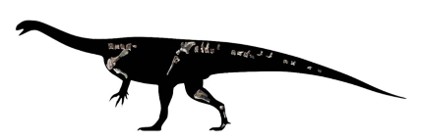
Musango matusadonaensis, Zimbabwe’s fifth dinosaur to be discovered
- Entry fee
- n/a
Introduction
This exciting new discovery on the shores of Lake Kariba dates from the late Triassic around 210 million years ago. This was when dinosaurs were beginning to dominate earth’s animals.[1] The evolutionary placement of Musango matusadonaensis puts it inside the family Unaysauridae, a group of primitive, bipedal, long-necked dinosaurs that thrived during the late Triassic period.[2]
According to a July 2026 description paper published in the Journal of Systematic Palaeontology, Musango is the closest evolutionary relative to Musankwa sanyatiensis, another of Zimbabwe’s dinosaurs discovered in the same geological formation.
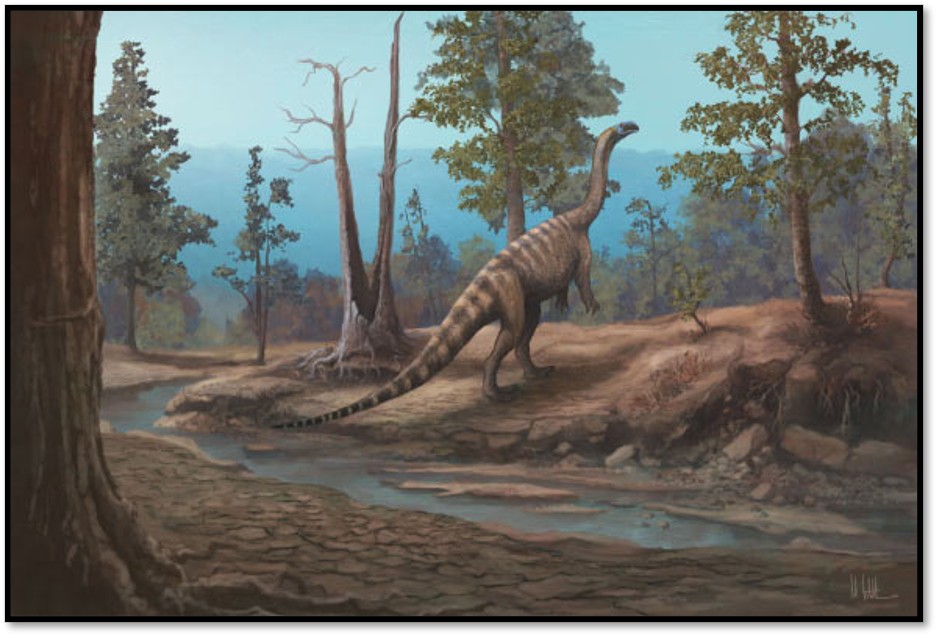
Life reconstruction of Musango matusadonaensis. Image credit: Mark Witton
The Phylogenetic (Family) Tree[3] for Musango
Dinosauria (All Dinosaurs)
└── Saurischia ("Lizard-hipped" Dinosaurs)
└── Sauropodomorpha (Long-necked Lineage) [1]
└── Bagualosauria (Advanced Early Sauropodomorphs)
└── Unaysauridae (The Family Branch) [2]
├── Jaklapallisaurus (India)
├── Unaysaurus (Brazil)
├── Macrocollum (Brazil)
└── Zimbabwean Clade [3]
├── Musankwa sanyatiensis
└── Musango matusadonaensis ◄ (new species)[4]
Breakdown of the Family Branches
[1] Sauropodomorpha: This is the parent lineage of all long-necked dinosaurs. While later descendants (like Diplodocus) grew into massive four-legged giants, early branches like Musango were small and walked on two legs.
[2] Unaysauridae: This specific family is characterized by being relatively small-to-medium-sized herbivores or omnivores. Members of this group are found across the ancient supercontinent Gondwana, primarily in Brazil, India, and Zimbabwe.
[3] Zimbabwean Clade: The discovery of Musango and Musankwa[5] side-by-side in the Pebbly Arkose Formation proves that Unaysaurids were highly successful in Triassic Africa. Though closely related, Musankwa was much larger, weighing more than double the size of Musango.
A description of the new Musango dinosaur
Unlike the giant long-necked dinosaurs that evolved millions of years later, Musango was relatively lightly built.[6] The 4.5 metre long (15 feet) dinosaur lived in the late Triassic around 210 million years ago and weighed an estimated 222 kilogrammes (490 pounds) and is the fifth dinosaur ever named from Zimbabwe. Musango is an early relative of Dipodocus[7] belonging to the sauropodomorphs group and walked on two legs[8] rather than four.
Why is this dinosaur so special?
The same article by James Ashworth states that as only the fifth dinosaur ever named from Zimbabwe, it is very likely there are even more dinosaur fossils waiting to be discovered as it was found in the same rocks as the larger Musankwa sanyatiensis. That shows that the same ecosystem in what is now northern Zimbabwe was capable of supporting a variety of dinosaurs. Professor Paul Barrett, a palaeontologist at the Natural History Museum, the study’s lead author, says that further discoveries from the region are likely to transform our understanding of this crucial time, “Until recently, it was assumed that the dinosaurs living across southern Africa were largely the same,” he explains. “However, these discoveries are showing that this part of the ancient supercontinent Gondwana was actually made of a series of smaller ecosystems – each with a different cast of characters.”[9]
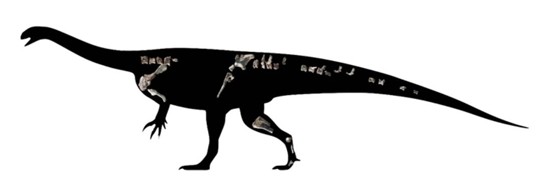
Brandon Stuart: likely image of Musango
The find may improve our understanding of how dinosaurs moved from relative insignificance in the Triassic before becoming larger and more diverse and dominating the Jurassic and Cretaceous periods that followed. This is still a major area of research and African fossils may hold the answer as they have historically been understudied compared to sites in Europe and North America.[10]
Professor Barrett said, “It suggests that what we’ve found so far is only the tip of the iceberg. We’ve already got one other new species that we’ve yet to describe, while our team has been told about other fossils from the region that we’ve yet to look at. I think it’s likely there are even more dinosaurs still to be found there.”[11]
A timeline of dinosaurs that have been discovered in Zimbabwe
Name | Discovered | Description |
Megapnosaurus (Megapnosaurus rhodesiensis) | 1969 | Originally named Syntarsus (and later renamed), this was the first dinosaur ever named in the country. It was a small, agile, and fast-moving carnivorous theropod that lived during the early Jurassic period |
Vulcanodon (Vulcanodon karibaensis) | 1972 | Discovered on an island in Lake Kariba, this was a crucial find in palaeontological history. Vulcanodon is one of the earliest known true sauropods (giant, long-necked herbivores), providing a vital link in understanding how these massive animals evolved. |
Mbiresaurus (Mbiresaurus raathi) | 2022 | Discovered in the Mbire district, this small, long-tailed sauropodomorph stood only about one metre tall. Dating back roughly 230 million years to the Late Triassic, it holds the record as Africa’s oldest definitive dinosaur. |
Musankwa (Musankwa sanyatiensis) | 2024 | The fourth dinosaur named from Zimbabwe was identified from a single fossilised hind leg found on the shoreline of Lake Kariba. It was a bipedal, plant-eating sauropodomorph that lived around 210 million years ago. |
Musango (Musango matusadonaensis) | 2026 | The fifth and most recent addition to Zimbabwe's prehistoric record. Excavated near the Matusadona National Park, Musango was a 4.5-metre-long, two-legged sauropodomorph that coexisted alongside Musankwa roughly 210 million years ago. Its discovery helps prove that ancient southern Africa featured highly diverse, distinct regional ecosystems rather than one uniform landscape. |
Collaboration between international palaeontologists is the key to discovery
Professor Jonah Choiniere, leader of the expedition and co-author[12] from Johannesburg’s Evolutionary Studies Institute (ESI) said, “This study is the result of an international collaboration between the UK, USA, South Africa and Zimbabwe” and “reinforces the importance of southern Africa in understanding dinosaur diversity.”
Professor Michael Raath is a legendary figure in Southern African palaeontology. He discovered and described Megapnosaurus (originally named Syntarsus) in 1969 and then described Vulcanodon in 1972 after its remains were found on an island in Lake Kariba.
He was followed by Dr Christopher Griffin from Yale University and formerly Virginia Tech who led the international team that unearthed Mbiresaurus in 2022.
Finally Professor Paul Barrett based at the Natural History Museum in London was the lead author on the teams that described Zimbabwe's two most recent dinosaur discoveries Musankwa (May 2024) and Musango (July 2026) While he was walking the shoreline of Spurwing Island on Lake Kariba during a 2018 expedition, Professor Barrett said the discovery happened almost by accident.
“We were walking along the shoreline when I noticed these leg bones eroding out of the ground. After we excavated the fossils, we realised it was quite different from the dinosaurs you might expect to find in the area.” He added, “I’ve named many species in my career, but this is the first time I’ve described a dinosaur that I found myself.”[13]
Professor Barrett continued, “It’s one of the most exciting digs I’ve been on. Being on a boat kept us mobile as we searched the area, but also kept us safe from the elephants, crocodiles and hippos that live nearby! It was nice to be involved in research that was purely exploratory, as we had no idea what we might find. This was about filling a blank spot on the palaeontological map of southern Africa and discovering what was within that.”[14]
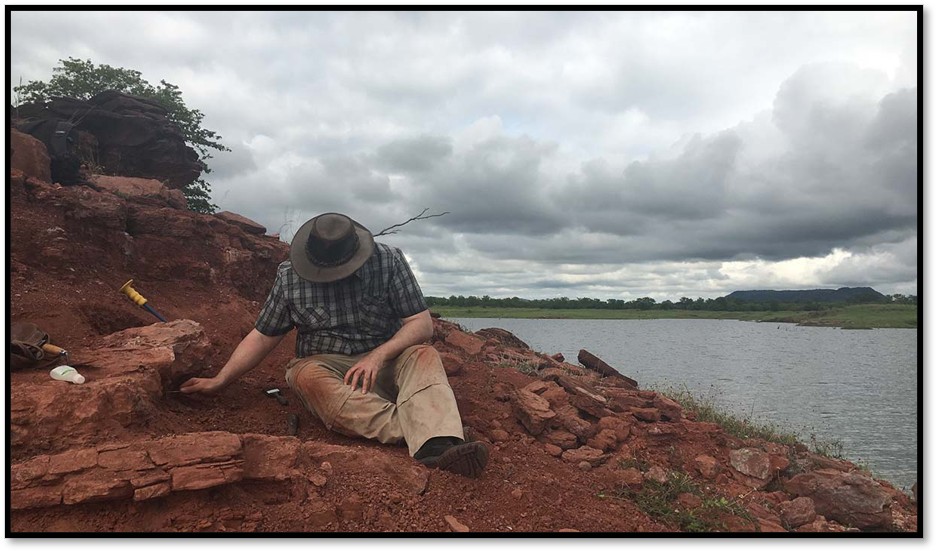
Credit Paul Barrett: Musango’s bones seen emerging from the rocks around Lake Kariba
Dr Kimberley Chappelle, an assistant professor and South African palaeontologist based at Stony Brook University in New York made a vital contribution as part of the modern international team working alongside Prof. Barrett to excavate, study and identify both Musankwa and Musango.
The Zimbabwean crew members who manned the mobile laboratory set up on a Lake Kariba houseboat off Spurwing Island - Coster Katupu, Godfrey Swalika, Simbarashe Mangoroma and Never Mapira - provided critical logistical support and field expertise.
What do we know about Musango?
The fossil is among the most complete dinosaur skeletons found in Zimbabwe.[15] The researchers recovered a partial skeleton that included the vertebrae, ribs, shoulder and hip bones and parts of the arms, legs and feet, but the skull was missing. So far they don’t know whether Musango ate only plants or was an omnivore.[16] It lived in a landscape crossed by rivers and streams, alongside lungfish, crocodile-like phytosaurs and other early dinosaurs.[17]
The discovery of Musango and other fossils in the Zimbabwe region is building up a picture of what the late Triassic would have been like. Zimbabwe gives more evidence for animals living in and around the rivers of Gondwana[18] rather than the drier areas found in what are now South Africa and Lesotho.[19]
Analysis of its fossils suggest Musango was around eight years old and almost fully grown at the time of its death and had previously recovered from a serious infection or injury.[20] Musango was a close relative of Musankwa sanyatiensis, another dinosaur previously found in the very same rock formation although they were clearly distinct species, differing in hip and limb anatomy and in body size with Musankwa estimated to have weighed more than twice as much as Musango.[21]
This new discovery appears to be just the tip of the iceberg
Professor Barrett said, “We’ve already got one other new species that we’ve yet to describe, while our team has been told about other fossils from the region that we’ve yet to look at…I think it’s likely there are even more dinosaurs still to be found there.”[22]
The Musango fossil was spotted jutting out from rocks just a few metres above the water before the team returned to excavate the surrounding area. The excavated finds were prepared and studied at Johannesburg’s Evolutionary Studies Institute before being returned to the Natural History Museum of Zimbabwe at Bulawayo.
Professor Barrett added, “It’s also important to revisit sites that haven’t been touched for decades. Zimbabwe’s Early Jurassic rocks, for example, haven’t been studied in depth for around 50 years, so a reanalysis would help to bring our knowledge of these areas up to date.”[23]
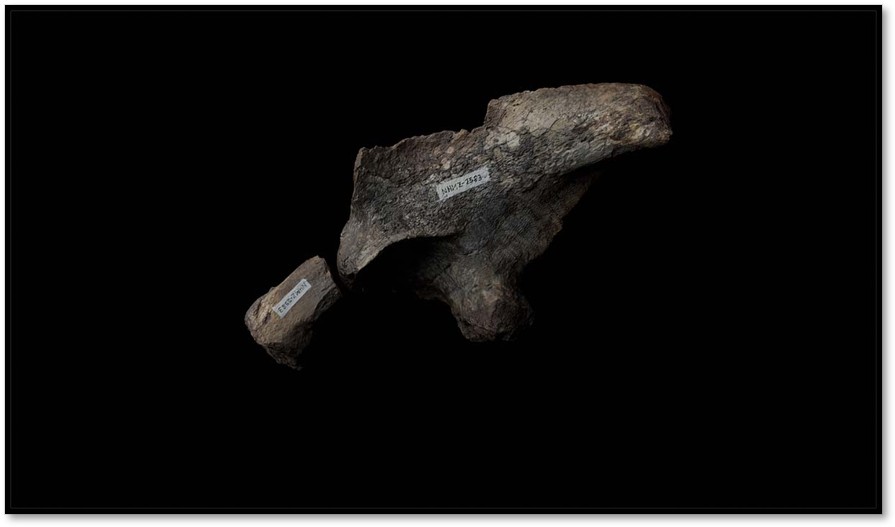
Credit Brandon Stuart: a scan of Musango’s bones
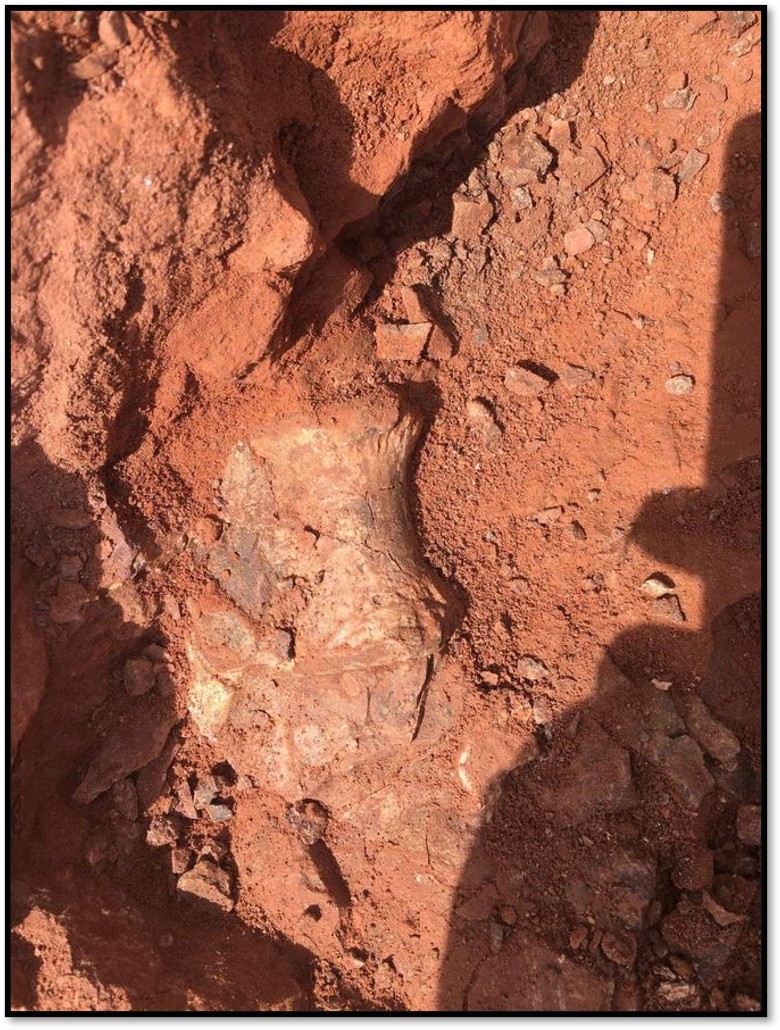
Fossilized Musango matusadonaensis bone: Image credit Paul Barrett
All of the scientists involved believe that this rare find in a country with a relatively unknown palaeontological past will lead to further discoveries. Only four other dinosaur species have been named from Zimbabwe, leaving key questions about the country’s past unanswered at present.
Paul Barratt added, “This ecosystem was able to support both Musankwa and Musango and likely other undiscovered dinosaurs as well.”
References
Paul M. Barrett et al, A new sauropodomorph dinosaur from the Pebbly Arkose Formation (Upper Triassic: Norian) of Kariba, Zimbabwe, Journal of Systematic Palaeontology (2026). DOI: 10.1080/14772019.2026.2678610
James Ashworth. 29 July 2026. Natural History Museum. Musango: The new Zimbabwean dinosaur discovered from a boat. https://www.nhm.ac.uk/discover/news/2026/july/musango-the-new-zimbabwean-dinosaur-discovered-from-a-boat.html
Natural History Museum Press Office. 29 July 2026. New Zimbabwean dinosaur species named by Museum scientist reveals Africa’s hidden history.
Anastasia Scott. 29 July 2026. Discover Magazine. Newly Discovered Dinosaur From Zimbabwe could change what we know about ancient Southern African Ecosystems. https://www.discovermagazine.com/newly-discovered-dinosaur-from-zimbabwe-could-change-what-we-know-about-ancient-southern-african-ecosystems-49463
Andrew Zinin. 29 July 2026. Phys.Org. Scientists discover 210-million-year-old dinosaur in Zimbabwe.
https://phys.org/news/2026-07-scientists-million-year-dinosaur-zimbabwe.html#google_vignette
Ashley Vega. 31 July 2026. People. Scientists Discover New 210-Million-Year-Old Dinosaur Species in Zimbabwe. https://people.com/newly-identified-dinosaur-fossil-sheds-light-on-early-dinosaur-evolution-12031900
BBC News. 30 July 2026. New dinosaur discovered in Zimbabwe
https://www.bbc.co.uk/newsround/articles/cn8n4x9zlzpo
Enrico de Lazaro. 29. July 2026. Science News. New Species of Triassic Dinosaur Discovered on Shores of Zimbabwe’s Lake Kariba. https://www.sci.news/paleontology/musango-matusadonaensis-14955.html
NOTES
[1] New Zimbabwean dinosaur species named by Museum scientist reveals Africa’s hidden history.
[2] New Species of Triassic Dinosaur Discovered on Shores of Zimbabwe’s Lake Kariba
[3] the Journal of Systematic Palaeontology, Musango states the new dinosaur belongs to a specific branch of early Late Triassic sauropodomorphs.
[4] Musango in Shona means ‘living in the bush’ and the species name matusadonaensis comes from the Matusadona National Park located nearby
[5] Musankwa is named after the houseboat Musankwa that served as the earlier expedition’s floating laboratory and the nearby Sanyati river
[6] Scientists discover 210-million-year-old dinosaur in Zimbabwe
[7] Dipodocus is amongst the best known sauropods and was a very large, long-necked, our legged dinosaur with a long whip-like tail. Their forelegs were slightly shorter than their hind legs giving them a horizontal posture
[8] Musango: The new Zimbabwean dinosaur discovered from a boat
[9] Musango: The new Zimbabwean dinosaur discovered from a boat
[10] New dinosaur discovered in Zimbabwe
[11] New Zimbabwean dinosaur species named by Museum scientist reveals Africa’s hidden history.
[12] The paper ‘A new sauropodomorph dinosaur from the Pebbly Arkose Formation (Upper Triassic: Norian) of Kariba, Zimbabwe opens in a new window’ was published in the Journal of Systematic Palaeontology.
[13] Scientists Discover New 210-Million-Year-Old Dinosaur Species in Zimbabwe
[14] Musango: The new Zimbabwean dinosaur discovered from a boat
[15] Scientists discover 210-million-year-old dinosaur in Zimbabwe
[16] An omnivore eats both plants and meat. From the Latin meaning ‘eat everything’
[17] Newly Discovered Dinosaur From Zimbabwe could change what we know about ancient Southern African Ecosystems
[18] The supercontinent called Gondwana included present-day South America, India, Australia and Antarctica.
[19] Musango: The new Zimbabwean dinosaur discovered from a boat
[20] New Zimbabwean dinosaur species named by Museum scientist reveals Africa’s hidden history
[21] New Species of Triassic Dinosaur Discovered on Shores of Zimbabwe’s Lake Kariba
[22] New Species of Triassic Dinosaur Discovered on Shores of Zimbabwe’s Lake Kariba
[23] Musango: The new Zimbabwean dinosaur discovered from a boat