
- Entry fee
- n/a
- National Monument
- No. not given
This article is about the national heritage cave shrine of Nehanda Charwe Nyakasikana, who is commonly known as Mbuya Nehanda, a powerful spirit medium and heroine of the First Chimurenga war against colonial settlers in the 1890’s.
The wide influence of the spirit mediums
Terence Ranger writes that despite chiefs Chikwakwa, Chinamora, Chiweshe, Gutu, Hwata, Masembura and Seke often being locked in bitter rivalries, they all came together at the Mashona Rebellion or First Chimurenga and this was largely due to the influence of the spirit mediums Kaguvi and Nehanda and others.[1] Frederick Selous wrote, “Since the arrival of the white men, the Mandoras [Mhondoro] have lost belief in their Mandoras and the Mandoras have lost belief in themselves.” But two years later he wrote, “Nianda [Nehanda] has been constantly spoken of in my hearing ever since I came to Mashonaland in 1890 by the Mashonas. At the present moment, Nianda is the most powerful wizard in Mashonaland and has the power of ordering all the people who rose lately and her orders would in every case be obeyed.”
Even in June 1896 the Native Commissioner Salisbury was writing, “Great belief was also formerly placed in the Mandoras or Lion Gods, and specially in one called Nianda” but his views understated the threat as in the two years prior to the uprising the Nehanda medium had been rallying the Mashonaland chiefs and urging them into action.
Nehanda was directly responsible for the death of Henry Hawken Pollard (‘Kunyaira’) the British South Africa Company (BSACo) Native Commissioner of the Mazowe area. In January 1898, Gutsa testified at Nehanda’s trial. “I was a native messenger. I went with Pollard to the M’Kori Kori. [Makorekore] While there we heard of the God. Then we went to Chipadzi’s; there they fired at us. We then went to Jeta and there they fired at us. Pollard gave us money to buy sweet potatoes and as we returned a lot of boys came with us. Gwazi was told to catch hold of Pollard. I was told to hold his hands so that he could not hurt us with his gun. So they took him to Nianda…She said, “Bring him here.” Then she came and knelt down and spoke with Pollard, but we constables were surrounded in the middle. I heard Nianda say to Wata, “Kill Pollard but take him some way off to the river or he will stink,” so they took him off. We were there still surrounded close to him. Wata said, “Nianda sent me.” Then he took his axe and chopped him behind the head.”[2]
Nehanda’s Influence in the southern Mashonaland area
The area was comparatively well populated[3] and among the chiefs there were Hwata, Chiweshe, Negomo, Makope, Nyachuru, Mseri, Nyamweda and Mbai. Most had lived in the area for a long time except Hwata and Chiweshe who were brothers and fled from the Buhera district. Prior to the 1896 Rebellion or First Chimurenga relations between chiefs often resulted in inter-tribal raids and there was no overall ruler who ruled over all the tribes.
Chikanda notes that Hwata and Chiweshe had moved from the Salisbury (now Harare) area because it was too open to amaNdebele raiding parties and settled in or near the Mazoe Valley where there was not only better soil but also kopjes and caves that were easier to defend.[4]
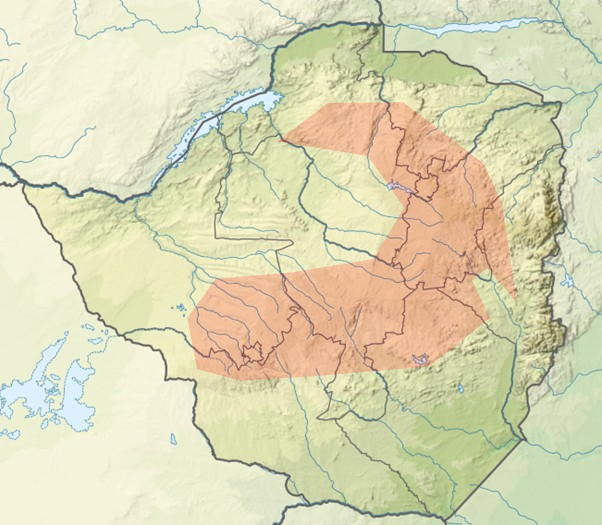
Adapted version of the Great Crescent from D.N. Beach (1994) highlighting the population areas
Nehanda’s influence as a spirit medium was dominant in the Mazowe area. A Chiweshe resident states, “Nehanda is responsible for rain and sometimes fighting. She was behind the rebellion right from the start. She told the people they should touch nothing that belong to the white man.[5] Their defeat was a result of the violation of this great order. During the rebellion, the power of the spirits rendered the white bullets useless and ineffective. Not many Africans were killed in the actual fighting.” Encouraged by these statements the people of Mashonaland rose up and obeying her orders carried the goods captured to Nehanda’s shrine cave, the same way as in Matabeleland stolen goods were carried to Mkwati's cave at Ntaba zika Mambo. The Chief Native Commissioner Henry Taberer[6] reported in March 1898 that Nehanda received a very large share of the loot obtained by the natives. “Among other things obtained from Nyanda’s kraal have been numerous rifles and over £140 in gold. I know that she still has concealed some £700, but because of the spirit she possesses the natives are afraid of giving any information thereon.”[7]
Hartley and Charter districts are the ‘nursery’ of the uprising
Ranger believes in the Hartley and Charter districts there was an overlap between the Mwari cult and the spirit mediums, including Kaguvi and Chief Mashayamombe’s half-brother, Dekwende. The children of Mwari carried messages between the chiefs. Chief Mashayamombe was in contact with Mkwati based in the Matobo Hills and at Ntaba zika Mambo and was pivotal in linking the spiritual and political aspects of the Matabeleland Rebellion or Umvukela.
These districts co-ordinated closely with Nehanda in the Mazoe Valley. Kaguvi’s had lived previously at Gondo’s kraal; three of his wives were from Headman Gondo’s kraal, less than a kilometre from Chief Chikwakwa’s kraal near present-day Goromonzi. This was intermediate between Hartley and Mazoe and so the two areas of resistance were able to co-ordinate their activities.
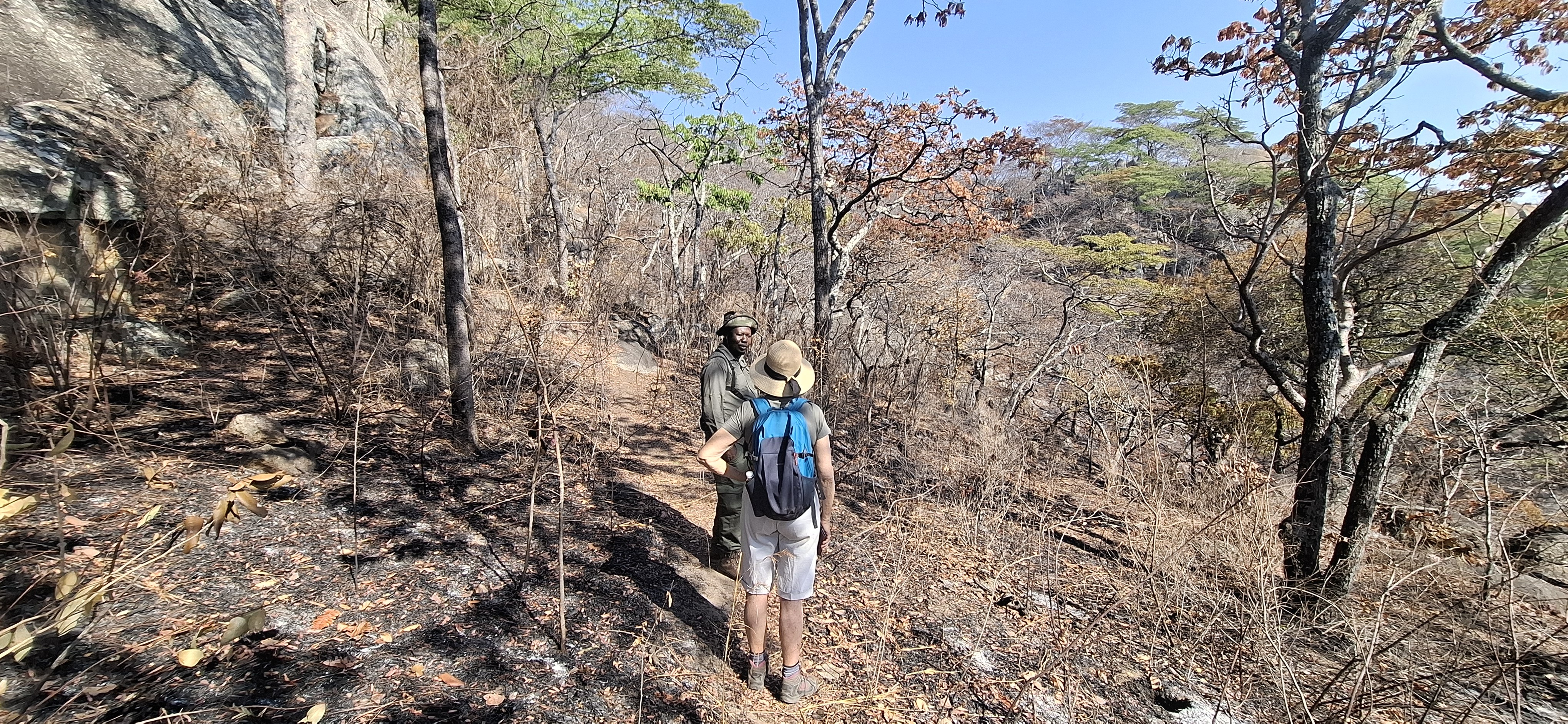
Guided through the Mazowe Botanical Garden Reserve in Christon Bank
How the spirit mediums provided leadership
By issuing orders that rejected the white man’s way of life and their goods the spirit mediums asserted the people would preserve their independence and thus provided a form of leadership. In June 1896 Nehanda told the people to fight with spears and sticks and to reject guns,[8] to use locally-made pottery and reject enamel pots and to kill pigs as ‘non-traditional’ animals.
But some concepts were borrowed from the whites. At Kaguvi’s trial witnesses told how he himself instituted a system of ‘trials.’ Africans who served whites (‘Zambezi boys’) were tried and found guilty by Kaguvi before execution. In many other instances, they were just murdered. At the Beatrice Mine W.J. Tate and S. Koefoed were killed on 16 June 1896 along with four of their mineworkers.
Other witnesses spoke of the spirit medium’s police force, “they were like the white man’s police officers, their only work was killing people.”[9]
The initial welcome to whites by Africans is a cautious wait-and-see
Initially the whites were welcomed as traders who it was believed would not stay long and could be used to the African’s advantage. Nehanda told the chiefs, “Don't be afraid of them. They're only traders. But take a black cow to them and say. This is the meat with which we greet you.” Most chiefs sent black cows, Negomo sent a brown bull.[10] The Whites were looking for gold and asked for help with prospecting and some chiefs did help as their ancestors had traded with the Portuguese in the 16th - 17th centuries trading alluvial gold found in the Mazowe River for guns, cloth and salt. Both Chief Chiweshe and Chief Hwata sent family members to help early prospectors.[11]
Soon however the enthusiasm turned to apathy. These whites were clearly different from the Portuguese who came just for short periods; they were planning on staying and showed no inclination to leave. For the initial period, the Africans adopted a wait and see attitude. An exchange of presents did not mean that the Africans had given up their self-governing or land rights; the whites had not conquered them either. The state of affairs was potentially hazardous as the chiefs and their people wanted to be left alone to plant their crops and hunt.
Oral tradition says some Africans, servants and semi-slaves of Mazowe district called Vhanyai, did engage quickly with the whites and joined the native police. Also, the Shangaans often referred to as ‘the colonial boys’ were used to working for whites for money. Even local people who used to trade with the Portuguese began to work for whites for cloth, blankets and beads. "We didn't know money or how to use it. It is the Zambesi people who taught us the use of money." The first labourers used to insist on cloth and beads - valuable luxuries at that time.
The white settlers provided plenty of grievances for the spirit mediums to exploit – land, insults and tax
Oral tradition says that Nehanda, one of the best informed and experienced mhondoro, early on prophesied a culture clash. Whites that had just been peacefully received, were particularly provocative. "They couldn’t listen to the talk of Africans as the owners of the land." "The whites coveted our land, its resources and riches."[12]
African misuse of tools they were unaccustomed to was a frequent source of irritation to whites. Africans too had to become accustomed to new concepts. One tells how in order to change or divide a ten shilling note, he would tear it in half and take it to the store where it was refused! For these mishaps they were often called ‘baboon’ or ‘monkey.’
Taxation was method by which whites attempted to establish their rule. Chiefs Hwata, Chiweshe and Negomo refused to pay tax as it didn't seem logical to pay tribute to anyone who was not acknowledged as ruler. The elders remembered that the Portuguese used to pay a tribute of forty-four guns a year to the Mashona.
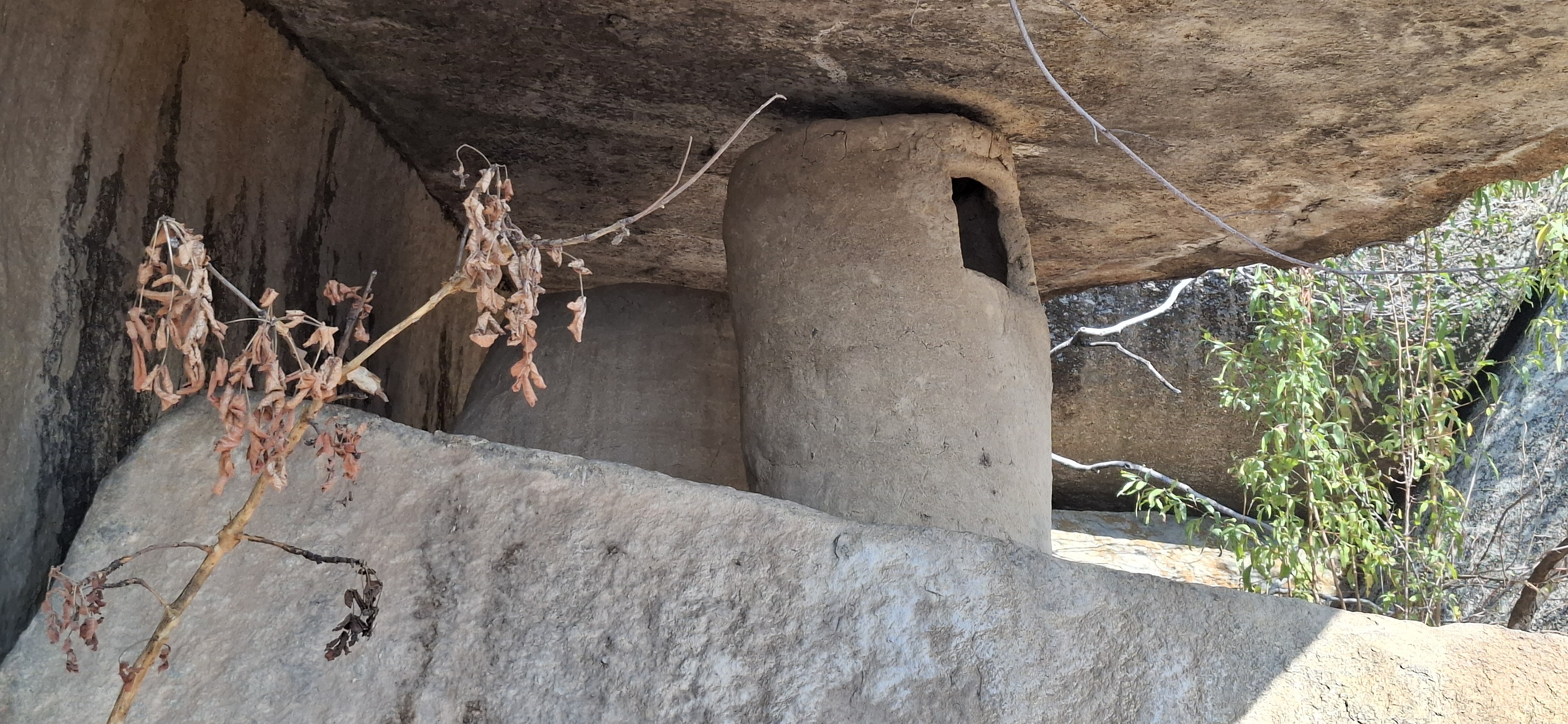
Shona grain bins in the vicinity of the Nehanda cave shrine
Natural disasters including locusts and rinderpest were aggravated by the native police, floggings and forced labour (Chibaro)
For the natives, the coming of the whites had brought untold misfortune in the form of locust swarms that caused famine and rinderpest that killed off most of their cattle. This opinion was held by the spirit mediums and also by the mass of the people. Probably disaster had not occurred on this scale before and the whites were thought to be the cause.
Some of the native police were local, others not, but their behaviour was always considered provocative. Their raids reminded the local people of amaNdebele raiding pre-1890. In addition the native police made demands for goats, girls to cook for them and then made them their mistresses.
The flogging was mostly carried out by the native police usually under the direction of the native commissioner, or by Pollard himself in the Mazowe district. He had a reputation for flogging indiscriminately. Victims were usually tied down to a tree or heavy object and might be left tied down for a whole day by him. The sjambok was most commonly applied to the victim’s back. The Mashona said, "Hovoka, chiyi chatakaita kuzoti boora hura.” "Alas, what have we done to deserve death through flogging.”
The rinderpest outbreak directly involved the chiefs. Chief Chiweshe (Chandaengerwa) was asked by Pollard why he had not reported cattle deaths at Negomo’s kraal. He replied that Pollard should have sent messengers and was flogged. Cattle that died of rinderpest were called ‘mombe dzechidarimanga’ and the BSACo insisted they were buried or burnt, something greatly resented by the people.
The native commissioners were constantly demanding labour. Messengers or native police would be sent to the chief. When they were available or not working in the fields the chiefs would comply. But if they did not send enough men the native police would come back and raid a village at night for more men. Labourers who ran away would be followed and relatives and neighbours punished by flogging. The chiefs complained to Native Commissioner H.H. Pollard (‘Kunyaira’) about this practice, and although he agreed it was wrong, it continued.
The people believed the whites did not respect the chiefs or the spirit mediums. They surveyed the land and gave themselves farms and dispossessed the natives. They started forcing natives to work on the gold mines and supply labour for building roads. They imposed a hut tax to pay for the BSACo’s administration. Those that ran away were flogged and humiliated. In contrast, the Portuguese in the 16th – 17th Century had paid tribute to the chiefs in the form of cloth, beads and guns; the settlers in the 1890’s demanded tax and labour.
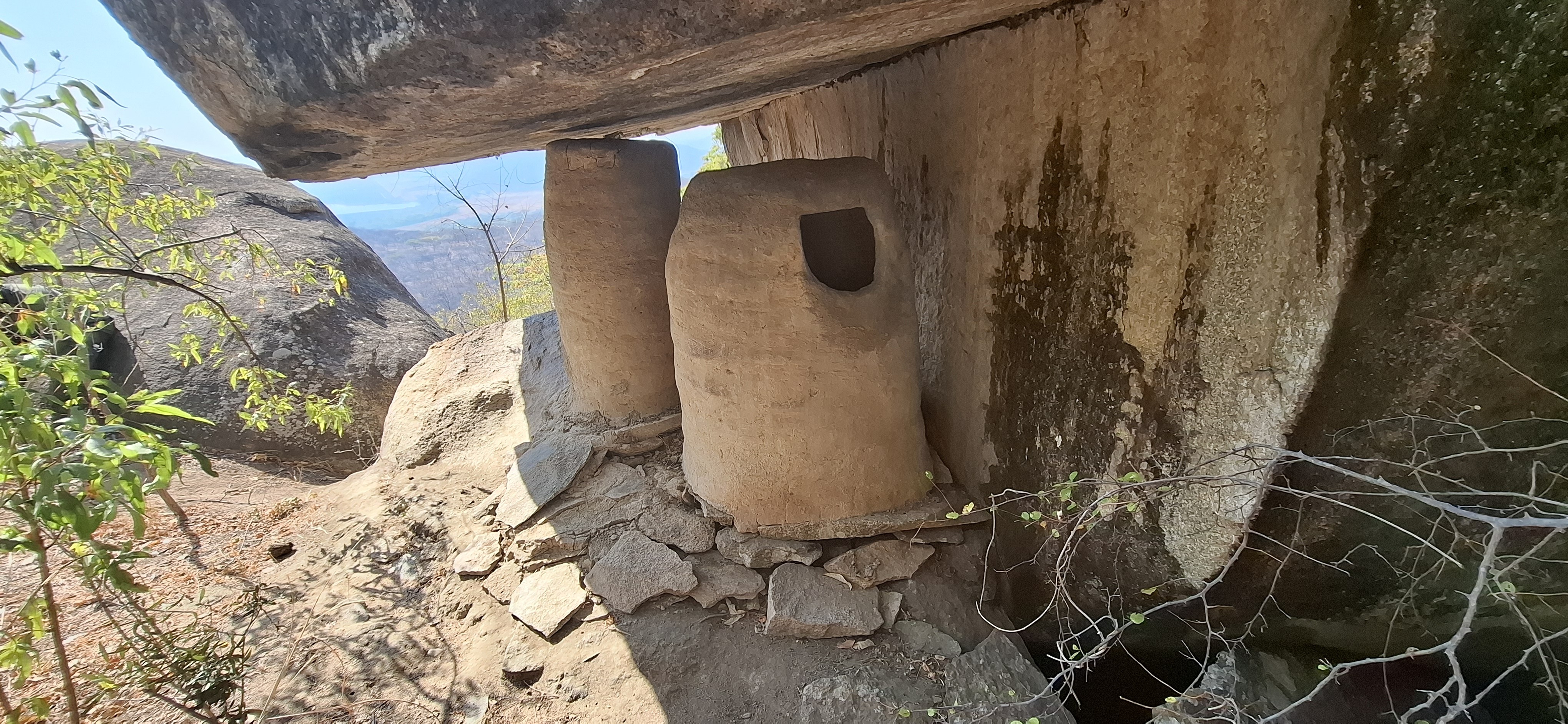
The Shona grain bins from another angle
Incidents of native resistance occur
Oral reports of increased beatings and floggings are reported as initially passive resistance occurs in response to demands for tax and forced labour. Then events escalated. A white nicknamed ‘Chimkwasha’ because he was too poor to own a cart or ox-wagon, traded in fowls, buying them from Chirnbagu or Mutumba, near Mt Darwin. He used porters, mostly from Chief Negomo’s area, to transport them to Salisbury. One day at Headman Rwanga’s kraal a man called Chirau refused to carry the load given to him and "Chimkwasha" shot Chirau in the arm. Then Chirau’s people killed him. Rwanga was arrested and fined twenty head of cattle.
The spirit mediums begin to mobilise for rebellion
The chiefs and headmen in the Mazoe Valley brought their troubles to Nehanda and she increasingly began to report to the spirit medium Kaguvi (Kagubi) at Chief Mashayamombe’s kraal on the Mupfure river. The people were being ill-treated and were ready to fight. Kaguvi promised his help, messages and presents were exchanged between them, the messengers travelling mostly at night. News of the Matabele Rebellion (Umvukela) that began in late March 1896 began to be exchanged. People in Mazoe shared the song, "Wakarigona Mashayamombe akati mhungu chena ngriurayiwe" - "Mashayamombe was just right when he said that the white cobra must be killed."[13]
Kaguvi led the organisation of the rebellion, messages and preparations went on for months in secret with details kept to a select group of people. Kaguvi gave orders and advice from Chief Mashayamombe with the final object of killing the whites although the subject was referred to as though it was a big hunt with the same hunting techniques being used. Attacks would be made in stealth in June when the grass was long and the thick vegetation would provide good cover. The people knew the roads frequently used by the whites; pits could be dug across roads and covered with sticks and grass as a trap, or "hunza."
Local organisation of the rebellion
The Shona in the Mazowe district did not gather together in revolt until the siege of the Alice Mine.[14] At the local level there were lesser mhondoro under Nehanda who carried out detailed planning and preparation. Every chief had a mhondoro in his clan who co-operated closely with him and who received messages from Nehanda.[15] The mhondoro of the Nyamweda clan was Chikare; that of the Chiweshe clan was Chikukwa. There was good communication between the chiefs and the spirit mediums who kept the people in fighting mood. "Chikukwa used to tell us also what to do and where to go." Nehanda was in overall charge.
Preparations were done at night. War songs were sung to the sound of mbira music and dancing would continue through the night often near a mountain away from the kraal. A goat would be sacrificed to dead ancestors who had been great warriors. These ceremonies worked up the people into a mood for war and the presence of the mhondoro made the people feel confident because the mhondoro was believed to be able to ward off danger.
The warriors morale was strengthened with muti[16] called ‘ndudzo’ believed to make bullets ineffective and to turn them into water. Oral accounts say that not many Africans were killed on account of using ‘ndudzo.’ Negomo’s people, who were considered warlike, had contacts with Dande, or the country around and beyond Mt Darwin, and were famous for their ‘ndudzo.’ It was prepared in the evening with zebra tail, eland horn, fats, pieces of grass and trees and other substances. The warriors would form a queue, first dipping the right hand and then the left into the ‘ndudzo’ and finally the forehead. This was the armour; bullets were believed to just hit and fall.
‘Ndudzo’ was however made ineffective by the seizing of loot from murdered whites according to Nehanda. Anything belonging to the whites should be refused, except for guns that could be used.
"If you accept their money you will he defeated." This order was not always obeyed and looted goods such as sugar, cloth and clothing was often distributed. Nehanda blamed any defeats that the Shona suffered on their disobeying this instruction. if people wanted to speak with Nehanda she would only accept a certain kind of snuff and refused other gifts.
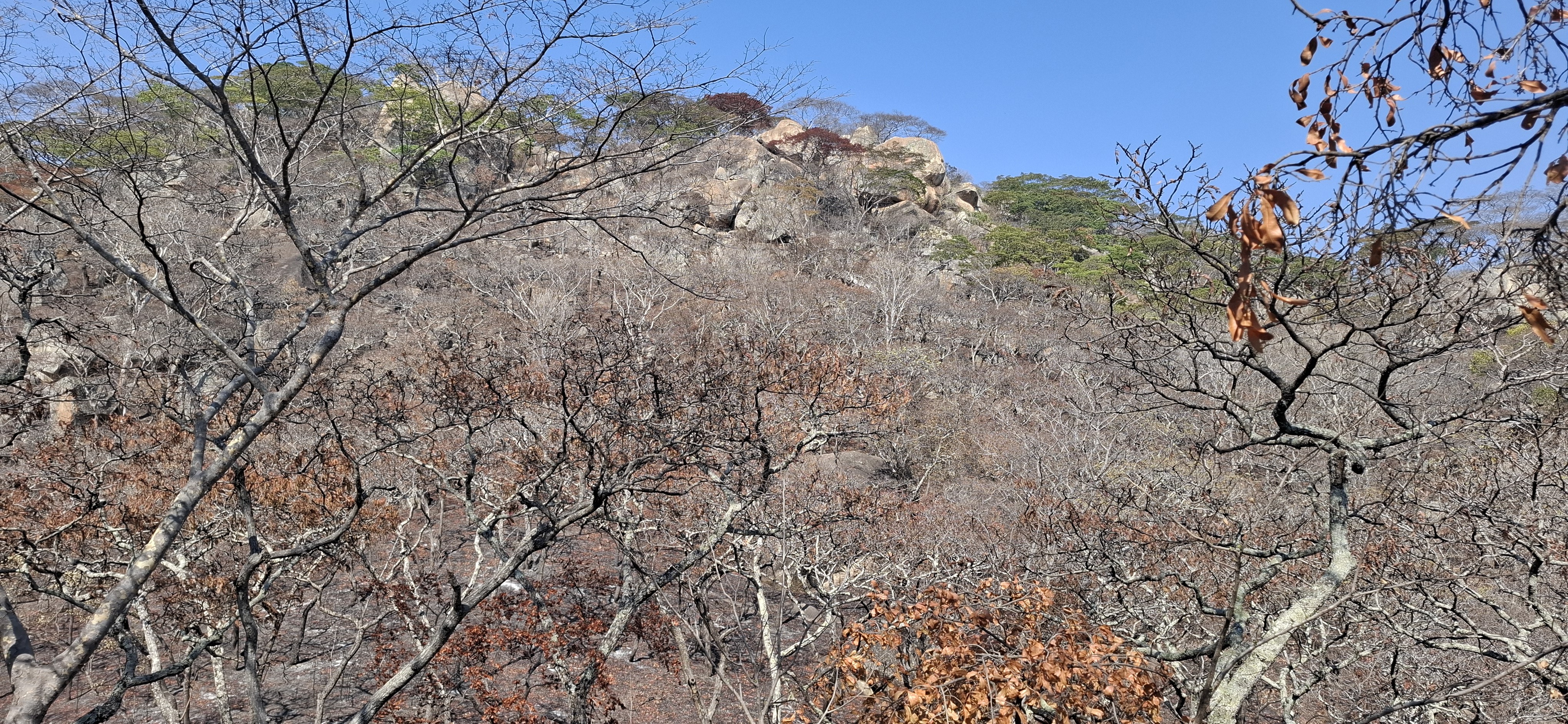
Looking towards the Nehanda cave shrine – the difficult terrain over which fighting took place
The chiefs decide to fight in their own districts
In the Mazowe district it was decided to attack the whites at the Alice Mine and to ambush anyone travelling to and from Mazowe. Many believed the whites in Salisbury were too strong to be attacked directly and the firepower of the Maxim gun (Chigwagwagwa) was greatly feared. They could not fight far from their home ground effectively, so the men took turns to go and attack whilst others looked after the villages and animals.
They were aware of the strength of whites in Salisbury and preferred to fight in their own area where they could retreat into caves in nearby kopjes when needed. This was the same strategy that the Shona had used against amaNdebele raiding parties - to wear them down by depriving them of food and the opportunity to fight and it worked well with the amaNdebele who only caught those who had ignored the warnings to retire to the caves.
Although information was still shared via messengers one disadvantage was that they no longer fought as one complete body. The second factor was that the Hwata clan and those near Salisbury began to bear the brunt of the fighting. This happened to Chief Chidamba the guardian of Nehanda and the spiritual powerhouse of the Shona. Chidamba and his followers were the most stubborn at resisting attack from the Imperial Forces and local troops and both Chinipanyanga, the man who oral tradition says killed Henry Pollard and Mhasvi,[17] the native policeman prominent in the Alice Mine attack were from the Hwata clan. When Chief Chiweshe heard of an eminent attack from the whites they left for their mountain stronghold west of the Mazowe Valley where they had stored water, grain and cattle in the caves that were inaccessible except through narrow and dangerous passages.
The killings begin - all means would be used to ensure victims felt they were not under threat
Chivanda writes, “The main target was of course the white people, but any policemen or Africans who co-operated with whites, as well as all Africans who were not Shona were to be attacked.”[18] Strict secrecy would be used by the plotters and any pretext should be used to get near their victims. The killers could pretend they wanted to trade, or look for work, be out hunting or just wanting conversation.
The killers of the West Brothers at Ntaba zika Mambo went to their store and pretended they had come to buy cloth.[19] In the Lomagundi district Herbert Eyre who was farming on the Great Dyke at Mpinga was killed on the doorstep of his house on 21 June by a party of natives who told him they had come to trade.[20]
The ’96 Rebellions report on the Abercorn (Shamva) district is illustrative: Unfortunately at the time of the rising there were several isolated prospectors and traders in the Abercorn district and the majority of these must have been cut off. We know of the following: William Steele and Andrew Noble, who were last heard of on the 22 June below the junction of the Mazowe and Pote rivers, Thomas William Crouchley and Robert Sagar who were attacked at Harrhy’s Camp and although they escaped into the bush have never since been heard of. Arthur Herbert Henckens who was travelling with a donkey wagon from Mazowe to Darwin, EW Harrhy, whose wounded servant escaped to Abercorn with the report that his master had been killed at Quezada’s kraal. Thomas James Gibson, who was last heard of near Chipadzi’s; a trader called Ruben Shapiro, known to have been murdered at Umlewan’s kraal; George St John Eaton who was killed on the 19 June at Sappho’s kraal, afterwards burned by Mr Duncan when a number of Eaton's goods were found there. John Dryden who must have perished near Chipadzi’s kraal which he left on the 18 June. Walter Tapsell farming on the Abercorn road who has been missing since the outbreak; James Steele and Frank Austin travelling from Abercorn to the Mazowe and a man called Frazer of whom nothing is known, also in the neighbourhood about that time.[21]
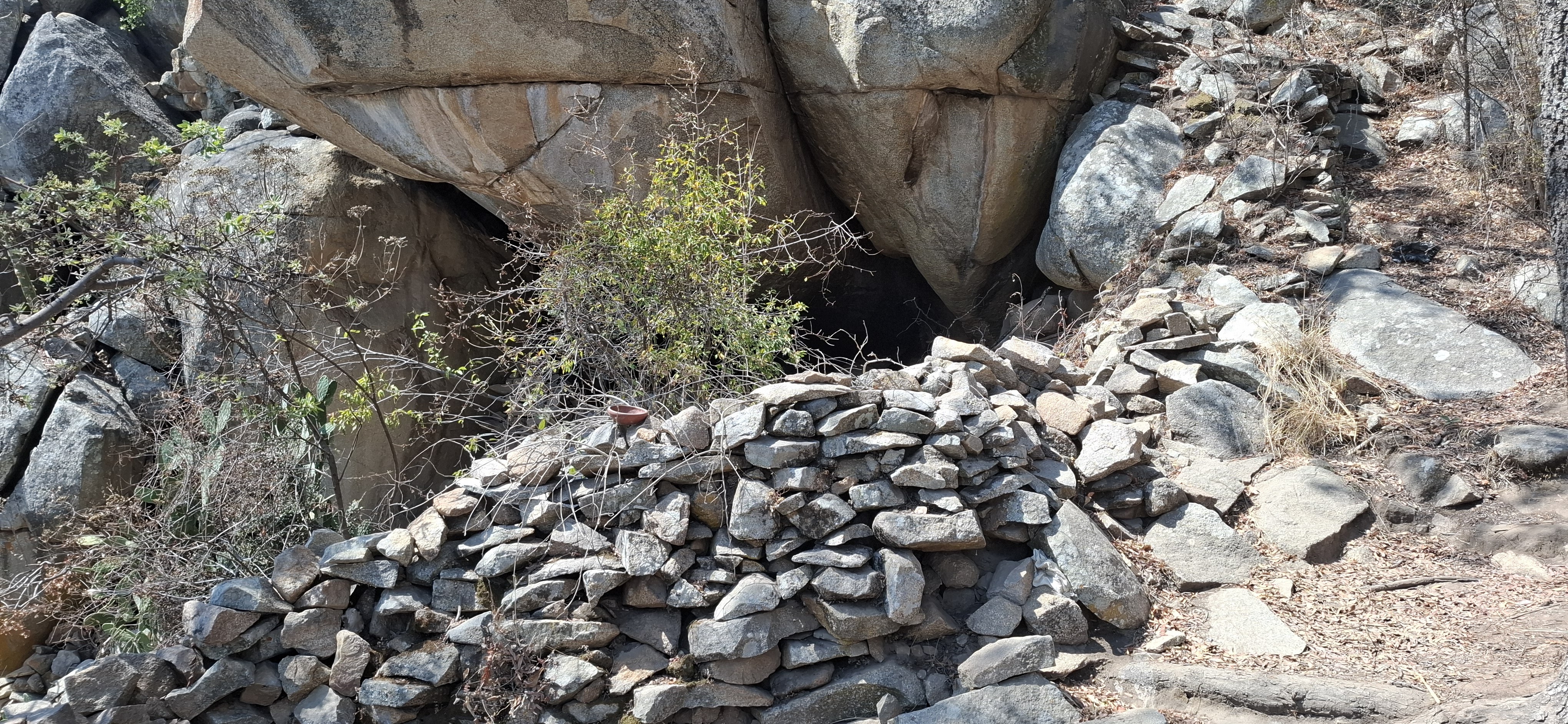
The Mbuya Nehanda cave shrine
Attention focuses on Nehanda
With the arrival of the Mounted Infantry under Lieut-Col EAH Alderson and the safeguarding of supply routes by detachments of troops the white military forces went on the offensive burning down kraals and crops and putting their native opponents under siege in their hideouts. Chief Chidamba came under special attention for harbouring Mhasvi and Nehanda also sensed the danger of being surprised and captured in her cave shrine at nearby Shavarunzi Hill. Before she left she met with Chiefs Chidamba, Chiweshe and others saying she was returning to Dande where she originally came from.[22]
Oral tradition states that Nehanda was a rain-goddess, but somehow the whites were thought either through prayer or by other spiritual means to have come to know her secrets and acquired her power. They saw the whites were gradually gaining the upper hand and that their spiritual leaders were under pressure and no longer confident of victory and their followers began to weaken. About the same time as Nehanda left Mazowe for Dande, Chief Mashayamombe and the spirit medium Kaguvi fled. Kaguvi “came to Mazoe when fighting there had virtually stopped. He didn’t settle there, but proceeded north with his dancing girls, six wives, eight sons and seven daughters, and about twelve donkeys to the Darwin district.”[23]
Others followed Nehanda fleeing north rather than surrender but as more and more troops began burning the crops and kraals in the Mazowe Valley the people faced famine and weariness from the fighting. Chief Chiweshe is generally acknowledged as the first to surrender and he was followed by many smaller clans. "Chiweshe gave up in consideration of his children. He had left his home, Chivavarire, and gone to Chikapanya or Eusaka, and stayed there till he was tired of hiding and wished to surrender." Then Chiweshe said "Ndatera" (I have surrendered)
However Chikukwa, Chief Chiweshe’s mhondoro, who had formerly prepared the warriors for battle claimed the major role in his chief’s surrender saying, "Ndapinda, ndakodza. Vana vangu chirimai zvenyu." (I have secured some good terms my people, you may now settle down and cultivate your fields) clearly implying he had negotiated the surrender.
Investigations take place into the role of the spirit mediums
In 1897-8 numerous and long investigations took place between the Native Commissioner for Mazoe aided by the Chief Native Commissioner Henry Melville Taberer (Teba) and Chiefs Chiweshe and Hwata and their senior Headmen. The people were pleased that Nehanda initially managed to dodge the pursuing BSA Police force. Her ability to foresee and avoid danger successfully kept up her reputation and her prestige. Only when her close followers had been taken did she surrender at Baradzanwa Hill; her arrest signalled the last of the resistance.
Nehanda’s close followers, the best known being Hwata (Chiripanyanga) Gutsa, Chakanotsa and Gatsi are accused by some of giving evidence against Nehanda at her trial in order to save their skins when they should have protected her. Hwata, in particular, is accused of abandoning Nehanda and causing her death. However even at the scaffold, Nehanda is believed to have defied death when the first two attempts to take her life failed. But oral tradition relates that Hwata's people, who were present, pointed out to the whites that she still had her snuff with her, taken just before execution. They advised the authorities to remove the snuff from her, and Nehanda, disappointed but courageous, gave it away and went to meet her death.[24]
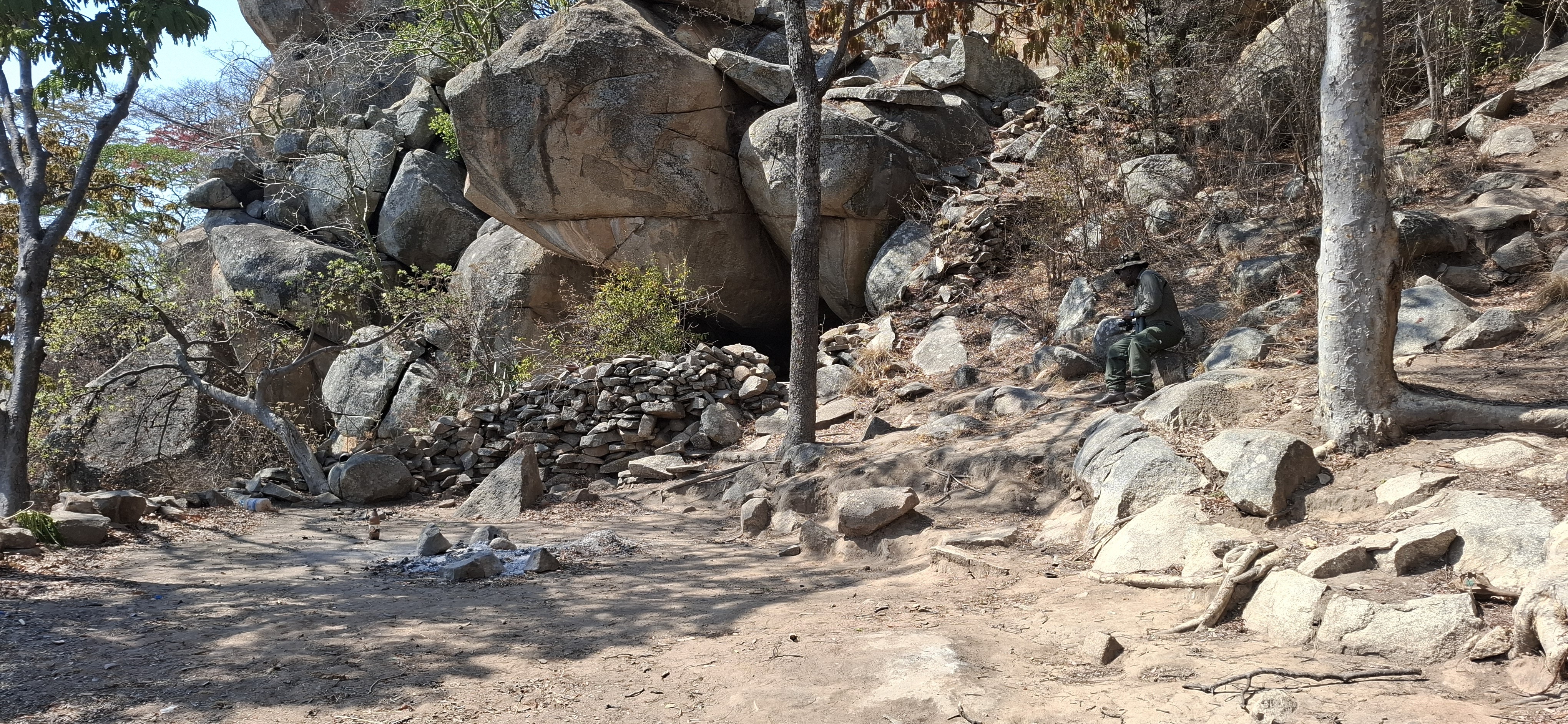
Surrounds of the Nehanda cave shrine
The role of the Mhondoro cult in the Mazowe Valley
The Mhondoro cult was particularly prominent in the Mazowe Valley. Mwari was known to exist, but was remote and only approachable through the Mhondoro, who are able to connect the dead with the living. In his article Chivanda says that very often mhondoro used to follow the feelings and prejudices of the people and were often used as an means of organising them. Being spirits of departed ancestors, they were usually conservative in their views and resisted change. Their views could be contested by a chief who felt his interests no longer agreed with those of the mhondoro.
Nehanda’s speciality was as a rain-maker, but she was also a prophetess and had for a long time warned against enemies and advised on the course people were to take. Although an influential voice the chiefs were also strong and independent leaders. Generally the relationship was an example of a successful co-operation between religious and traditional leaders especially in the beginning of the uprising. Chivanda believes Nehanda and Kaguvi, the spirit mediums, should not have been blamed solely for the uprising as they could not have got the obedience and co-operation of the people if they were not believed by them.
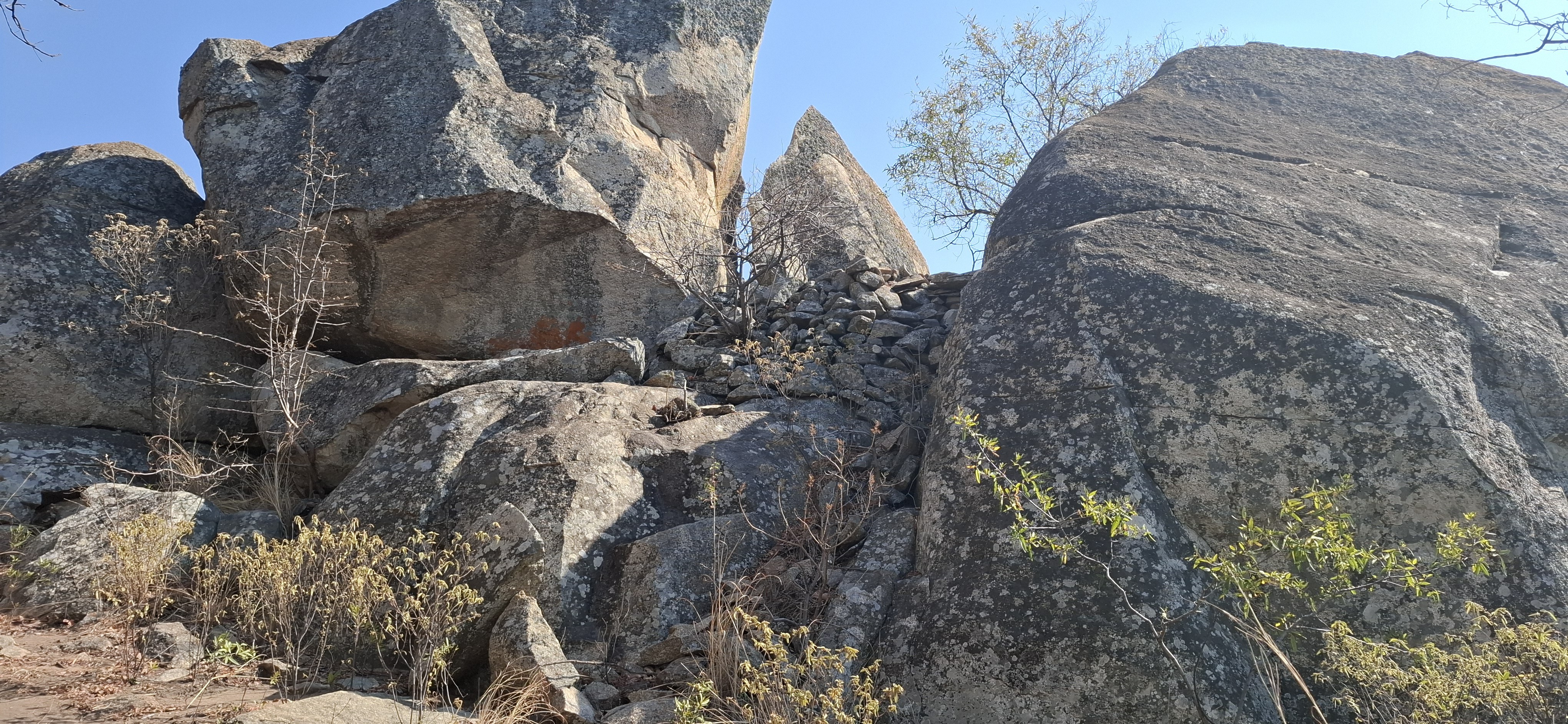
‘Refuge’ style stone walling that may date from the 1896 period
Some historic accounts of the assaults on Nehanda’s cave shrine
This has been abbreviated from Chapter XI[25] Clearing the Granite Range in The Mazoe Valley, P170-187 by Captain Sir Horace W. McMahon, BART, DSO. Text in [] is added by Mike Tucker
On the 17th of September [1896] Colonel Alderson gave me his instructions for a patrol, which was to start the next morning for the Mazoe District, about 28 miles from Salisbury, under my command. His orders were that we were to go to the Mazoe Fort, which is situated a few hundred yards from the Alice Mine and was at that time garrisoned by about thirty Salisbury Rifles under Lieut Fairbairn and in conjunction with the latter, to try and arrange a meeting for Judge Vincent with some chiefs who were reported to be willing to surrender…In the event of being unable to communicate with the rebels, they were to be attacked and driven from their position without delay. Next day the following troops, which were to form the patrol, started from Salisbury. Two sections of my Irish company, Mounted Infantry, Royal Irish, Lieut French and Royal Irish Rifles, Lieut King-Harman. The artillery troop of the Rhodesian Horse, one seven-pounder, Lieut Ashe. The dismounted troop, Rhodesia Horse, Lieut Ross and a detachment of the native contingent consisting of Shangaans. Total about 150 men.
Fairbairn met us a few miles further on, and whilst the column preceded to the Fort, he, French and myself, with three of the native contingent, one of whom was to act as interpreter and spoke tolerably fair English, returned to the Granite Range to commence negotiations. This proved the most tedious process. Each day that we held communication with the natives, our conversation commenced by shouting in a sort of sing-song voice at a distance of about half a mile and as soon as the meaning of our message was grasped it had to be conveyed even further back to the Chiefs before any answer could be obtained. Gradually, more confidence would be established and two or three would eventually pluck up enough courage to come down and talk with us. But even then they insisted on the negotiations being carried on across a small stream.[26]
[They then went to Chidamba’s kraal, 12 miles north of Mazoe on a rather fruitless exercise...They took the kraal but the Mashona resorted to their usual tactics of retreating into the caves and could not be found. They captured Mazwi, a native policeman who had deserted from the native police and led the siege of the Alice Mine.[27] He was put in an iron shed within the Mazoe Fort, handcuffed and tied to a friendly for the night but managed to escape without being detected! They then moved back to the Mazoe Range]
When daylight appeared next morning, we found ourselves moving to the attack of Gaderra’s kraal, which lies on the northern side of the range, and which we had chosen as the best point at which to commence operations. We were all on foot and left only a small party to look after the wagons and horses, as the camp would be well within our view. We had hardly commenced the ascent to the hills before firing commenced. It was with some difficulty that the seven-pounder was dragged up into a position from where the kraal could be shelled, and after a short bombardment, which could not have had much effect then of frightening our enemy, the Mounted Infantry and the Rhodesia Horse advanced up the hill. The position was a dense mass of rocks and trees and the ascent was so steep that it was only with the greatest difficulty that bodies of men could be kept together. The firing increased tenfold as soon as the enemy saw our men coming up to them, but it was almost impossible to detect the position of the firers, not only on account of the trees and rocks, but chiefly because the majority of the rifles in the hands of the enemy were of a small-bore pattern and were fired out of caves some distance back from the entrance to them.
Eventually, after several hours fighting, Ashe, with some of the Rhodesia Horse, affected an entrance into Gaderra’s kraal, while French and King-Harman with their sections kept up a continuous fusillade, directed on the heights above, to subdue the fire from that quarter, which otherwise would have rendered Ashe’s position untenable. The seven-pounder was now powerless to help owing to the close proximity of our men to the enemy. For half an hour after Ashe and his men gained a footing in the kraal, they were evidently having some sharp fighting, judging from the amount of firing going on inside, but gradually this ceased, and he signalled down for mining materials. These were sent up in boxes carried by the Shangaans. These warriors going up, came in for a fresh outburst of firing, and the boxes were constantly placed on the floor whilst the bearer returned to some position more agreeable to himself. The difficulty of persuading them to persevere increased after one of them was wounded, but finally the cases reached their destination in safety.
After the customary warning., which was always given before using explosives, that all women and children, who came out should be allowed to go free and that the men might surrender and only those convicted of crimes should be punished, the mines were fired and it was decided to return to the camp for the night. No sooner had this course being commenced than the enemy’s fire was redoubled, as we suppose they imagined that we had been beaten back. The Mounted Infantry still kept up their fire to cover the party retiring from the kraal, but as soon as they in their turn commenced to retire, each position as their vacated it was re-occupied by the enemy…Lieut French. Royal Irish Regiment serving with the Mounted Infantry, Corporal Tully, Rhodesia Horse and one of the native contingent wounded. Next afternoon, reinforcements arrived and a native contingent of about 50 with another seven-pounder. In all, about 140 men.
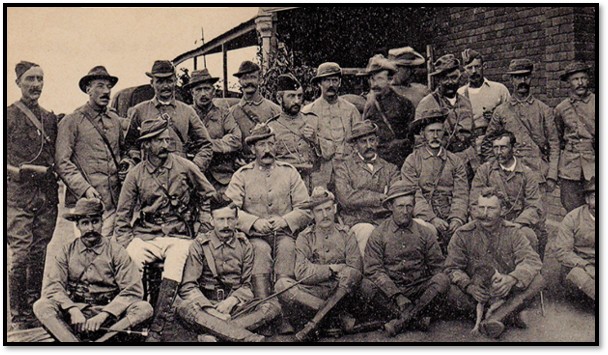
NAZ: Officers at the Salisbury laager in 1896 – some of whom would have taken part in the Mazowe action
At sunrise next day I attacked with the whole force from the same direction as on the previous occasion and at first met with slight opposition...On our ascent, we were fired at from time to time and from different positions, but we were obviously only fighting with outposts, who retired as we advanced. This of course, was a very slow proceeding, not only on account of the difficult climbing, but also from the necessity of making sure we left none of the enemy in our area. On our way, we burn several kraals and mined some of the more important caves. The Salisbury Rifles and Zulus on the right, with Harding and Ashe, both most valuable officers, whose coolness and daring on every occasion would be hard to beat, came in for most of the fighting and drove the enemy back from one position to another, until a determined stand was made at Chidamba’s kraal.
In this kraal was the cave of the famous witch-doctress Nyanda [Nehanda] who was reported to be the cause of most of the discontent prevailing in the district and whose capture we were consequently most anxious to effect. It took some time to find the entrance to the kraal and after heavy firing on both sides it was rushed by Lieut Pilson and the Royal Dublin Fusiliers section. The natives pursued their ordinary tactics and retired into their caves, which on this occasion were even more extensive than usual and from which it was hopeless of thinking of dislodging them with the mining material in our possession. However, we captured many arms and cattle and a quantity of property which had been taken by the natives from their murdered victims, all of which were concealed in Nyanda’s cave, but unfortunately the witch was gone. This cave we determined to destroy completely, in order to show the natives that the white man had little respect for Nyanda's power. After a party, which had been sent to warn everybody to come out of the cave had returned and reported that all was clear, the mines were fired and the place blown to pieces.
We then turned for our camp, as the sun was low, and were moving off when a terrible scene met our view. Behind us a practically nude figure, apparently blind, covered with dirt and blood and crying out for water, came hurrying up to us in a more pitiable condition than I can describe. For some seconds one could not think what it meant, but we soon saw that it must be one of our own people who had in some way or other been injured by the explosion. By some mischance, the poor fellow had been concealed behind a rock when the party went in to order all out of the cave and had met with this terrible accident. He was one of the Salisbury Rifles, named Day, and it turned out afterwards that he had found a £5 banknote and was diligently hunting for more, quite innocent of his own danger. He had been blown out of the cave and fell through a tree, which no doubt saved his life, a distance of at least thirty feet. Curiously enough, he had put the £5 note in his trousers’ pocket, and these garments were taken completely off him by the explosion.
As soon as his loss became generally known, it was curious to find out how many of his friends, and their names appeared to be legion, were anxious to go next day to try and recover his rifle for him, this weapon having of course been his companion during his search in the cave and probably therefore in pieces. I am glad to say that after being taken to Salisbury Hospital and placed under the care of Doctors Fleming, Mother Patrick and the Jesuit sisters - to whom numbers in Rhodesia, including myself, owe a lasting debt of gratitude - except for being slightly deaf, he came out little the worse for his terrifying experience.
As rations were short with us and all available food at Salisbury was required for the larger expedition to the Hartley Hills, it was decided not to follow up on the Mazoe rebels at present and so after another day at Forbes's farm, which is utilised by the Colonel in going to inspect Mazoe Fort and the Granite Range and by the troops in two parties under Pilson and Moberley in further patrolling the scene of the late operations to make certain that the enemy had finally vacated the position, we commenced our return march to Salisbury to prepare for our trip to Hartley…
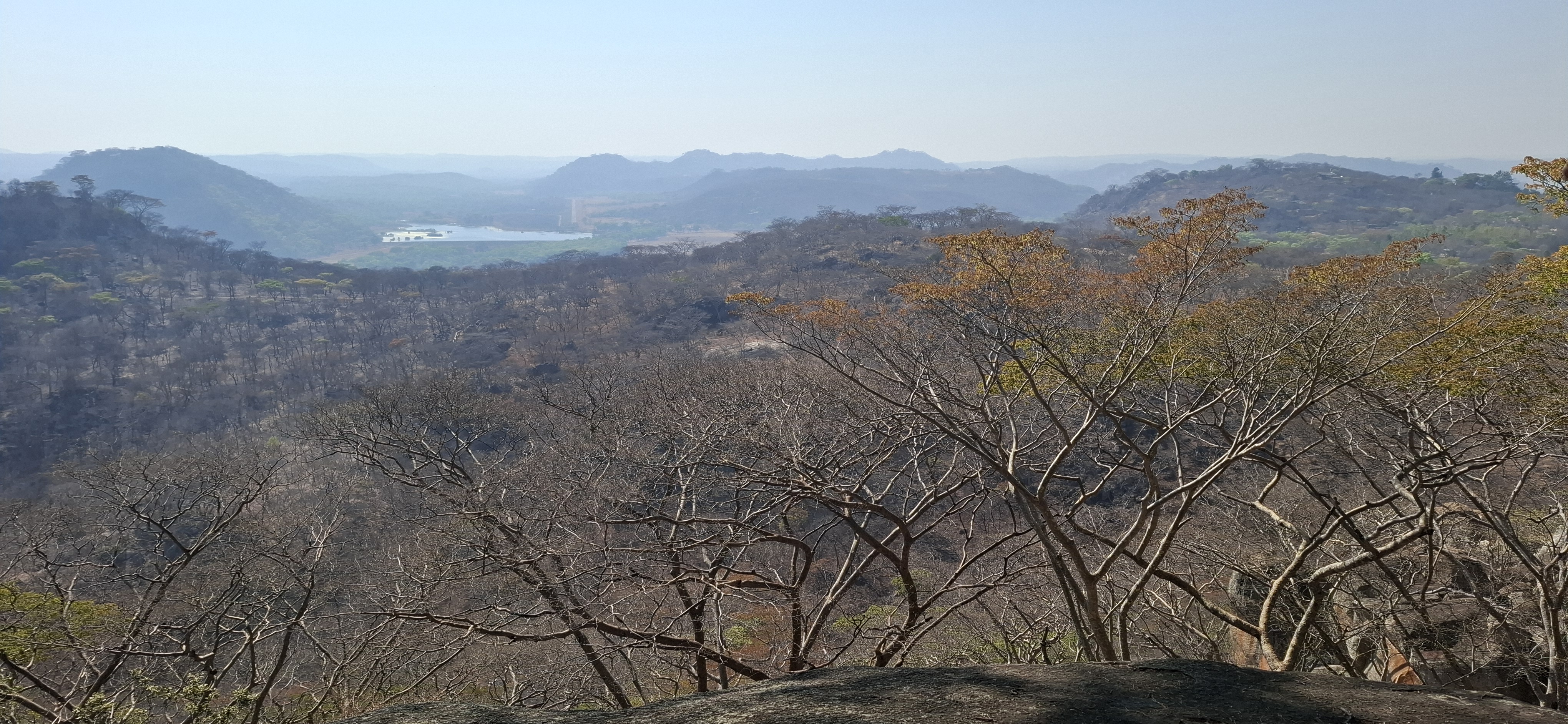
View from Nehanda’s cave shrine towards the Mazowe Dam
This has been extracted from Far Bugles, P52-53 by Lt-Col Colin Harding, CMG, DSO:
Another patrol which I well remember was one under the command of Captain Horace McMahon to the Mazoe Valley. The idea of it was, if possible, to arrive at a peaceful understanding with a most important insurgent Chief named Chidamba, but if he refused our peaceful overtures, to fight him…
Aimless talk went on for a day or two, and might have gone on until this day, had not three of the rebels taken the law into their own hands and with their rifles at the trail stalked McMahon from the rear. They would undoubtably have bagged this gallant soldier and his peaceful adherents, but for the quick eyes of a Mashonaland native policeman. This policeman, knowing the ways of his country-men better than we did, was on the lookout for treachery and spotted them in time, gave the alarm and to cut matters short, negotiations were broken off.
It was in Chidamba's kraal that we found the cave of the famous witch-doctor, a lady named Nyamba [Nehanda] who had the reputation of causing a lot of trouble. We had been anxious to make the close acquaintance of this ‘bewitching’ lady, but we were doomed to disappointment, as all we captured was a lot of property which, through her instrumentality had been Iooted by the natives she duped from their murdered victims. In order to demonstrate to the natives that we had Iittle respect for the alleged power of ‘Doctor Nyamba’ we determined to send for mining tools (so officially described) or in other words, dynamite and detonators.
In an unguarded moment, I informed McMahon that I knew all about dynamite (I was not over-rating my knowledge for I had been nearly blown up on more than one occasion) consequently, I was deputed to superintend the blasting of Nyamba’s cave.
I had taken a great fancy to Lieut. Ashe, so I suggested to him that he should help. He did not know so much about dynamite as I did, or he would not have accepted my invitation so readily. Anyhow, we collaborated and after clearing everyone out of the vicinity of the cave (a clearance which was not difficult to effect as soon as its reason was apparent) we inserted two or three cases as far as possible into the cave. Taking every precaution I prepared the dynamite for explosion and then Ashe put it in the cave. We had a beautiful explosion, stones, rocks, clothing, native pots and every portable and conceivable thing one could imagine went flying into the air. But the greatest joy of all was to see a human form, very much like a windmill in a 60-mile an hour gale hurtling towards the sky and thinking it was the form of Nyamba whose witchcraft had done so much harm, I was not in the least perturbed when I heard the body pitch with a thud in the bushes near where I stood. Intending to send up a fatigue to bury it, I, with others preceded leisurely towards our camp. We hadn't gone far when looking back, we saw a nude form approaching, apparently blind, covered with dirt and blood.
It was, indeed, the form which I had seen in mid-air but unfortunately not the body of the arrogant witch doctor, but that of one of our own men who had somehow got mixed up with the explosion. It turned out afterwards that he found a £5 bank note and was diligently seeking for more, quite innocent of danger. He had been thrown out of the cave and fell through a tree, which no doubt saved his life, a distance of 30 feet. Curiously enough, he had put the £5 note in his trousers pocket and these garments were taking completely off him by the explosion. Needless to say, the witch doctor escaped without a scratch.
Current situation
Christon Bank is the original home of Chief Hwata and the home of the spirit medium Mbuya Nehanda Charwe. Shavarunzi Hill at Christon Bank is where chiefs and previous spirit mediums of the Hwata clan are said to be buried.
The Christon Bank community have proposed that the Mazowe valley be made a tourist destination and is seeking Government intervention to stop the destruction by illegal miners around Shavarunzi Hill and area that is having a negative impact on Mbuya Nehanda shrine.
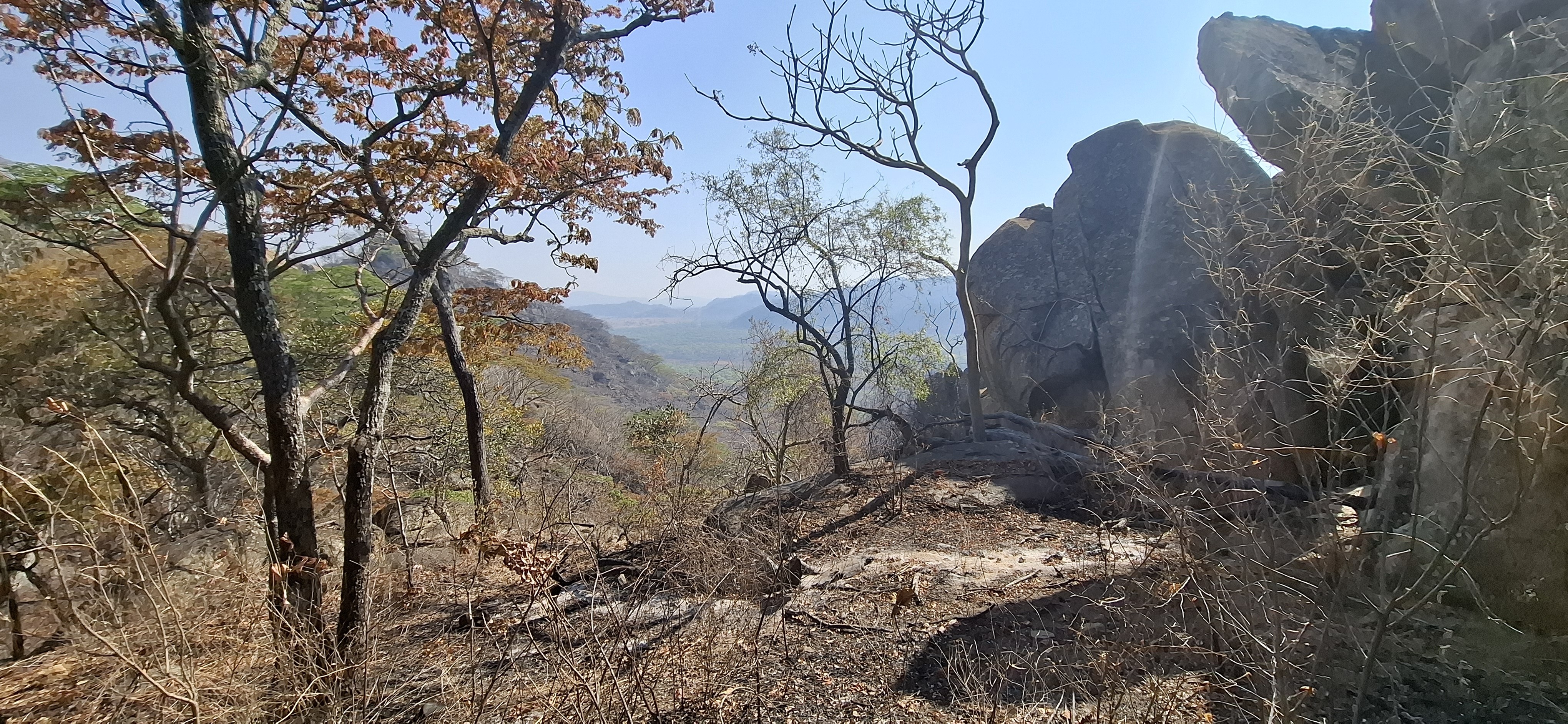
Other organisations have added their concerns. BirdLife Zimbabwe chief executive officer Julia Pierini said the area, home to nearly 200 bird species, including the rare cinnamon-breasted tit, had tremendous potential to generate revenue through Avi-tourism where bird-watchers could view birds in their natural habitats. She said, “If this environmental destruction continues unabated, it would not be possible to attract bird watchers in this niche tourism market.”
National Herbarium and Botanic Gardens acting head Chris Chapano said the Mazowe Botanical Garden Reserve in Christon Bank, made up of Miombo woodlands, was home to more than 300 species of plants. He said, “The illegal mining activities and tree chopping in the Mazowe Botanical Reserve are eroding our biodiversity…It is a protected area and it must not be disturbed.”
Christon Bank Environment and Tourism Association spokesperson Ms Avril Dlamini said recently that the historic site that includes late Stone Age rock paintings, grain bins and Mbuya Nehanda’s cave shrine were being destroyed by gold panners. She said, “CBETA’s vision is to make the whole area a tourist destination where visitors could enjoy the heritage sites, enjoy the diverse flora and birdlife in the Mazowe Botanic Reserve, as well as recreational activities such as walking, rock climbing and picnicking…Whatever you do, you should sustain the environment and tourism does that. We want the illegal mining activities to be stopped. We also want the illegal settlements to be stopped and correct land use to be restored.”
Professional guide and outdoor enthusiast Jono Francis said Christon Bank formed the headwaters for Mazowe River and its waters were now being contaminated by heavy metals such as mercury and cyanide used in gold extraction, “Gold panners are polluting the Mazowe River that flows into the Zambezi River below Cahora Bassa Dam in Mozambique and I don’t even want to tell you how many people live along that river...We have to act quickly to stop the destruction of the Mbuya Nehanda Heritage Site and the pollution and siltation of Mazowe River.”
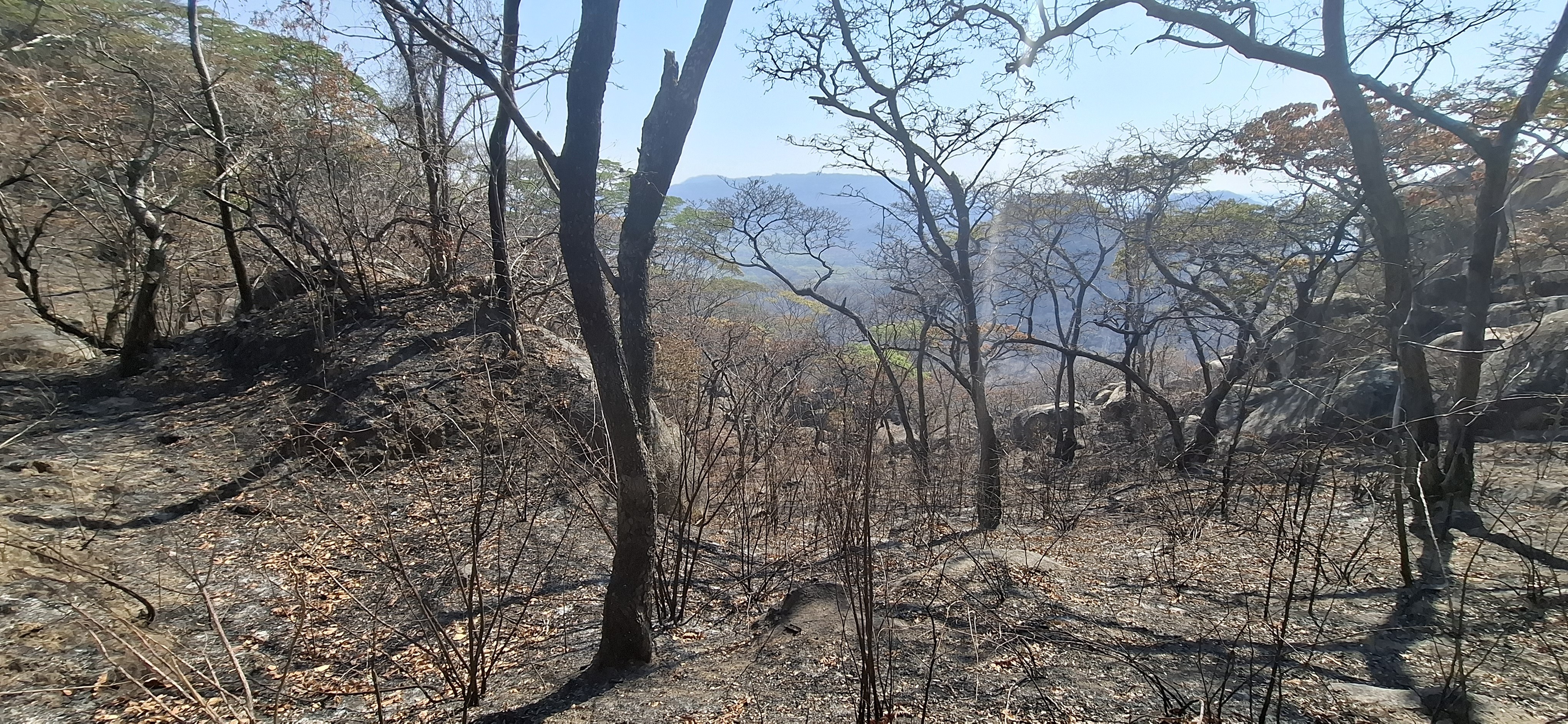
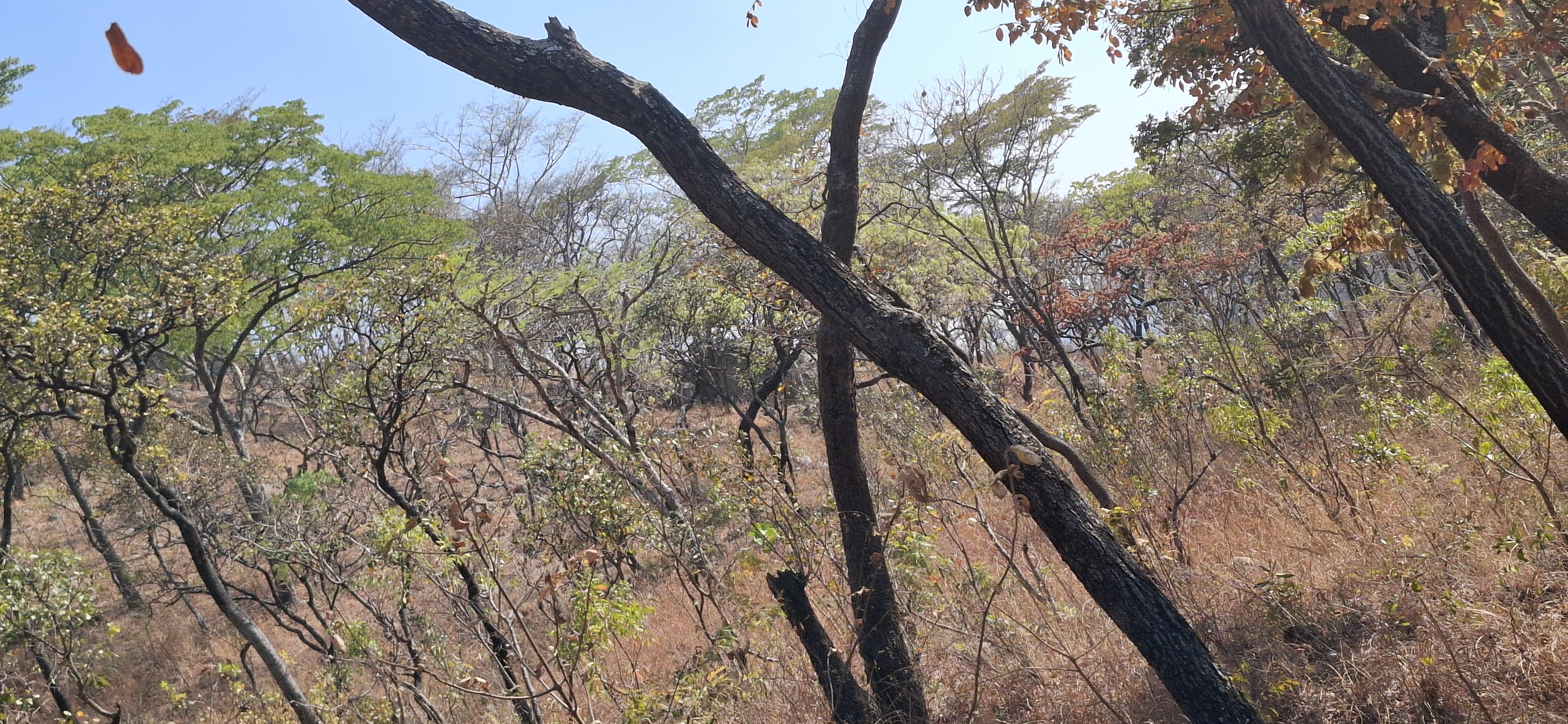
Burnt Miombo woodland scene at Christon Bank
References
E.A.H. Alderson. With the Mounted Infantry and the MFF 1896. Books of Rhodesia, Bulawayo 1971
D.N. Beach. The Shona and their Neighbours. Blackwell Publishers, Oxford 1994
C.C. Chivanda. Seminar Paper No 9. 23 June 1966. Mashona Rebellion Oral Tradition: Mazowe District. University of Zimbabwe Institutional Repository. https://ir.uz.ac.zw/bitstream/handle/10646/2858/Mashona_rebellion_in_oral_tradition_Mazowe_District.pdf?sequence=1&isAllowed=y
C. Harding. Far Bugles. Simpson Marshall Ltd, 1933
T.O. Ranger. Revolt in Southern Rhodesia 1896-7. Heinemann, 1979
The ’96 Rebellions; The British South Africa Company Reports on the Native Disturbances in Rhodesia, 1896-97. Books of Rhodesia, Bulawayo 1975
Notes
[1] Revolt in Southern Rhodesia 1896-7, P208
[2] Ibid, P209
[3] The Shona and their Neighbours
[4] The Mashona Rebellion in Oral Tradition: Mazoe District, P4
[5] This order not to loot goods but deliver them to the spirit mediums prevented the rising from breaking up into property raids and is an example of the leadership provided by the spirit mediums
[6] Chief native commissioner in Mashonaland 1896-1900
[7] Revolt in Southern Rhodesia 1896-7, P210
[8] Ranger states that Mkwati and Kaguvi did collect stolen guns and distribute them for loyal and effective service, P354
[9] Ibid
[10] The Mashona Rebellion in Oral Tradition: Mazoe District, P4
[11] Ibid, P4
[12] Ibid, P5
[13] Ibid, P8
[14] See the article The June 1896 Mazoe Patrol skirmish with detailed accounts from those besieged and their Mashona attackers under Mashonaland Central on the website www.zimfieldguide.com
[15] Mashona rebellion oral tradition: Mazowe District, P9
[16] Muti is traditional medicine or herbal remedies
[17] Mhasvi was Native Commissioner Henry Pollard’s head native policeman and deserted from him to lead the siege at the Alice Mine. After capture he managed to escape. See the article The June 1896 Mazoe Patrol skirmish with detailed accounts from those besieged and their Mashona attackers under Mashonaland Central on the website www.zimfieldguide.com
[18] Ibid, P8
[19] See the article Mambo Rebellion Memorial – with three oral history accounts collected by Foster Windram in 1936 and 1938 concerning the killings at West’s store under Matabeleland North on the website www.zimfieldguide.com
[20] The ‘96 Rebellions, P60
[21] Ibid
[22] Mashona rebellion oral tradition: Mazowe District, P12
[23] Ibid, P13
[24] Ibid, P16
[25] E.A.H. Alderson. With the Mounted Infantry and the M.F.F. 1896
[26] Chivanda states in Mashona Rebellion Oral Tradition: Mazowe District that many of the questions were about Mhasvi, NC Pollard’s former head native policeman who deserted that the white military forces thought was being safeguarded by Chief Chidamba. The whites would shout, "Chidamba, buruka titaurirane. Usuraye vanhu vako nenzara! Buruka." (Chidamba, come down and let's negotiate. Don't let your people starve! Come down!) - or "Tinoda Masvi” (We want Masvi).
[27] See the article The June 1896 Mazoe Patrol skirmish with detailed accounts from those besieged and their Mashona attackers under Mashonaland Central on the website www.zimfieldguide.com