
- Entry fee
- n/a
Who was Mbuya Nehanda?
The historical ‘Nehanda’ whose name was Nyamita was the fifteenth century daughter of Nyatsimba Mutota, the founder of the Mutapa dynasty. Nyatsimba Mutota is believed to have established his capital at Zvongombe, 10 kms east of the village of Centenary in Northern Mashonaland in the early 1430’s.
Mutota ordered Nyamita to perform ritual incest with her younger half-brother Mwened Matope who succeeded his father and this is believed to have given the dynasty mystical power.[1]
After her death she became a mhondoro, a royal mudzimu (ancestral spirit) or "lion spirit", that uses women as her mediums.[2] Mhondoro spirits are revered amongst the Shona, as it is believed that they can interpret the commands of Mwari, the senior God.[3] Nyamita’s spiritual powers lived through a succession of svikiro[4] or spirit mediums until the spirit occupied the body of Charwe Nyakasikana. When spirit mediums are possessed by the spirit of Nehanda they are believed to be speaking with the voice and behaviour of the original Nehanda and not with their own voice.[5]
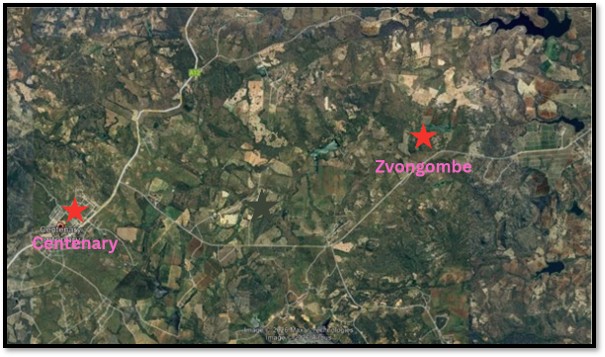
Zvongombe, the first Mutapa capital
Charwe Nyakasikana (c.1840-27 April 1898) known as Mbuya – “grandmother” in the Shona language became the latest iteration of the svikiro, or spirit medium of the Zezuru Shona people about 1884[6] and was given the title of Nehanda. Her father was Chitaura, the youngest son of Shayachimwe who founded the Hwata Shona dynasty in the upper Mazowe valley in the late eighteenth century.[7] She married and had two daughters and a son living in Chidamba’s village[8] in the Mazowe district, details of her husband are not known.
Beach writes that in 1889 African soldiers of Manuel Antonio de Souza (Guveya) arrived with guns and a Portuguese flag and an offer of an alliance against the amaNdebele. This was part of Joaquim Carlos Paiva de Andrada’s (Payiva) drive to form alliances with Portugal in Mashonaland before the Pioneer Column arrived. De Souza’s soldiers reported they had secured Mutimumwe as the Hwata Chief and that their efforts to establish an alliance were supported by the Mhondoro medium Nehanda whose shrine was at Shavarunzi Hill.[9]
Even before the Pioneer Column’s arrival in September 1890 Charwe carried out traditional ceremonies in the Mazowe valley that ensured good rains and produced abundant crops and she was held in great respect as a svikiro (spirit medium) for being committed to Shona culture. Initially she believed the white traders and prospectors should be welcomed perhaps believing that like the Portuguese in the sixteenth / seventeenth century they were itinerant and would not settle permanently. She said, “Don't be afraid of them, as they are only traders, but take a black cow to them and say this is the meat with which we greet you."
Her attitude changed however when the settlers began to parcel out the land as farms[10] and she was even more hostile in 1894 when the British South Africa Company (BSAC) imposed a hut tax to pay for its administration and began conscripting local people through the Native Commissioners into enforced labour on the mines and roads.[11]
However Beach states there is no evidence that Nehanda played any significant part in the early days of the uprising, unlike Kaguvi who played a very important role in the Mupfure area extending across to Goromonzi.[12] The upper Mazoe Valley remained peaceful until the 18 June 1896 and there are few references to Nehanda in the trials that followed in 1898. He believes that the uprising was not the subject of elaborate co-ordinated planning but spread rapidly over Mashonaland and that it spread outwards from the Mupfure river area over a short period of ten days in response to the false news that Colonel Beal’s column going from Salisbury to the relief of Bulawayo had been defeated by the amaNdebele; Beach believed the uprising was mostly opportunistic.[13]
He criticises Terence Ranger [14] for over-emphasizing Nehanda’s role in the uprising despite knowing the Kaguvi medium was more important than Nehanda by claiming that because “she did not recant and convert before her death, whereas he did. She was thus primarily a symbol of intransigence.”[15]
Even the witness accounts concerning the murder of Native Commissioner Pollard are contradictory. According to Hwata and Gutsa and other trial witnesses she ordered Pollard’s death, but Nehanda claimed she had not. She denied seeing Pollard and claimed she had run away and repeatedly denied ordering his killing. “If I had sent him [Hwata] I would own up to it. I have nothing more to say…I did not give the order. Why should I hide it if I did?”[16]
Beach writes that none of the reports of murders reaching Salisbury in June to July 1896 mentioned Nehanda and when later they did, they were very uncertain and mixed up with many unreliable rumours. There was great confusion amongst the settlers on mhondoro, masvikiro, ‘witch-doctors’ and witches and their association with caves.
The military forces reached the ‘granite hills’ of Christon Bank on 10 September 1896 to begin negotiations and when Hwata’s people said they would give up the people who made them rise, the settlers believed “this we thought must be Mahanda [Nehanda] the great witch.”[17]
Beach then writes, “It is not surprising that, when the British army did finally fight its way into the Granite Hills and found a cave full of loot captured from whites, ‘it was supposed to belong to the witch-doctress Nyanda.[18] The element of doubt was suppressed in later versions of the report and it became established ‘fact’ that the cave belonged to Charwe [Nehanda] It may have been, but really it might have belonged to Hwata, Chidamba, or any other local leader.”
After the attack on Chidamba’s kraal and the dynamiting of the cave, Nehanda and Chidamba moved to the Ndoma Hills, east of the Mazowe river and the capture of both she and Kaguvi became a high police priority. Both gradually moved north, Nehanda toward the Musengezi river. When Kaguvi sent messages suggesting surrender, she threatened to kill him. Kaguvi surrendered on the 27 October 1897 saying, “I have heard what these women [witnesses] say, but it is not true. I only want a place where I can live. If the government want me to pay for these things I will pay with a young girl. I want Nyanda, Goronga and Wamponga brought in, they started the rebellion.”[19]
In November 1897, the Chiweshe people turned against Nehanda; she tried to flee into Mozambique but was forced south and captured. Nehanda and Hwata were arrested on 18 December 1897.[20]
The High Commissioner in Cape Town, Sir Alfred Milner, ordered that all those suspected of murder should be handed over to the civil courts. This came after the outcry following the military court martials and execution by firing squads of Chief Chingaira Makoni[21] and Chief Uwini.[22] Nehanda and Kaguvi were kept in separate cells in the overcrowded gaol; the other prisoners were kept together and with the lax security several prisoners escaped.[23] [24]
The charges against the prisoners were not for rebellion, but for those who committed murder or ordered the murder and assault of whites and Africans including policemen, catechists, migrant workers and farmers.
Beach reminds us that for most officials, missionaries and settlers the belief that Nehanda played a major part in the uprising was based mostly on a web of rumours or assumptions.[25] He continues, “Charwe was obviously in favour of the Chimurenga, but was no more influential than Hwata, Chidamba, Chiweshe, or any of the other Mazowe valley leaders in its initial stages, and the evidence for her playing an exceptional role after that - except in Rhodesian imagination - is not very strong.”[26]
What part did Kaguvi (Kagubi) take?
R.H. Wood[27] writes that the historical Kaguvi lived between 1660 - 1680 in what was called Guruuswa[28],[29] the area occupying the south-west quarter of Zimbabwe. He had taken over leadership of the Rozwi dynasty from Gumboreshumba the founder of the Rozwi dynasty.[30]
Kaguvi's spirit or mudzimu[31] has lived on from that time occupying the human form of a spirit medium or svikiro. In pre-colonial times, Kaguvi's spirit medium was Kawodza who lived on Kaguvi Hill[32] on the southern bank of the Umfuli river (Mupfure) between Beatrice and Hartley (now Chegutu) Chief Mashayamombe’s kraal was on the northern bank. Kaguvi Hill would later “serve a very important function, for it was Kaguvi's stronghold where the Chivero / Mashayamombe people would hide and plan war strategies against their adversaries.”[33] Below this hill is a pool in the Mupfure river which has never been known to dry up and from which according to tradition came noises of cattle, sheep, goats and cockerels. Kawodza was killed by a raiding amaNdebele party pre-1890. One of his grandsons was Gumboreshumba named after the founder of the Rozwi dynasty and prior to the European occupation in 1890, Gumboreshumba found himself possessed of the Kaguvi spirit previously held by his grandfather, Kawodza.
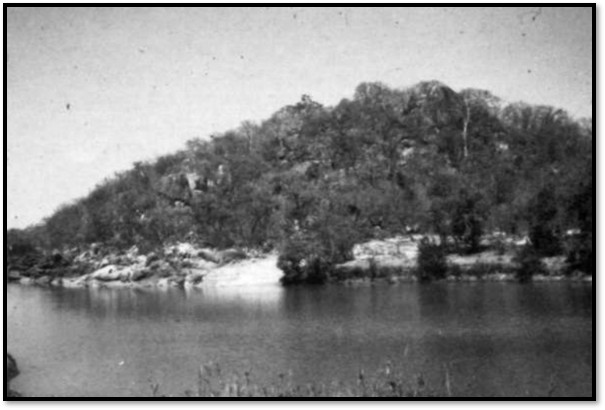
Kaguvi Hill with the pool below in the Mupfure river
Kaguvi’s actual name was Gumboreshumba (c.1870- 27 April 1898) meaning ‘lion's paw’ and he lived in Chief Gondo’s kraal near present-day Goromonzi.[34] He had four wives, One of his four wives was Chief Chinengundu Mashayamombe’s daughter, the other three wives were from Headman Gondo’s kraal, less than a kilometre from Chief Chikwakwa’s kraal.
He became known for predicting good luck in hunting and was able to speak to people ‘from the trees and the rocks’ and was believed to be the spirit husband of the other great Shona spirit, Nehanda, who apparently recognised Kaguvi's authority. It may have been this connection which enabled him in due [35]course to persuade Mbuya Nehanda to preach the gospel of war in Mashonaland.
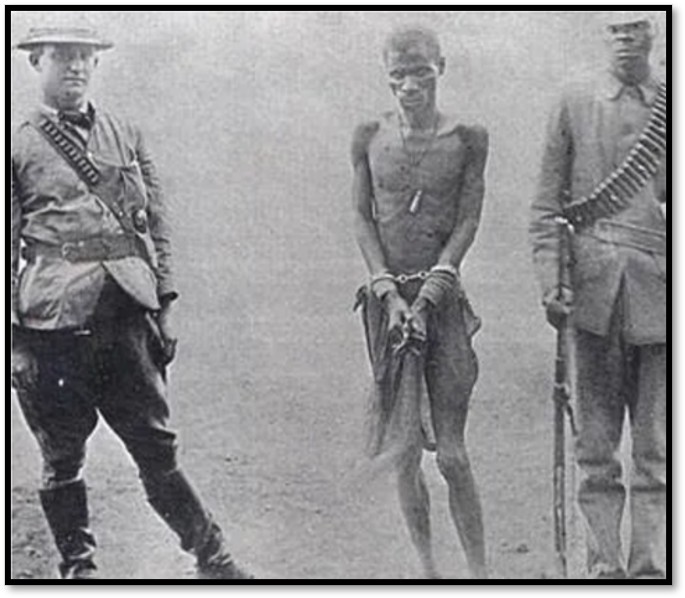
NAZ: Kaguvi after capture at Salisbury (now Harare) gaol in Victoria Street (now Mbuya Nehanda Street)
He moved frequently between Chief Chikwakwa’s near Goromonzi and Chief Mashayamombe’s kraals to the south west near the Mupfure river urging them to take up arms and drive out the settlers. The Goromonzi area with Chiefs Seke, Chikwakwa and Kunzwe, together with Chief Mashayamombe formed the heartland of the Shona Uprising / First Chimurenga.[36]
Shortly before the uprising began, Kaguvi returned to the Mupfure area and sent messengers to the spirit medium, Mkwati, who lived in the Matopos (now Matobo) and who was the svikiro of the Supreme God, Mwari. These messengers were supposedly sent to obtain medicine to destroy locusts but they returned to Mashonaland with the secret message that Mkwati had said the Shona should rise up against the whites in the same way as the amaNdebele had risen in March 1896 and that Kaguvi had the same powers to kill all the whites as Mkwati had. On receipt of this message, Kaguvi sent messengers to all the chiefs and spirit mediums in Mashonaland to start the uprising promising them there was nothing to fear because the white man's bullets would turn to water.
Were the whites aware of the growing sense of rebelliousness in Mashonaland?
The authorities in Mashonaland were aware of the possibilities of an uprising. For example, in the Lomagundi district there were about twelve miners at the Ayrshire Mine[37] and another twelve scattered around the district. On 27 March 1896, Percy Inskipp, then the Administrator’s secretary[38] wrote to A.J. Jameson, the Mining Commissioner of the district, explaining that an uprising had broken out in Matabeleland and warning him to keep a sharp watch on the natives in the district and to report at once if there were any signs of dissatisfaction amongst them. If there was, he was to order the miners to proceed immediately to Salisbury.
In late April when reports reached Inskipp of growing discontent in the Hartley, Gwelo and Iron Mine Hill areas he wrote again saying the inhabitants should seriously consider leaving the district as it would be difficult to send a rescue mission from Salisbury. Jameson replied that the district was quiet, but there had been rumours that natives were going north and would return in ‘two moons’ to kill the miners. In response, H.M. Taberer the Chief Native Commissioner, sent out native detectives to try and get more information.
On 31 May a white miner, John Dougherty, was murdered by his employees at Alaska Mine; the nearest chief handed over two suspects who he said were responsible although it was never proved.
About the 15 June two Ayrshire miners, Eustace and Jollie retuned to Salisbury with the news that the natives throughout the district were leaving their kraals and gathering in the north and were rumoured to be planning mass murder.[39]
This scenario was replicated in other districts such as Charter, Hartley Hill, Makoni, Marandellas and Mtoko.
The BSACo’s Notice to Prospectors and Others[40]
As is well known, a rising amongst the natives in Matabeleland has taken place and although His Honour, the Acting Administrator and the Council have no reason to believe that there is any probability of a similar rising of natives in Mashonaland, yet they consider it advisable to point out that should the natives of Mashonaland take advantage of the present crisis and attack and loot isolated stores, mining camps and farms, it is important to impress upon such persons as are in outlying and isolated positions the necessity for vigilance.
His Honour the Acting Administrator and Council desire to point out that owing to the fact that prospectors and other persons are scattered over a very wide area, difficulties may arise in the event of certain emergencies of speedily affording relief. His Honour and Council therefore desire to express the opinion that, in the event of any circumstances arising which may excite suspicion, prompt information should at once be given to the Company's nearest official and that all possible steps should be taken by the above mentioned persons to place themselves in a position of defence and security.
14th April 1896 WR Fielde, Acting Secretary to the Council. Salisbury.
How many read the Government Gazette is unknown, but it is possible that copies of this Notice were posted up at local Post Offices in the districts.
Outbreak of the Mashona Rebellion or First Chimurenga
Consequently, this area traversed by the road from Salisbury (now Harare) to Marandellas (now Marondera) suffered many settler casualties in the early days of the Shona Rebellion. For a comprehensive account of the impact of the uprising on this area see R.S. Burrett’s article.[41] Probably the first victims of the uprising were two or three Indian traders who ran a store on the southern bank of the Mupfure river near Kaguvi Hill.[42] First news reached Salisbury on the evening of 15 June 1896 when a native reached Six-mile spruit[43] with news that William James Tate and S. Koefoed[44] with four native servants had been murdered at the Beatrice Mine by a party under Chifamba Muchena, a brother of Chief Mashayamombe.[45] In response, Judge Vintcent issued orders that the Natal Troop, then at Fort Charter, with a Rhodesia Horse patrol under Lieutenant Christison should attack Mashayamombe’s kraal.[46]
On the 18 June, a public meeting was held in Salisbury and preparations began for building a defensive laager; citizens were ordered to bring in their arms and ammunition and pickets were posted around the town. Details of the Norton family massacre reached the town, Edmonds galloped in from his farm at Glen Lorne and confirmed the natives were killing whites rather than just looting homesteads. The newly -appointed Defence Committee asked Justice Vintcent to proclaim martial law. There was near panic as citizens flocked into town with the possessions they could carry – women and children were guided to the gaol yard.
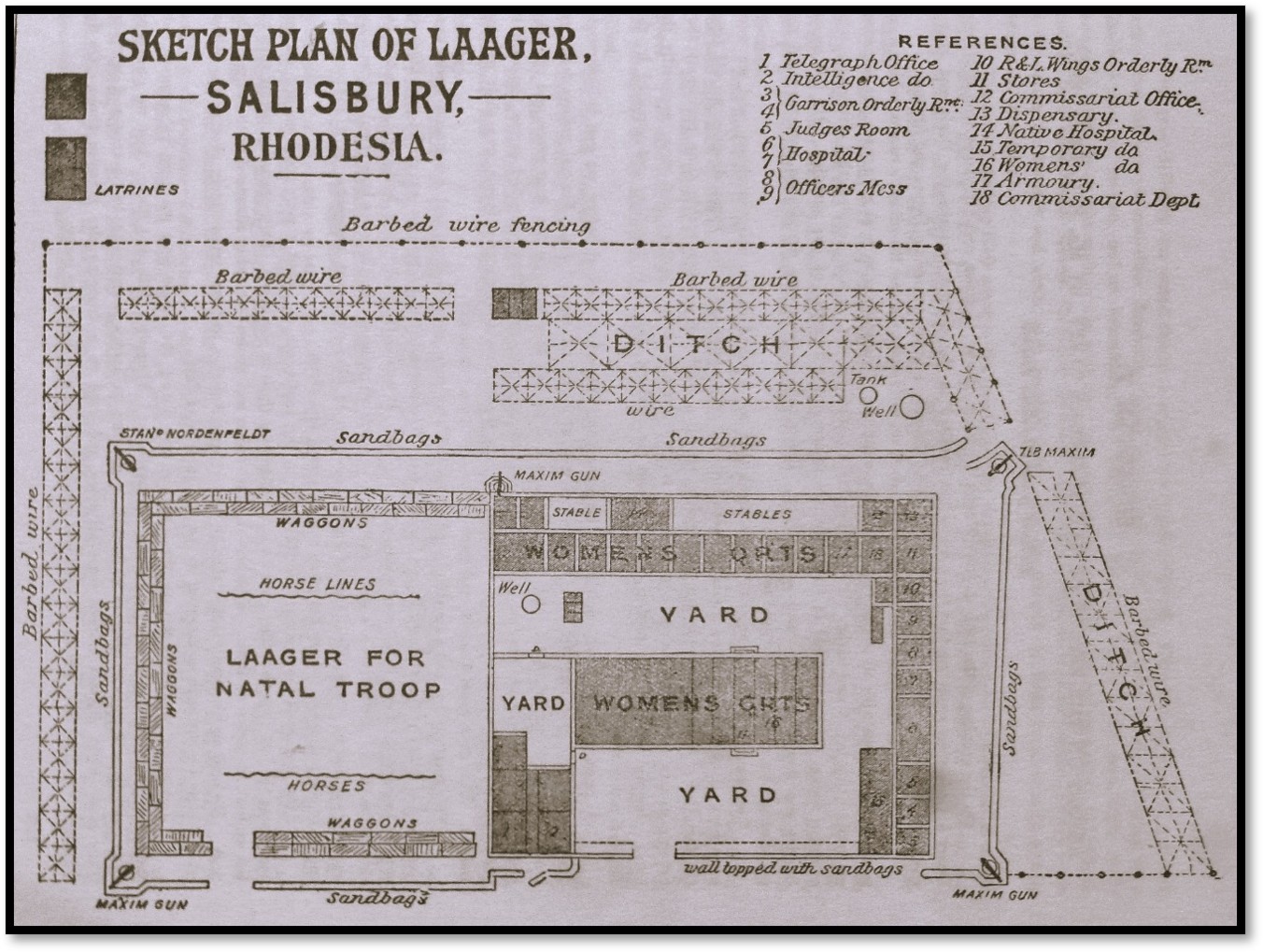
The ’96 Reports: Salisbury Laager
In August 1896 Lt-Col E.A.H. Alderson arrived in Salisbury with the Mounted Infantry and Mashonaland Field Force and from then on the Europeans went on the offensive. The same month Major Jenner burnt down Chief Chikwakwa’s kraal.
It was usual for chiefs to supply the spirit mediums with young girls as servants and when Chief Mashayamombe failed to do so, Kaguvi grabbed some women and in the fighting that followed two of Kaguvi’s followers were killed creating a serious fallout between them.
The authorities had at last recognised the importance of the spirit mediums to the Shona cause. Lord Earl Grey wrote to his wife, “Kaguvi is the witch-doctor who is preventing the Mashona from surrendering.” Whilst a Native Commissioner in Salisbury wrote, “If we capture Kaguvi, the war is over.” From then on the military began to exert increasing pressure on the areas where Kaguvi and Mkwati had set up their headquarters.[47]
With the significance of Kaguvi's role in the rebellion now known, the police established Fort Martin[48] opposite Chief Mashayamombe’s kraal on the northern bank of the Mupfure river and attempts were made to capture him. They were unsuccessful although the Kaguvi cave was dynamited and Headman Chena’s kraal burnt.[49] Another short-lived fort was established as Fort Mhondoro on the south bank of the Mupfure river.[50]
Forewarned by the Chishawasha Jesuits, Lieut. Harding went to Headman Cheshumba and offered a £100 reward for Kaguvi’s capture. Kaguvi’s wives passed through Headman Chiremba’s kraal and stolen cattle were driven through Headman Simbanoota’s kraal on 10 January. Three days later, Harding and twenty-five BSA Police burnt the kraal down. About 18 January 1897 Kaguvi fled the Umfuli area and made his way back to his old home in Headman Gondo's Kraal at Goromonzi.
Chief Chikwakwa and Headman Gondo went to the Mrewa (now Murewa) area.
News of his fleeing was brought to Fort Mhondoro the same day by two messengers from Chief Mashayamombe who was giving De Moleyns[51] most of his information. On 25 January, Earl Grey, H.M. Taberer and Maj. A.V. Gosling had fruitless talks with Chief Seke and finally realised that he was just obeying instructions from Kaguvi. They returned at dawn to Headman Cheshumba’s kraal and dynamited the caves. Then after a day’s rest, the force of seventy whites and thirty African BSA Police moved to Chief Chikwakwa’s, set up camp and started building a fort opposite the kopjes that dominated both Chief Chikwakwa and Headman Gondo’s kraals, to be named Fort Harding after its first commander. Negotiations began for a peaceful resolution.[52] They were unsuccessful, the kopjes were shelled with a seven-pounder and stormed although it seems the defenders had already fled.
Kaguvi managed to evade capture until October 1897 when he gave himself up to a Native Commissioner.[53]
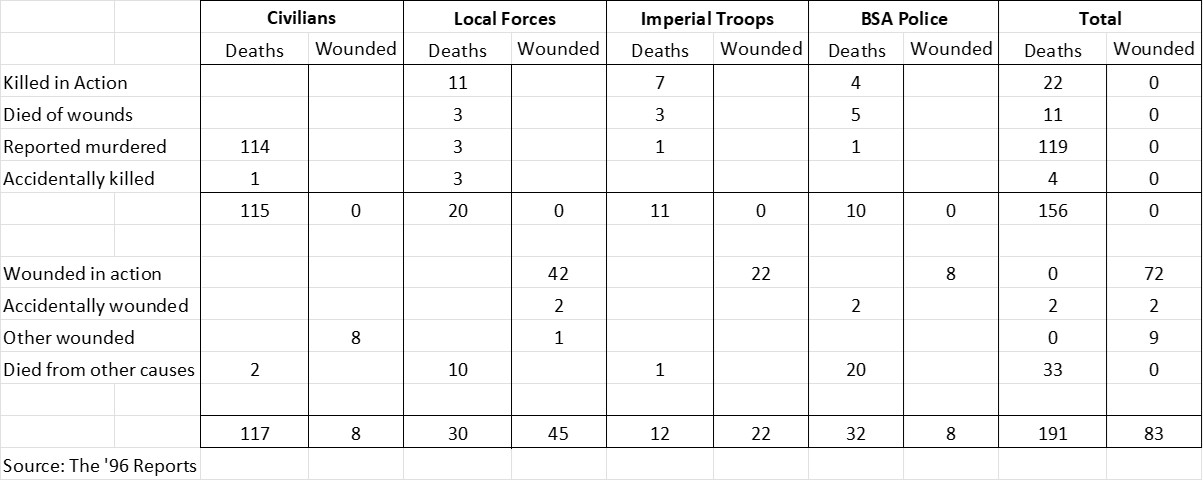
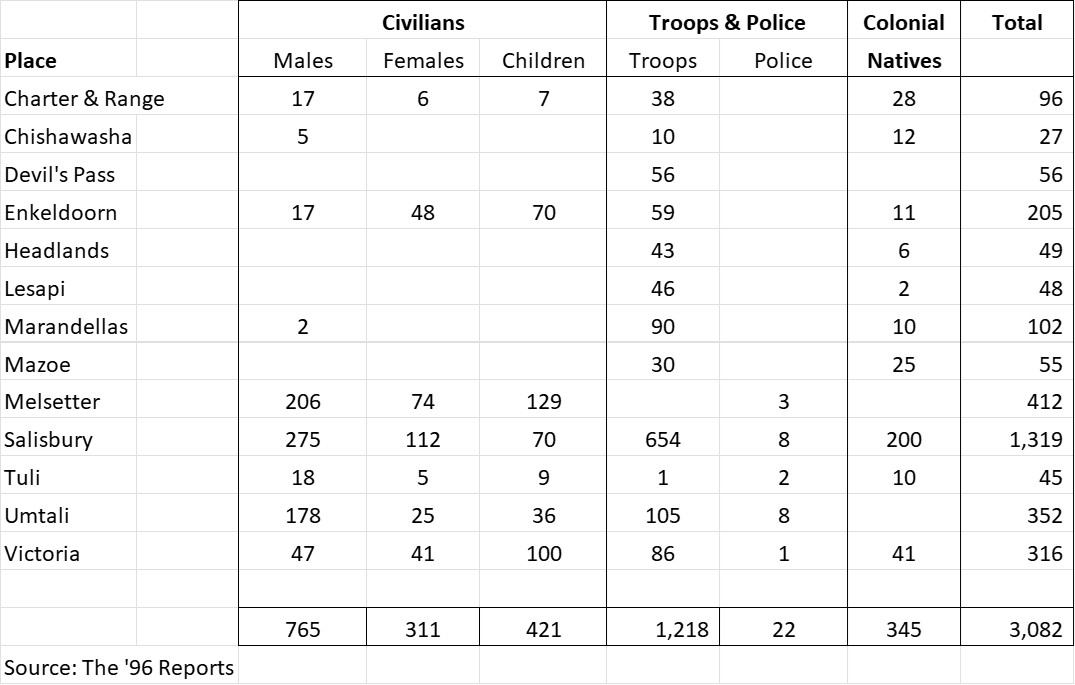
The numbers of Mashonaland casualties are tabled as Appendix 3 and the Mashonaland population as Appendix 4.
The trial of Kaguvi
The trials of Nehanda and Kaguvi have been thought to have taken place at the French South Africa Development (F.S.A.D.) Company building[54] that had been finished in June 1896 when it became the office chambers of lawyers and architects. However, It appears that the High Court moved into the F.S.A.D. building at some stage between the beginning of April 1898 and the end of that year and by that time their trials were concluded.[55]
Nehanda’s trial occurred in two stages, a Preliminary Examination being held by the Acting Magistrate C. Bailey, on 12 January 1898 and Spencer-Cook writes “there seems little doubt that this must have occurred at ‘The Court House.’[56]
Following the Preliminary Examination of Nehanda, Gutsa, Hwata and Zindongu, the Public Prosecutor, H.H. Castens, summonsed the witnesses and the accused to appear in the High Court on 20 February. Judge Watermeyer passed sentence on 2 March 1898.[57] [58]
Kaguvi was brought to trial on 2nd March and charged with the murder of a native policeman called 'Charlie' who had been taken to Kaguvi’s at Chief Mashayamombe’s kraal where he was accused of collaborating with the BSAC and ordered to be murdered. A witness recalled the event at the trial, “They killed him because he was a policeman. Kagubi ordered them to do it. I heard Kagubi give the order. I heard it with my ears. Kagubi’s words were, ‘Take Charlie and kill him. He is a bafu.’ The word bafu is interpreted as one who is not on our side. They caught Charlie and tied him up and took him away. They took Charlie towards the river. I then heard the reports of guns from the direction of the river. All four had guns with them when they took Charlie away. I saw smoke down near the river about 100 yards from where I was. Immediately after the shooting, the four came back. Charlie did not come back. The prisoners on their return said, We have finished him off.”[59]
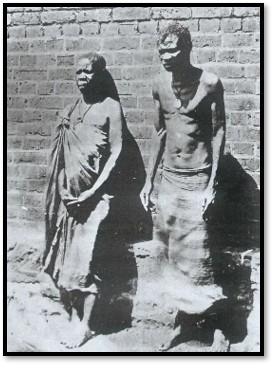
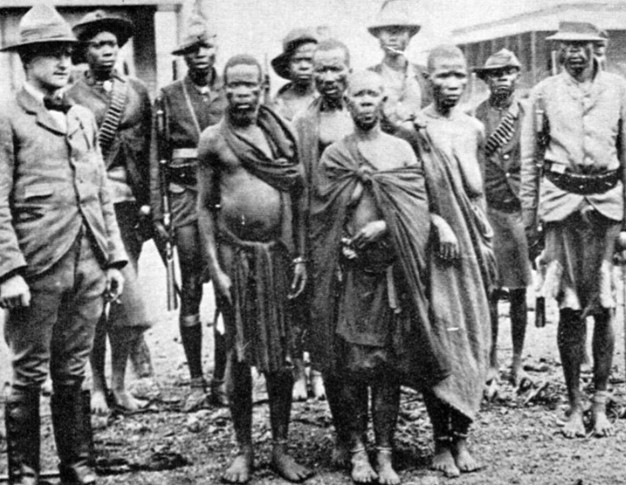
The Shona svikiro (spirit medium) Mbuya Nehanda with her spiritual husband Kaguvi after their capture in 1897
Additionally, during the trial of the Norton murders, one of the accused Tshikerima [Chikerema] was asked why the murders took place and replied, “The order came from Kagubi to murder all the white men. We were to kill all the white men. This was because Kagubi said the white men sent their police to thrash the Mashonas.”[60]
Nehanda and Kaguvi are the spiritual leaders of the Shona Rebellion or First Chimurenga
In March 1896, the Matabele Rebellion or Umvukela broke out under the spiritual leadership of Mukwati. In Mashonaland Mbuya Nehanda and Sekuru[61] Kaguvi led the resistance in Mashonaland becoming the spiritual leaders of the First Chimurenga against the settlers and British South Africa Company in 1896-7.[62] The Shona believed that Kaguvi (aka Kagubi) was Nehanda’s spirit husband and this relationship persuaded Mbuya Nehanda to rally the political leaders (the chiefs) to think in terms of conducting war against the settlers. The chiefs and the people believed Nehanda and Kaguvi spoke for the God Mwari.
Together they persuaded the chiefs and the people that the BSAC and settlers were the cause of all their troubles. The year 1896 was a year of disaster for large parts of south-eastern Africa. Drought triggered harvest failures that were exacerbated by swarms of locusts destroying the remaining maize and sorghum crops. Then followed the outbreak of rinderpest cattle disease that crossed the Zambesi river from the north sweeping through the region and destroying the local populations’ traditional store of wealth. Marquardt (2005) and Spinage (2012) believe the drought reduced the number of watering sites and feeding grounds and therefore contributed towards infective contacts between livestock and vulnerable wildlife. An almost total loss of cattle was observed in Southern Rhodesia with estimates ranging from 90-97% of cattle being destroyed (Marquardt 2005)[63] In addition, regulations issued by the BSAC stated that cattle that died from rinderpest were not to be eaten but had to be burned or buried and these regulations were enforced by the Native Commissioners.
Nehanda and Kaguvi preached that the white men were to be driven from the country; that the people had nothing to fear because Mwari would turn the bullets of the white man into water. Resistance was initially passive with villagers running away from Native Commissioners collecting tax, robberies of isolated farmsteads and a refusal to supply labour and general disobedience. This led up to the murders of David Enraght Moony[64] a Native Commissioner, at Mashongombi’s kraal near Hartley Hill on 15 June 1896; also A. Shell and John Stunt at Mashayamombe’s kraal and Harry Thurgood, formerly a Native commissioner on the same day.[65]
Many others would be murdered within the next few days including Henry Hawken Pollard (‘Kunjaira’[66]) the BSAC Native Commissioner for the Mazoe district, who was killed on or about 18 June 1896 while on patrol at Tamaringa’s kraal in the Mazowe Valley of Mashonaland.[67] The ’96 Reports say (incorrectly) that Pollard was killed by his own native policemen after he had thrashed Chief Chiweshe for failing to report cases of rinderpest amongst the cattle.[68] This created much resentment amongst the villagers; eye witnesses at her trial later confirmed that it was the spirit medium Nehanda who pronounced the death sentence.
Nehanda and Kaguvi’s capture signalled the end of the Shona Rebellion and Nehanda was charged with the murder of Native Commissioner Henry Hawkins Pollard. A public press photograph was taken of Nehanda and Kaguvi in 1897 by the BSA Police to show their successes in quelling the rebellion.
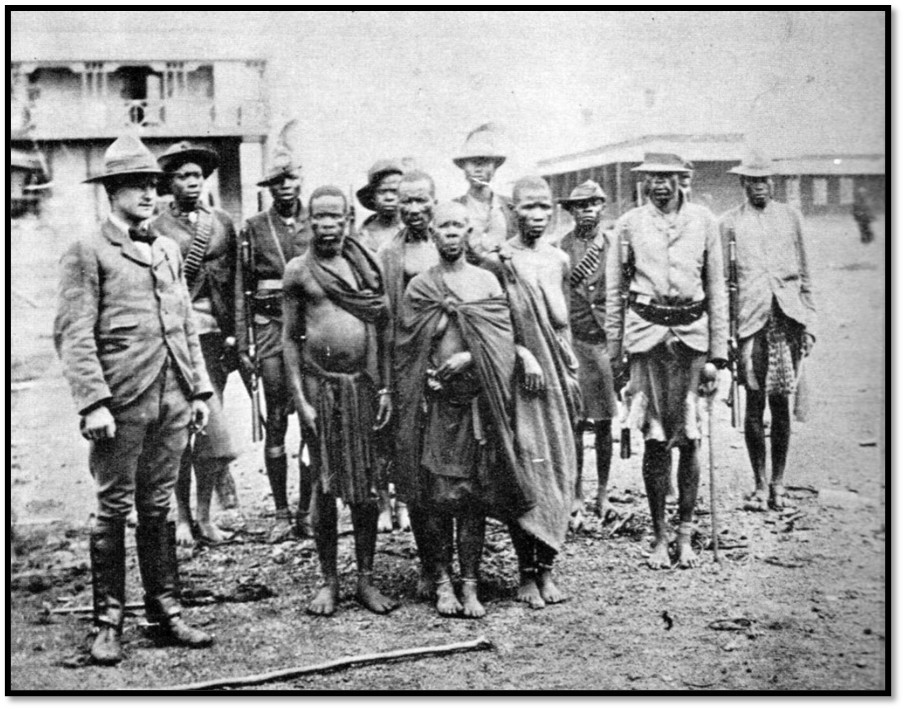
NAZ: Nehanda and Kaguvi are photographed after their capture
Trials and Execution
At the 1898 Criminal sessions the trial judge was Judge John P.F Watermeyer[69] who kept meticulous notes now preserved in the National Archives of Zimbabwe. Both Nehanda and Kaguvi were found guilty of ordering murders and sentenced to be hanged. The only surviving description of their execution comes from the Roman Catholic Jesuit Priest, Fr. Francis Richartz SJ who had been sent to Mashonaland as a missionary and tried to convert the prisoners to Christianity before their execution. He managed to convert Kaguvi after he had met his two daughters, Dziribi and Likande, at Salisbury gaol. He was able to baptise some of the others condemned to execution, but Nehanda refused to convert to Christianity and resisted right up to the moment when she was hanged. Fr. Richartz’ account of her execution is included as appendix 2 at the end of this article.[70]
The trial of Mbuya Nehanda
Four persons were initially charged with the murder of Native Commissioner Henry Pollard on about 18 June 1896.[71] They were Nehanda (spelt Nianda by the Judge) Hwata, Gutsa and Zindoga, but the last two escaped before the trial date. Her trial began on 21 February 1897.[72] Nehanda pleaded not guilty. Hwata replied, “I did it.” As the defending Counsel Murphy could not defend both of them with different pleas, he resigned, and as there was no other Counsel available in Salisbury, Judge Watermeyer continued with the accused unrepresented and entered not guilty pleas for both accused.[73]
The first witness was a Police Messenger who said he accompanied ‘Kunjira’ (Pollard’s African name) on a hunting trip in the Mazowe Valley. He stated on their return they were attacked at Chipadzi’s kraal but went on and Pollard sent two of his staff to buy sweet potatoes. They returned with other men who seized Pollard and took him and his messengers to Nehanda’s kraal. Pollard was made to sit in front of Nehanda and after some conversation, Nehanda shouted, “Kill him some way off - don't kill him close to the kraal.” His evidence continued, “They took Pollard away. They took me away also. There were a great many people. They took us some distance. They took us down to a little stream. Wata [Hwata] struck Pollard on the back of the head with a battle axe. Then Zindoga finished him off with a gun.”
The prisoners were asked to examine the witness. Nehanda said, “I deny giving the order. I have nothing to ask the boy.” Hwata said, “The witness is telling the truth.”
The next witness Mitsakadze confirmed the messenger’s testimony and added that Hwata had been reluctant to kill Pollard but was persuaded to do so by Nehanda.
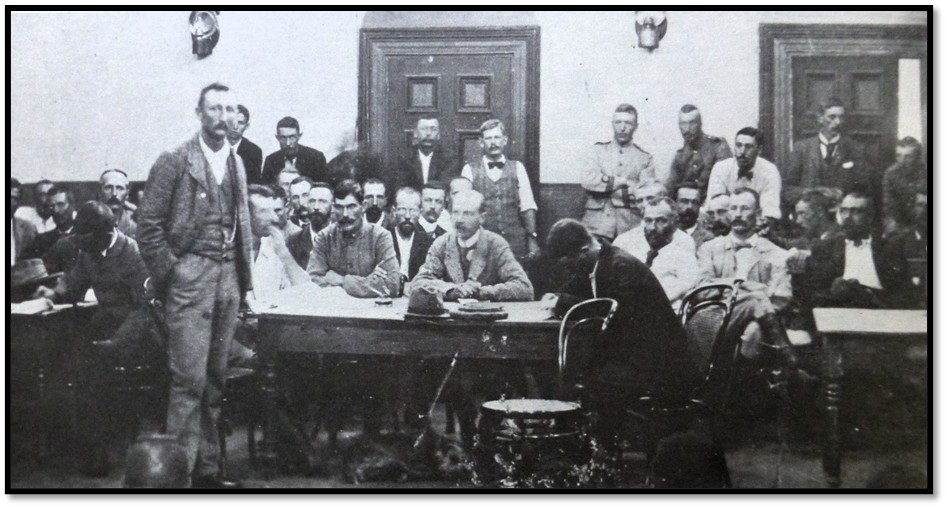
This maybe (unconfirmed) the 1898 courtroom scene at Nehanda’s trial. Standing W.E. Thomas; seated at table (L-R) Herbert J. Taylor, Hon Sir Arthur Lawley, Johan Colenbrander (in white suit) R. Townsend
The third witness confirmed the previous evidence but added the following on Nehanda’s influence in contemporary Shona society. “Nehanda was the chief of the kraal, Chitauro is her brother. Chitauro was the chief, but Nehanda has the power. Nehanda was over Chitauro. I don't know how we came to be under a woman. Nehanda is a Mhondoro. She gave orders, Chitauro obeyed her. All the people did what Nehanda told them. This has been for a long time. I know of no other woman who rules kraals…If people didn't do what Nehanda told them I don't know what would happen. I don't know of her punishing people. I was afraid of Nehanda. I was afraid to refuse to do anything, she told me. I don't know why I was afraid. I don't know of Nehanda punishing any member of the kraal.”
This evidence would have convinced the judge and assessors of the spiritual authority that powerful spirit mediums had over the people of Mashonaland at this time.
Other evidence was given by Native Commissioner (NC) Kenny, Chief NC Taberer, acting Magistrate Cecil Bayley and the District Surgeon before Nehanda was asked to address the court. She again denied sending Hwata to kill Pollard. “If I had sent him, I would own up to it. I have nothing more to say. It is not true that I gave this order to kill. It was called my kraal, but it is only a name.” Hwata who had consistently said the witnesses were telling the truth had nothing more to say.
The assessors summed up that Pollard was murdered. That Nehanda gave the order. That Hwata carried out the killing under fear of punishment if he disobeyed and recommended mercy for Hwata on the basis that he acted under fear of Nehanda.
Tried and sentenced to death on 5 March 1898,[74] she refused to convert to Christianity and struggled right up to the moment when she was hanged.[75] [76]
Nehanda and Kaguvi’s legacy
The legacy of the spirit mediums continued to be linked to the theme of resistance to colonial rule, particularly during the 1970’s guerrilla war. Nehanda’s name achieved prominence probably because she struggled to the end and did not convert to Christianity. Her name became of increasing importance to the nationalist movements in Zimbabwe.
Before she was executed, Nehanda is believed to have said her body would rise again to fight a second war of liberation. It is believed that Nehanda’s words, “My bones will rise again” predicted the second Chimurenga Uprising of 1964-1979, which ended with Zimbabwe’s independence.
In May 2021, a statue of Mbuya Nehanda sculpted by David Guy Mutasa was unveiled in Zimbabwe's capital city Harare along Julias Nyerere Way, where the road meets Samora Machel Avenue. Other commemorations include the names of hospitals and streets, novels, poems and songs.
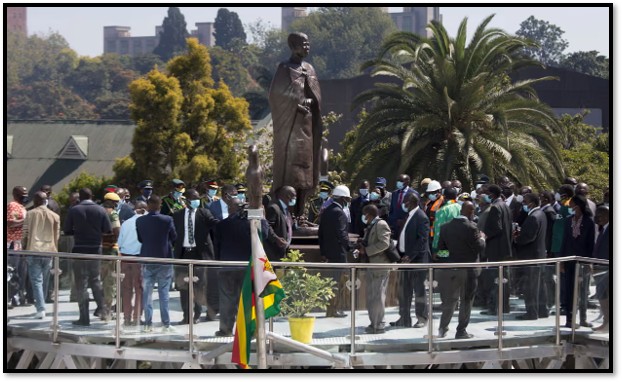
The Guardian: Mbuya Nehanda’s bronze statue at the junction of Samora Machel Avenue / Julius Nyerere Way
The unveiling of the monument sparked wide debate on social media, with many people questioning spending money on “non-essentials,” even though they agreed on the historical importance of Nehanda. “Ordinarily, honouring cultural and liberation heroes is a noble thing to do but I think it is a disgrace to do it at a time when Zimbabweans are going to bed on empty stomachs…It is a disgrace to do it at a time when Zimbabweans are going to hospitals without medication. It is a serious disgrace when we build statues when our youths do not have jobs…The person being honoured would have wanted people to have access to good medication.”
Appendix 1 – Mhondoro meaning
Mhondoro or Midzimu Mikurukuru are believed by the Shona to be spirits who roam the plains and forests as ‘lions’ awaiting a new life but in their lion state help people interpret Mwari's (God’s) wishes and desires and safeguard the welfare of the people. They will send plentiful rains and create good relationships amongst the community and supervise important ceremonies.
The original Mbuya Nehanda lived in the 15th century and possessed great spiritual powers and on her death was believed to have disappeared into a mountain, Gomo reNehanda and became one of the most important Lion Spirits.
In 1890 when the Pioneer Column occupied Mashonaland the Nehanda medium was Charwe Nyakasikana, a woman who lived in the Mazowe district of the country and whose influence was already quite widespread. Nehanda, along with two other Lion spirits (Mukwati in Matabeleland and Gumboreshumba (Kaguvi or Kagubi) in the Goromonzi / Mupfure area of Mashonaland) found herself organizing and directing her people's resistance to foreigners. In fact, the mhondoro effectively conveyed to the chiefs and their people that Mwari, their supreme God, unmistakably disapproved of the white presence and demanded that they be removed from the land and they became the organisers and spiritual leaders behind the Shona Rebellion or First Chimurenga.
Appendix 2 – Fr Francis Richartz SJ. “The End of Kakubi and the other Condemned Murderers” that appeared in the Zambesi Mission Record of November 1898 Vol 2 P53–55.
Kakubi [Kaguvi] the leader of the Mashona rebels and the instigator of the Mashona rising, was sentenced to death for the murder, or rather for ordering the murder of a native who had been employed by white men. With him were condemned Neanda [Nehanda] the famous "prophetess" of the Mazoe and eleven others.
The date of their execution, after having been several times altered, was finally fixed for the following dates, April 27th and 29th, and May 3rd and 12th. [1898] On several previous days I visited the different murderers in prison and spoke to them of their approaching death, exhorting them to listen to my instructions and so make a good end. All of them hoped against hope till the last that they would regain their liberty, or that at least their sentence would be commuted into penal servitude.
For good reasons, I abstained from visiting Neanda till the day of execution was at hand, as she would have given much trouble to the warders by her hysterics and restlessness. However, when I did speak to her she listened willingly and quietly.
During the first days I used to instruct all the condemned prisoners together, except Kakubi and Neanda, who were kept separated from the others. The other eleven prisoners seemed to like what I told them, but Kakubi refused to listen to me. As soon as I began to speak about religious subjects, he would say, "Go to the others; I refuse." It is probable that he hoped to induce me to secure his freedom, as he believed that I could obtain it if I only wished to do so. He promised me ten head of cattle, his children etc., if only I would get his sentence changed.
On Saturday, April 23rd, I went to Chishawasha with Fr. Moreau after I had seen and instructed the prisoners and I returned on the Monday following. As Dziribi, Kakubi's daughter, one of our school-girls, wanted to see her father before his death, I asked permission for her from the acting Magistrate, Mr Bayley, and called her to town on the Tuesday. She arrived in the afternoon with her sister, Likande, and I went with them and our native Christian boy, Victor, to the gaol and had a conversation with Kakubi, who had given me, in the morning, some hope of changing his mind, when he should see his child. The conversation with Kakubi, during which Victor and Dziribi did their best to induce him to yield and listen to my instruction and receive baptism had the good result that Kakubi promised to do as they asked and when the children had gone and I talked with him alone, he assented and even asked me to promise him that he should not die without having been instructed and baptized by me.
I had been asked in the morning by the gaoler to inform the four prisoners, Kakubi, Neanda, Mashanganiyka [Mashonganyika] and Muzampi who were to be executed next morning that their time had come. Kakubi showed fear and began to cry. Mashanganiyka and Muzampi took the news quietly. To Neanda I did not speak till evening, in order to avoid a scene, though I had a long quiet talk with her which made me feel even hopeful. However, when in the evening about 6 o'clock I saw her again and in the presence of Victor who tried his best to persuade her to listen to me, told her that she had to die next morning, she began to behave like a mad woman. She took her blankets and wished to leave the cell and when told to remain and keep quiet she refused and said she never would endure to be locked up. When we saw that nothing could be done with her I went away with Victor, and Neanda began to dance, to laugh and talk, so that the warders were obliged to tie her hands and watch her continually as she threatened to kill herself.
On Wednesday April 27th, the Feast of Blessed Peter Canisius I said an early Mass and drove to the gaol, where I found the officials ready and everything prepared. I again made an attempt to speak to Neanda and bring her to a better frame of mind, but she refused, called for her people and wanted to go back to her own country, the Mazoe and die there, and behaved as she had done the night before. When I saw that nothing could be done with her the time for the execution having arrived, I left Neanda and went to Kakubi who received me in good dispositions. Whilst I was conversing with him Neanda was taken out to the scaffold. Her cries and resistance when she was taken up the ladder, the screaming and yelling on the scaffold disturbed my conversation with Kakubi very much, till the noisy opening of the trap-door upon which she stood, followed by the heavy thud of her body as it fell, made an end to the interruption.
Though very much frightened Kakubi listened to me and repeated that he would no longer refuse to receive Baptism. After he had made the necessary acts of faith, repentance, etc., I baptised him, giving him the name of the good thief, Dismas, with whom he was to share the great blessing of forgiveness in the hour of death. I had to promise him again that I would take care of his family and after I had given some suitable exhortations to die well and to continue making acts of faith and repentance, the hangman came and did his duty, whilst I went to the next to be executed, Mashanganiyka. Kakubi did not give the least trouble nor did he make any lamentation. He died as he had been told the evening before by Victor to die, quiet and resigned and as I hope, in good dispositions.
The next two, Mashanganiyka and Muzampi, were very well disposed. When I entered the cell of the former, he rose and saluted me in a very friendly and cheerful manner and answered all my questions very satisfactorily. He asked me to look after his children and tell them that he was dead. I baptised him John Edward. He died quietly. Muzampi being somewhat stupid and rather deaf was more difficult to prepare; but he listened readily to my exhortations, taking his death willingly and was baptised Peter Canisius. In climbing up the ladder he seemed to be frightened and repeated, "I have been deceived (or rather seduced) by Kakubi," and also their usual cry - "Baba 'we Zogo."
After some time had elapsed and the last body had been taken down and placed with the others in the gaol hospital and inspected by the authorities, they were all covered up and I said the funeral service over them. Death was in every case instantaneous. All the officials and warders were very kind and obliging, which was a great help to me.
Everyone felt relieved after the execution as the very existence of the main actors in the horrors of the rebellion, though they were secured in prison, made one feel uncomfortable as though they might still be able to create difficulties.
In the afternoon I visited the remaining nine murderers, but I found them excited and restless, in consequence of the executions in the morning, and indisposed to listen to instruction. I therefore left them alone for that day and proposed to keep Victor at the gaol and see them next day in his presence, at least the four who were to be next executed on Friday April 29th. On the morning of Thursday, April 28th, I went with Victor to the gaol and saw the two murderers of the Nortons, Maremba and Ndowa and also Zwidembo and Maremba, the murderers of Austin and Steele. Victor very fluently repeated my instructions, removed their doubts and difficulties and in the end they seemed well disposed and willing to die as children of God. In the afternoon I again saw them and found them fully determined to do what they had promised in the morning and they were glad when I assured them that they would certainly not die before having been instructed and baptised by me. Victor's confirmation of what I had said had a visible influence on their resolutions. I saw them again in the afternoon and they listened readily to my instructions.
On the morning of Friday, April 29th, the Feast of St. Peter Martyr, O.P., I was in gaol about 5.20 and had ample time to talk to the four men. They were quiet and resigned and clearly expressed their wish to be baptised and to go to heaven. I baptised Maremba, Joseph Peter (Martyr); Ndowa, Joseph Barnabas; Zwidembo, Joseph Thaddeus; and Gundusa, Joseph Thomas. All of them and more especially the two last, died quietly and with resignation. Whilst they were undergoing their sentences, I said the prayers for the dying and afterwards the burial prayers over their dead bodies in the gaol hospital.
Of the other four murderers, Mvenuri and Mashindu, Monyongani and Chiriscre who were executed on Monday, May 2nd, I succeeded in persuading only the last two to receive Baptism. The other two flatly refused.
There are several other murderers in gaol awaiting their trial and I have lately received official notice that nine others, recently condemned to death, are to be executed on the 29th, 30th, and 31st of August; three each morning. Francis Richartz, SJ.
Fr. Francis Richartz wrote another article “More about the condemned Murderers in Mashonaland” in The Zambezi Mission Record of May 1899 Vol 4 P127-8 that gives a further account of the execution of a further eight condemned men on 27, 30 and 31 August 1898.
Appendix 3 - European Civilian and Military Casualties during the Mashona Uprising / First Chimurenga
Appendix 4 - Population of Mashonaland as at 31 October 1896
References
E.A.H. Alderson. With the Mounted Infantry and the M.F.F. 1896. Books of Rhodesia, Byo 1971
D.N. Beach. An Innocent Woman, Unjustly Accused? Charwe, Medium of the Nehanda Mhondoro Spirit, and the 1896-97 Central Shona Rising in Zimbabwe. History in Africa Vol 25 (1998) P27-54. https://www.jstor.org/stable/3172179
D.N. Beach. Kaguvi and Fort Mhondoro. Rhodesiana Publication No 27, December 1972. P29-47
Encyclopedia of African Religion
https://sk.sagepub.com/ency/edvol/africanreligion/chpt/nehanda#_
C. Harding. Far Bugles. Simpson Marshall Ltd, London 1933
Victor Maphosa. The Herald. 15 Feb 2020. Mbuya Nehanda shrine under threat. https://www.zimbabwesituation.com/news/mbuya-nehanda-shrine-under-threat/
Linet Mutema. Symbols, History and Archaeology of Resistance - The Kaguvi Hill: a Century After the First Chimurenga. Heritage of Zimbabwe Publication No 15, 2011. P117-120
Fr Francis Richartz. Zambesi Mission Record of November 1898 Vol 2 P53–55. The End of Kakubi and the other Condemned Murderers. https://www.rhodesianstudycircle.org.uk/wp-content/uploads/2022/06/ZMR-1-4-May-1899_compressed.pdf
The ’96 Rebellions; the British South Africa Reports on the Native Disturbances in Rhodesia, 1896-97. Books of Rhodesia, Silver Series, Vol 2. Bulawayo 1975
A. M. Spencer-Cook. F.S.A.D. Building: and the trial of Mbuya Nehanda. Heritage of Zimbabwe Publication No 2, 1982. P7-14
J. Waters. A Note on the Josiah Tongogara Msasa. Heritage of Zimbabwe Publication No 30, 2011. P117-8
Wikipedia. Nehanda Charwe Nyakasikana. https://en.wikipedia.org/wiki/Nehanda_Charwe_Nyakasikana
R.H. Wood. Kagubi: Why is he forgotten? Heritage of Zimbabwe Publication No 3, 1983. P41-46
R.H. Wood. The 1898 Criminal Sessions. Heritage of Zimbabwe Publication No 6, 1986. P47-58
Notes
[1] See the article The Mutapa (Mwenemutapa, Monomotapa) State in its heyday c.1480 – c.1623 under Mashonaland Central Province on the website www.zimfieldguide.com
[2] An Innocent Woman, Unjustly Accused? Charwe, Medium of the Nehanda Mhondoro Spirit, and the 1896–97 Central Shona Rising in Zimbabwe
[3] See Appendix 1 on the significance of Mhondoro
[4] Plural of svikiro is masvikiro
[5] Spirit mediums are not to be confused with a witch or wizard, muroyi, nor a witch-finder or herbalist, n'anga
[6] An Innocent Woman, Unjustly Accused? Charwe, Medium of the Nehanda Mhondoro Spirit, and the 1896-97 Central Shona Rising in Zimbabwe
[7] An Innocent Woman, Unjustly Accused? Charwe, Medium of the Nehanda Mhondoro Spirit, and the 1896-97 Central Shona Rising in Zimbabwe, P29
[8] Beach writes that Chidamba who lived in the present-day Christon Bank area (‘Granite Hills’ as opposed to the Iron Mask Range) was not the Hwata Chief
[9] Ibid, P30
[10] Members of the Pioneer Column were not paid, but each received a land grant of 3,000 acres (1,214 hectares or 12.14 sq. kms) with options to buy more cheaply and the right to claim 15 mining claims as a reward for settling the country for the British South Africa Company. Most sold their farms to speculators such as the firm of Johnson, Heany and Borrow; their Borrowdale Estates extended to over 22,275 hectares (55,043 acres) The Society of Jesus was granted over 10,000 hectares (25,000 acres) of land about 25 kilometres northeast of present-day Harare
[11] Later known as ‘chibaro labour’ and best described through Charles van Onselen’s book Chibaro: African Mine Labour in Southern Rhodesia, 1900-1933 that details the exploitative, often forced, system of Black African migrants in the mines of Southern Rhodesia (present-day Zimbabwe)
[12] An Innocent Woman, Unjustly Accused? Charwe, Medium of the Nehanda Mhondoro Spirit, and the 1896-97 Central Shona Rising in Zimbabwe, P34
[13] Ibid, P52
[14] Revolt in Southern Rhodesia
[15] An Innocent Woman, Unjustly Accused? Charwe, Medium of the Nehanda Mhondoro Spirit, and the 1896-97 Central Shona Rising in Zimbabwe, P52
[16] Ibid, P38
[17] Ibid, P40
[18] Ibid, Report of Capt McMahon
[19] Ibid, P41
[20] Beach writes that in January 1898 Nehanda claimed to be 36 years old. He says the connection with the word Mbuya (an old woman) started with a later version of the Nehanda spirit medium in 1959
[21] See the article Fort Haynes and the fight at Chief Chingaira Makoni’s Kraal under Manicaland province on the website www.zimfieldguide.com
[22] See the article Baden-Powell in Matabeleland during 1896 where he learned the principles of Scouting under Bulawayo on the website www.zimfieldguide.com
[23] On the 25 February 1898 47 prisoners escaped in a mass gaol break and were not recaptured
[24] There were deaths in gaol including those of Mutekedza, Svosve, Rusike and Hwata
[25] An Innocent Woman, Unjustly Accused? Charwe, Medium of the Nehanda Mhondoro Spirit, and the 1896-97 Central Shona Rising in Zimbabwe, P46
[26] An Innocent Woman, Unjustly Accused? Charwe, Medium of the Nehanda Mhondoro Spirit, and the 1896-97 Central Shona Rising in Zimbabwe, P53
[27] Kagubi: Why is he forgotten?
[28] On most European sixteenth century maps this area is named as Butua
[29] Guruuswa means ‘long grass’ in Shona
[30] Kagubi: Why is he forgotten? P41
[31] Mudzimu is a Shona term for an ancestral spirit or spirit of a deceased person
[32] Beach writes that the cave at the summit of the hill standing above the Mupfure river pool that never dries up gave the site great importance for the Shona and formed an obvious choice for a spirit medium’s shrine
[33] Symbols, History and Archaeology of Resistance - The Kaguvi Hill: a Century After the First Chimurenga
[34] See the article Fort Harding, Chief Chikwakwa and Headman Gondo’s kraals and Warrendale Farm Police Camp under Mashonaland East on the website www.zimfieldguide.com
[35] Kaguvi and Fort Mhondoro, P33
[36] Chimurenga means war of liberation
[37] The Ayrshire Mine was about thirty kilometres north of Banket
[38] Major Percy Sidney Inskipp (1871 – 1941) rose to commercial manager of the British South Africa Company
[39] The ’96 Reports, P51-2
[40] The BSACo Notice was issued in the Government Gazette of 15 April 1896
[41] See the article The Selous Road, Balleyhooley Hotel, and the Ruwa and Goromonzi districts by Rob Burrett in Heritage of Zimbabwe Publication No 17, 1998. P108-120
[42] The Indian traders bodies were seen by Native Commissioner Moony before most of his native police deserted and he was also shot and killed
[43] Six Mile Spruit was where the Pioneer Column crossed on 11 September 1890 where there was a firm shelf across the stream close to the present Seven-Mile Hotel on the Salisbury-Beatrice road. (Source: E.E. Burke. Fort Victoria to Fort Salisbury. The latter part of the Journey of the Pioneer Column in 1890. Rhodesiana Publication No 28, July 1973, P1-15)
[44] The ’96 Reports, P141-2
[45] Kaguvi and Mhondoro, P38
[46] The ’96 Rebellions: Salisbury and Mazoe Districts, P55
[47] Ibid, P119
[48] See the article Chief Chinengundu Mashayamombe’s stronghold, Fort Martin and Cemetery under Mashonaland West on the website www.zimfieldguide.com
[49] In 1972 Kaguvi Hill was declared a National Monument in terms of Section 9 of the Monuments and Relics Act (Chapter 70).
[50] D.N. Beach, Kaguvi and Fort Mhondoro, Rhodesiana No. 27, December 1972. From a garrison of approximately 100 men on 1 February 1897 numbers were reduced to 24 men on 12 March 1897
[51] Frederick Eveleigh-de-Moleyns, 5th Baron Ventry along with Robert Baden-Powell were put in charge of creating a new police force in Mashonaland.
[52] See the article Fort Harding, Chief Chikwakwa and Headman Gondo’s kraals and Warrendale Farm Police Camp under Mashonaland East on the website www.zimfieldguide.com
[53] Kagubi: Why is he forgotten?
[54] F. S.A.D. Building: and the trial of Mbuya Nehanda
[55] Ibid, P12
[56] The Court House was situated opposite the Market Square at 86 Victoria Street, at the comer of Victoria Street (now Mbuya Nehanda Street) and Bank Street on the northern side of the Market Square but the original Court House was demolished and replaced
[57] High Court of Matabeleland Criminal Sessions, February. 1898, Case No. 252, Regina v. Zindongu, Wata, Nehanda and Gutsa
[58] Spencer-Cook states the death sentence was passed on 5 March 1898
[59] The 1898 Criminal Sessions, P50
[60] Ibid, P49
[61] Sekuru means “grandfather or uncle” in Shona
[62] See the article The part played by religion in the Mashona Rebellion (First Chimurenga) in 1896-7 as told by Terence Ranger in Revolt in Southern Rhodesia 1896-7 under Mashonaland East on the website www.zimfieldguide.com
[63] See the article by K. Pribyl, D.J. Nash, J. Klein, G.H. Endfield entitled The Role of Drought in Agrarian Crisis and Social Change: the Famine of the 1890’s in South Eastern Africa
[64] Spelt Mooney in the ’96 Rebellions. It was NC Moony who said he. "taxed Old Mashayingombi with this, but he informed me that he had only sent down to the Matabele 'Umlimo' for some medicines to prevent the locusts from eating his crops next year."
[65] The ’96 Rebellions, P138-143
[66] Kunjaira in Shona ‘One who walks jerkily or without dignity’
[67] See the article The June 1896 Mazoe Patrol skirmish with detailed accounts from those besieged and their Mashona attackers under Mashonaland Central on the website www.zimfieldguide.com
[68] Beach (An Innocent Woman, Unjustly Accused? Charwe, Medium of the Nehanda Mhondoro Spirit, and the 1896-97 Central Shona Rising in Zimbabwe, P32) writes that the Native Commissioner Pollard who arrived in April 1895 was notorious for tax collections and forced labour and his use of the sjambok
[69] Judge Watermeyer had four assessors: Messrs Aria, Eustace, Homan and van Praagh
[70] Appendix 2
[71] The ’96 Rebellions, P147
[72] F.S.A.D. Building: and the trial of Mbuya Nehanda, P12. Although the court records state 20 February 1898; the 20th was a Sunday and the trial was in 1897
[73] Heritage of Zimbabwe Publication No 6, 1986. P50-52
[74] F.S.A.D. Building: and the trial of Mbuya Nehanda, P12
[75] For Fr Francis Richartz’s account see Appendix 3 of this article
[76] Jono Waters confirms that the hangings were carried out in the gaol at Victoria street, present-day Mbuya Nehanda Street in his article A Note on the Josiah Tongogara Msasa that was printed in Heritage Publication No 30 (2011) P117