
- Entry fee
- n/a
What is the current concern?
Most local and international observers are convinced that Zimbabwe has now slid into an entrenched dictatorship led by President Emmerson Mnangagwa that seeks to perpetuate the authoritarian and repressive rule of ZANU-PF
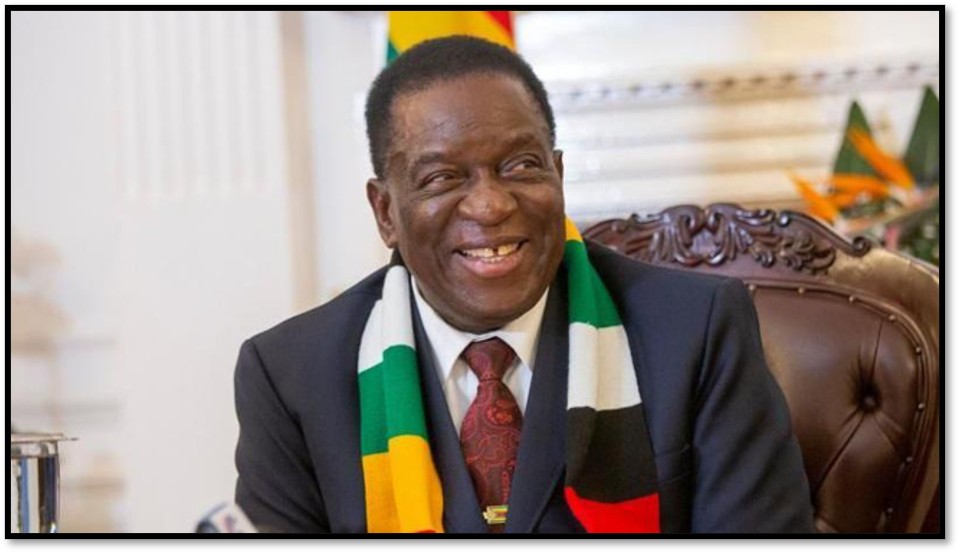
Zimbabwe’s third President since 1980 – Emmerson Mnangagwa
The legacy of Robert Mugabe
Following elections on 18 April 1980 Robert Mugabe became the first Prime Minister of an independent Zimbabwe. The first President was Canaan Banana, a Methodist minister and politician. In 1987 he was accused of being a homosexual and after a trial convicted of eleven counts of sodomy and sentenced to ten years in jail, nine years suspended, but he actually only served six months in prison.[1] In 1987 his largely ceremonial post was taken over by Mugabe, who made himself executive President
Over nearly four decades of rule (1980–2017) Robert Mugabe transformed Zimbabwe from a once prosperous nation into one characterised by massive unemployment and hyper-inflation brought about by the seizure of thousands of white-owned farms (fast track land reform) that resulted in the collapse of agriculture – the backbone of the economy.[2]
As opposition to his rule intensified over the years Mugabe maintained his grip on power through a combination of violence, oppression through the state security forces and electoral fraud. His years in office are remembered for:
· The Gukurahundi Massacres: the North Korean-trained Fifth Brigade was used in the early 1980’s to crush the Zimbabwe African People’s Union (ZAPU) in Matabeleland, killing an estimated 20,000 Ndebele civilians.[3]
· Political Repression: through ZANU-PF he used the state security forces, police and party youth militias to violently suppress political opponents and employed sophisticated foreign organisations to rigg the voter’s rolls and hijack the elections in 2002, 2008 and 2013.
· Aggressive Disfranchisement: he developed laws, policies and tactics designed to strip individuals or specific demographics of their civil rights—most notably, the right to vote through campaigns such as Operation Murambatsvina (in Shona ‘clear the filth’) in 2005 which forcibly cleared urban slums and displaced 700,000 people to punish urban voters who supported the opposition.
· Marginalization: laws were passed including a constitutional ban on same-sex marriage and criminal penalties for consensual same-sex acts between men.
Robert Mugabe’s legacy descended from a celebrated anti-colonial liberation hero into an autocratic dictator who plunged Zimbabwe into economic ruin.
After 37 years Mugabe is removed from office by Emmerson Mnangagwa
In November 2017 President Mugabe was removed from office in a bloodless military coup by Emmerson Mnangagwa.[4] Mugabe went after a succession battle between his wife, Grace, and Mnangagwa’s faction. The military settled this struggle decisively, putting Mugabe under house arrest at his ‘blue roof’ mansion and Grace fled the country with Mnangagwa installed as acting president. However, it is clear in retrospect the Mugabe was removed from office not to change Zimbabwe’s political system, but simply to perpetuate ZANU-PF’s continued rule.
Many citizens and international observers cautiously hoped that the southern African nation of Zimbabwe would find its way from dictatorship to democracy. Mugabe had been a violent, repressive ruler and Mnangagwa – whose nickname is “the Crocodile” – was vice president and enforcer. In the weeks since the election the government ruthlessly cracked down on the opposition. Police had beaten and arrested dozens of Chamisa supporters and groups of Mnangagwa’s youth militia had conducted house-to-house searches for opposition leaders.[6]
However, the announced 2018 results were disputed by MDC alliance and critiqued internationally as a flawed election process, including: the Zimbabwe Election Commission’s lack of independence, heavily biased state media favouring the ruling party, voter intimidation, the unconstitutional influence of tribal leaders, failure to provide an electronic preliminary voters roll, politicization of food aid, security services’ excessive use of force and lack of transparency concerning election results.[7]
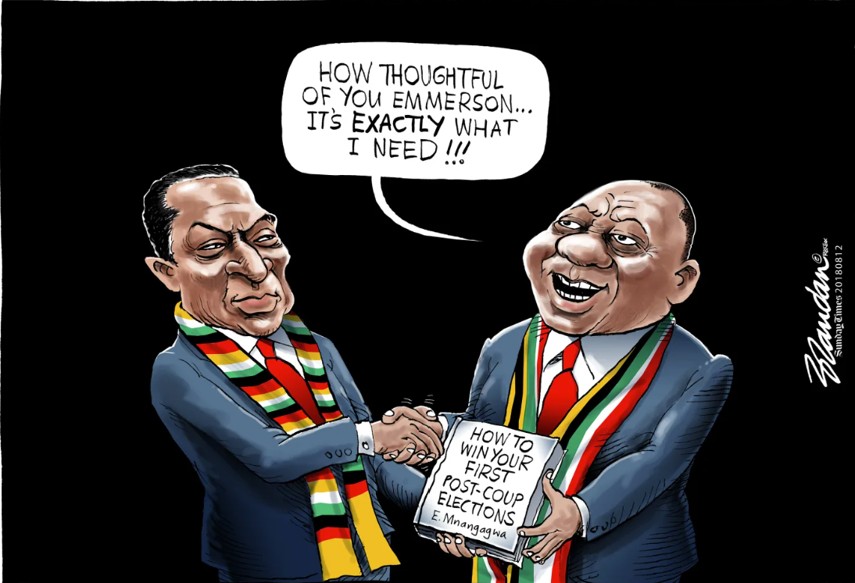
Brandon in The Sunday Times, 12 August 2018. President Cyril Ramaphosa attends the inauguration ceremony of Zimbabwe’s president-elect Emmerson Mnangagwa…
Was President Emmerson Mnangagwa the mastermind behind the Gukurahundi?
The Gukurahundi massacre of Ndebele civilians was perpetrated by the 4,000-strong all-Shona Fifth Brigade of the Zimbabwean National Army led by Perrance Shiri. Emmerson Mnangagwa had oversight over both the army’s Fifth Brigade and the Central Intelligence Organisation (CIO) in his role as Minister of internal security and Chairman of Zimbabwe’s Joint High Command. He reported directly to Mugabe. President Mnangagwa has however denied accusations he played an active role in Operation Gukurahundi.
Since election as President, Mnangagwa has been determined to stay in power indefinitely
When elected President Mnangagwa[8] referred to the importance of human rights and invited international observers and local NGO’s to monitor future elections whilst at the same time ensuring that ZANU-PF stayed in power for the foreseeable future. The repressive methods taken by President Mnangagwa to ensure he stays in power include:
Targeting the Opposition and Civil Society: Opposition leaders, human rights lawyers and independent journalists face persistent harassment, arbitrary arrests and denial of bail. High-profile opposition figures have repeatedly been detained for posting messages on social media that are described as "inciting public violence." The main challenge facing President Mnangagwa and the one that he has overcome through the legislation enacted in 2026 is public opposition to ZANU-PF.
Electoral Engineering: Independent monitors have reported that past general elections have been deeply flawed.[9] For example, the voter registration roll was not released by the Electoral Commission until it was too late for voters who discovered their names were missing to re-register.
Voter intimidation has been widespread, especially in rural areas, where security forces have been used to ‘remind’ people to vote – for Mnangagwa.
State-controlled media has relentlessly broadcast pro-Mnangagwa and ZANU-PF messages.
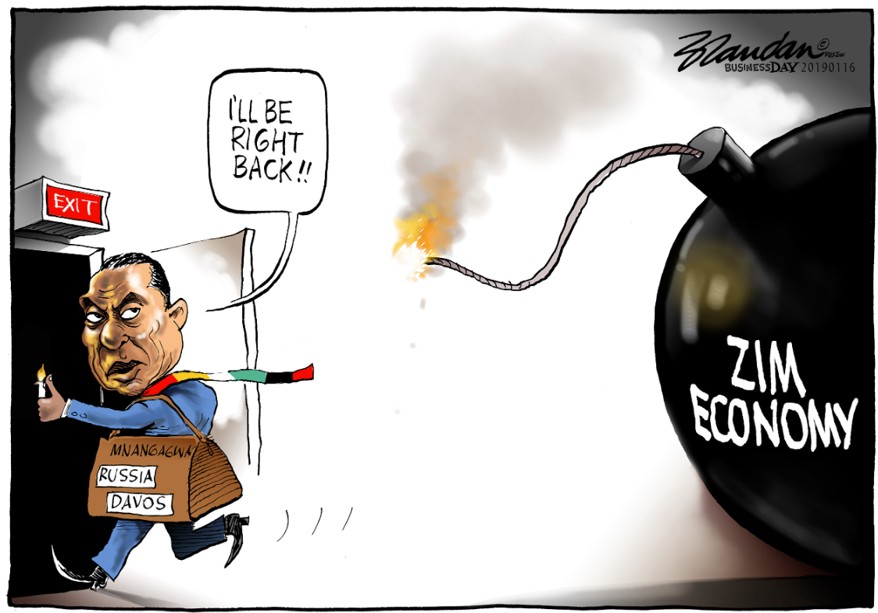
Business Day, 16 January 2019. President Emmerson Mnangagwa AWOL as Zimbabwe burns…
A timeline to dictatorship in Zimbabwe
2018-19 Post-Election Violence and use of military force
The deception of democracy quickly melted away following the July 2018 harmonised elections.
- August 2018 Shootings: State security forces killed six unarmed citizens in protests following the elections[10]
- 2019 Protest Crackdown: widespread demonstrations brought about by fuel price hikes and the economic collapse of the economy were put down violently by riot police backed up by the defence forces. It became clear that the new state policy was that public protests would be put-down by the military.
- Security Sector Integration: security forces would be secretly embedded within civilian institutions, including newspaper, radio and TV and the Zimbabwe Electoral Commission.
Zimbabweans are not cowards with a vast number critical of ZANU-PF’s mis-rule. The fact is that all activist protest by individuals in Zimbabwe is violently crushed by anti-riot police and protesters thrown into jail, civil society NGO’s are threatened with ruinous litigation. For most Zimbabweans the only real form of protest they can make is to flee the country and join the diaspora.
2020-22: Institutional Capture and legal warfare
The ZANU-PF government shifted tactics from crude violence to ‘lawfare,’ using the justice system and legislative to hamstring political rivals.
- Judicial capture: constitutional amendments granted the president direct power to appoint senior judges, eliminating their role as an independent check on the executive
- Wear down the Opposition: The state exploited any internal differences within the opposition parties using the courts to strip the main opposition party (MDC Alliance) of its headquarters, state funding and parliamentary seats, allocating them to friendly factions.
- Civil society restrictions: COVID-19 rules were used to impose heavy-handed regulations that criminalized public protests, independent journalism[11] and NGO operations
- State Violence: Opposition leaders, lawyers and human rights activists face targeted intimidation, arbitrary arrests and physical violence by state security forces if they challenge constitutional changes.
2023: a flawed election and parliamentary fraud
The August 2023 elections were totally flawed through:
- Electoral Disfranchisement: voters were intimidated in opposition strongholds and voter rolls were withheld until the last minute
- Regional Condemnation: The Southern African Development Community (SADC) observer mission declared that the elections failed to meet international and regional democratic standards.
- Parliamentary recalls: the ruling party used a political loophole to force opposition politicians out of office and replace them with their own members, giving them complete control over the country's laws.
Legislation passed in 2023 through the heavily criticized ‘Patriotic Bill’ imposed harsh penalties of up to twenty years in prison for any citizens convicted of ‘undermining the sovereignty’ of Zimbabwe.
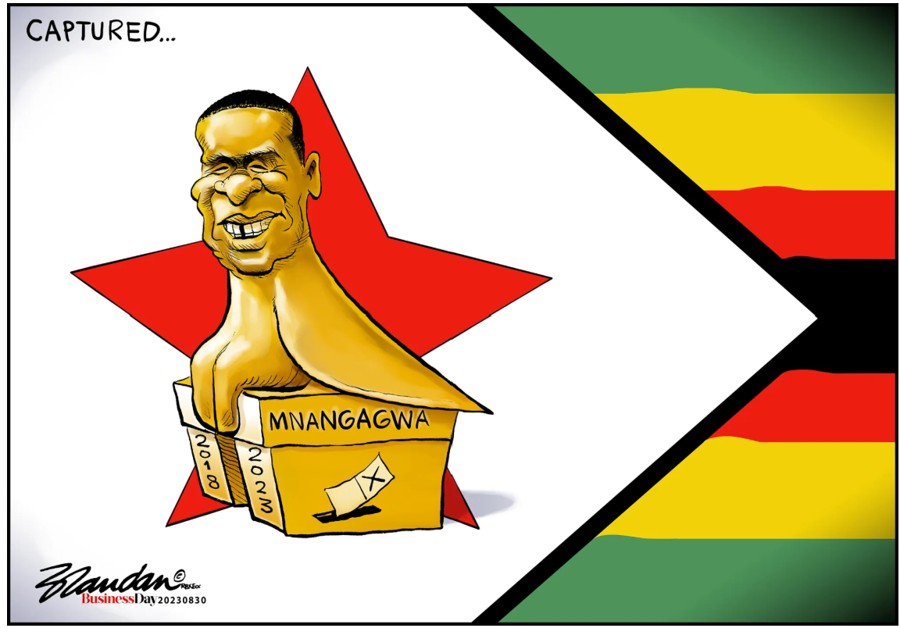
Brandon in Business Day, 30 August 2023. Zimbabwean president Emmerson Mnangagwa celebrates another questionable election victory…
2026: The Constitutional overhaul has led to de facto dictatorship
Now with an absolute legislative majority, President Mnangagwa sought to nullify the 2013 Constitution by
- Abolishment of direct elections for the Presidency: Two hundred and sixteen ZANU-PF parliamentarians approved constitutional amendments that enabled Parliament to appoint the head of state shielding the role from the popular vote.[12] The ruling ZANU-PF party currently holds a two-thirds majority in Parliament and will ensure that President Mnangagwa remains in power though clearly he cannot possibly equal Robert Mugabe’s presidential term from 1987 to 2017 (30 years)
- Term Limit Extensions: Presidential terms increased from five to seven years allowing the 83-year-old Mnangagwa to stay in power to at least 2030. His second and final term was due to end in 2028.
- Independent oversight eliminated: the nominally independent Zimbabwe Electoral Commission (ZEC) lost its voter registration duties which were transferred to the government appointed Registrar-General.[13]
Zimbabwe is now a constitutional dictatorship
The aims of the 2026 Constitutional changes were to criminalise public opposition and protest and to consolidate ZANU-PF power into the foreseeable future. This has been achieved. Controversial legal changes, executive power concentration and the elimination of direct presidential elections have resulted in Zimbabwe becoming a de facto constitutional dictatorship.
There have been a series of court appeals against the 2026 legislation arguing that such fundamental changes should be put to a national referendum. Few held out hope that Zimbabwe’s Constitutional Court with its compromised judiciary[14] would rule against the changes and, sure enough, the legal challenges to block the bill were dismissed by the Constitutional Court.
Neighbouring country politicians, including South Africa, the African Union and SADC have been largely silent, although individual publications such as the Daily Maverick have been critical of Zimbabwe moving from flawed democracy to fully-fledged dictatorship. In his article Mondli Makhanya in the Daily Maverick writes that the people who should be hanging their heads for failure of courage, failure of conscience and failure of conviction are the leaders of the African Union and SADC. He continues saying that Mnangagwa is known as the ‘Crocodile’ for his ruthlessness as he rose through the ranks of ZANU-PF.
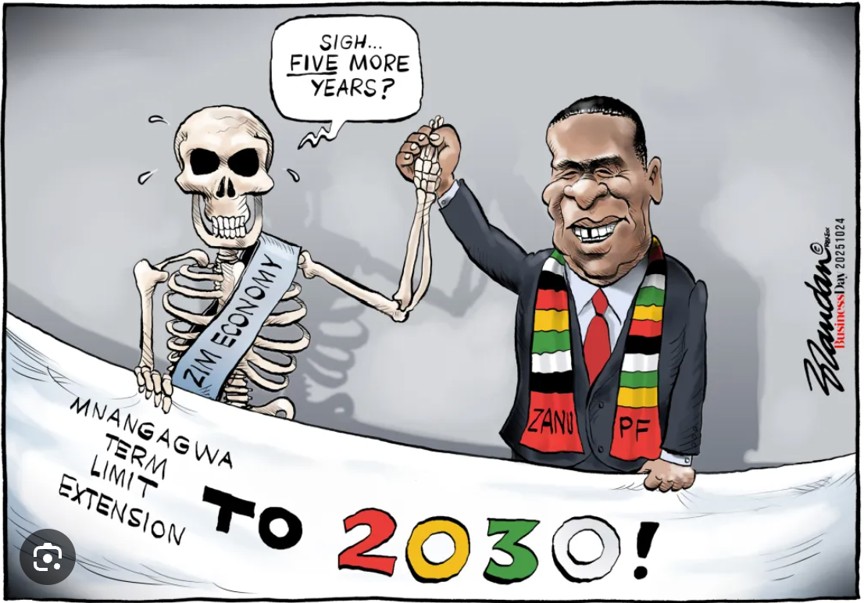
Brandon in Business Day 24 Oct 2025. Zimbabwe majority party ZANU-PF is to change the constitution to extend presidential terms from 5 years to 7 years, to benefit incumbent Emmerson Mnangagwa who has been president since 2018…
The 2013 constitution restricted a president to serving a maximum of two terms and that any move to extend the term limits would need to be endorsed by voters in a referendum and that a sitting president cannot benefit from any extension unless voters give their approval in a second referendum.
The actual legislation relating to the above changes is contained in Constitution Amendment Bill No 3. Readers can be sure that when President Emmerson Mnangagwa’s new term of office ends in 2030 he will seek re-election for a third term to consolidate ZANU-PF’s hold on Zimbabwe.
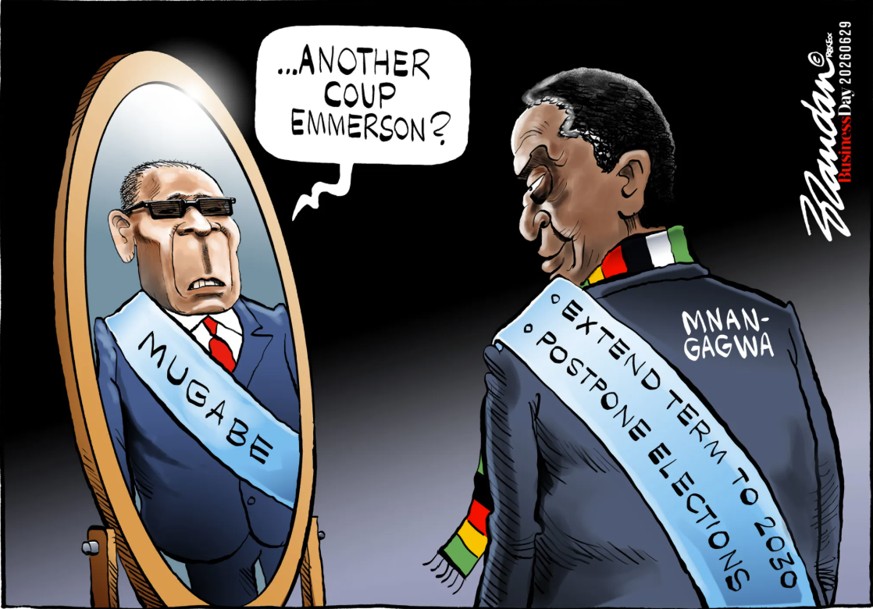
Brandon in Business Day, 29 June 2026. President Emmerson Mnangagwa extends his rule and grip on power in Zimbabwe…
References
Steve Feldstein. 16 August 2018. Carnegie Endowment for International Peace. Zimbabwe’s Coup Did Not Create Democracy from Dictatorship
https://carnegieendowment.org/posts/2018/08/zimbabwes-coup-did-not-create-democracy-from-dictatorship
Wycliffe Muia and Alfred Lasteck. 19 June 2026. BBC News. Zimbabwe MPs pass bill to extend president's time in power. https://www.bbc.co.uk/news/articles/c20y15m0337o
Mondli Makhanya. 25 July 2026. Daily Maverick. Zimbabwe’s descent into dictatorship and the peril of African leaders’ apathy. https://www.dailymaverick.co.za/article/2026-07-25-zimbabwes-descent-into-dictatorship-and-the-peril-of-african-leaders-apathy/?utm_
Cartoons by Brandon at: https://brandanreynolds.com/
[4] Reuters. 29 July 2020. Zimbabwe minister Shiri, who helped plot Mugabe ouster, dies at 65. https://af.reuters.com/article/topNews/idAFKCN24U0UY-OZATP
[5] The vote percentages quoted in Wikipedia do not agree with the actual figures. Nor do they agree with the figures quoted by the Zimbabwe Ministry of Information on Facebook. Another article states he won with 50.8% of the vote. Very confusing results! https://www.facebook.com/watch/?v=971710013919936
[6] Article: Zimbabwe’s Coup Did Not Create Democracy from Dictatorship
[7] https://www.state.gov/reports/2022-country-reports-on-human-rights-practices/zimbabwe/
[8] Emmerson Mnagagwa was elected Zimbabwe’s president on 3 August 2018
[9] Even Southern Africa Development Community (SADC) monitors were critical of the elections
[10] The security forces swear loyalty to ZANU-PF rather than the country
[11] Radio and TV are heavily biased in favour of ZANU-PF and basically the ruling parties propaganda arm. Most of the media, except independent publications, are similarly biased
[12] 187 parliamentary votes would have secured a two-thirds majority
[13] The Zimbabwe Electoral Commission (ZEC) was always a ZANU-PF organ
[14] The Zimbabwe judiciary is dominated by ZANU-PF loyalists