
- Entry fee
- n/a
Elizabeth Goodall’s death in 1971 was a great loss to the country. Her obituary states, “Her shy, unassuming, kindly and sympathetic nature will be missed by all.” Her self-discipline and work output were an example to all who knew her, yet she never discussed herself and at her death even her museum colleagues were surprised about how little they knew about her. Her legacy was to make a lasting and invaluable contribution to the study of rock-art in Rhodesia (present-day Zimbabwe) and her pioneering work was perhaps only equaled by Peter Garlake.
Sadly, her contribution is little acknowledged in Zimbabwe today. Laura de Harde writes, “I have seen in the decades since her death some of her rock art copies remain part of displays in the Museum of Human Sciences (ZMHS) and the documentary legacy she left to the museum survives scattered across storage boxes and steel cabinets. Goodall has on balance earned little recognition as a rock art researcher and even less as an artist in her own right.”[1]
Background
Born in Hamburg on 7 July 1891, Elisabeth[2] Amanda Margarethe Mannsfeld[3] decided after finishing school that she would study to be an art teacher and was admitted to the Trade School for Girls (Gewerbeschule für Mädchen) from 1908 to 1911.[4] Her first job on leaving was a technical assistant producing ethnographic drawings and book and catalogue illustrations at the Hamburg Museum of Ethnology (Museum für Völkerkunde)² and also taught part-time at the State Continuing Education School Professor Weckwerth and at the Trade School for Girls. In 1919, she moved from Hamburg to Munich and worked as a freelance illustrator and teacher, also attending courses in medicine and anatomy at Ludwig Maximilian University.
Around 1923 she met Professor Leo Frobenius, a noted German authority on African cultures and prehistoric art,[5] who hired her as a scientific illustrator for his Institute for Cultural Morphology and in 1925 she moved to Frankfurt am Main when he established his Forschungsinstitut für Kulturmorphologie where she worked as an illustrator and archivist.[6] Her colleagues were Agnes Schulz and Maria Weyersberg and their work making ethnographic and prehistoric documents and copying objects in the ethnological museums and collections of Europe. Ultimately Frobenius wanted illustrations from the cultures of non-European peoples to support his cultural-morphological theses. To prepare them, the three illustrators visited the Musée d’Ethnographie du Trocadéro in Paris, the British Museum in London and the Museo di Antropologia e Etnologia in Florence. They also visited the museums at Berlin, Bremen, Munich and Hamburg and made drawings of various ethnographic exhibits.
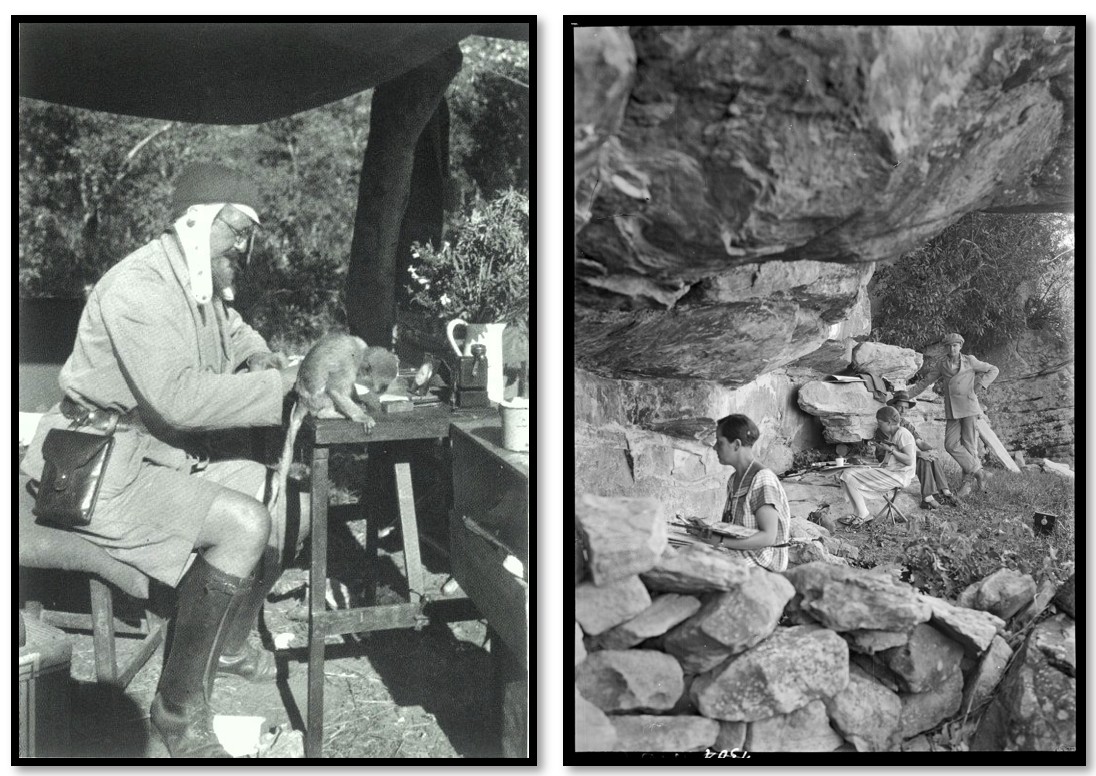
Frobenius Institute: Leo Frobenius at Belingwe writing up notes in the late 1920’s, note the monkey! Maria Weyersberg and Elisabeth Mannsfeld with Joachim Lutz copying paintings on Farm Heldenmoed, South Africa
Petro Keene says Frobenius, “found cultural practices to be inextricably bound to the material resources available to people, and so geography and the landscape were critical in his researches.”[7] However a major criticism was that the enormous number of cultural objects he acquired from indigenous peoples were then sold to fund further expeditions.[8] The expedition was guided to the various rock art sites by people familiar with the communal areas, such as the Marandellas Native Commissioner F.W.T. Posselt and camps set up with tents, makeshift ladders, easels and artists' paraphernalia.
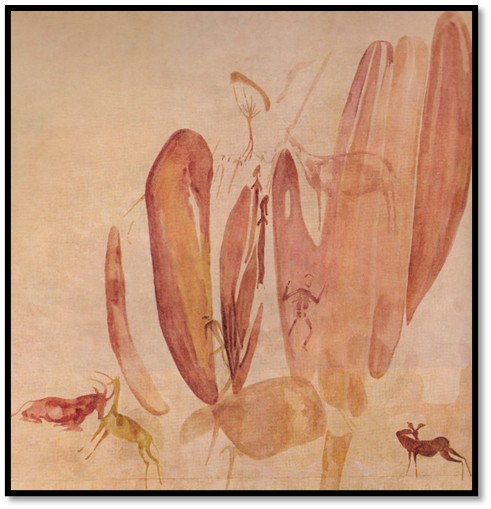
Elisabeth’s painting technique was mostly in watercolors, usually applied in thin layers of paint or coloured pencil drawings in earthy green and brown tones. Some depict reddish-brown, more rarely yellow, long-limbed figures in lively movement often with weapons and in great numbers. Others depict antelope, elephants, giraffes and zebras, or parts of these animals.
Peter Garlake has much praise for her work, “Despite the primitive materials she had to use in tracing and the techniques these imposed on her, her copies succeed in capturing the character of the art in a different medium while retaining accuracy, precision and detail more successively than any other copyist, copying system or photography.”[9]
The 1928 – Frobenius Institute’s ninth expedition to southern Africa
In 1928 the artists Elisabeth Mannsfeld, together with Agnes Schulz and Maria Weyersberg, the painter Joachim Lutz and the scholars Adolf E. Jensen, Heinrich Wieschhoff and Albert Seekirchner and with Leo Frobenius as leader set out on the institute’s ninth expedition, which was to southern Africa.
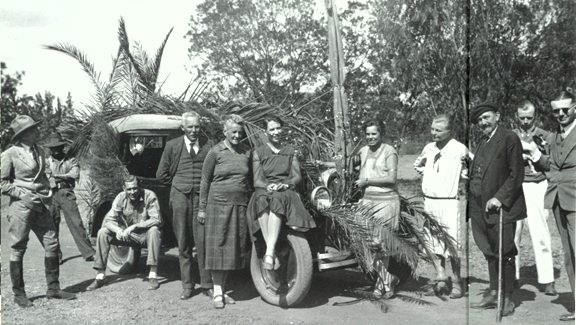
Frobenius Institute: Frobenius and the ninth expedition team at Pretoria
At the end of 1929 she returned to Frankfurt to work on the expedition material and her copies of rock-art friezes feature prominently in the material that was published. The copies were exhibited from 1930 to 1932 in Paris, Brussels, Amsterdam and Zurich, and in 1937 in the United States, first at the Museum of Modern Art and then a subsequent tour of 37 cities including the Hamburg Museum of Ethnology. Elisabeth helped prepare the exhibition ‘South African Rock Paintings’ and also gave guided tours in which she added her personal experiences as a rock-art illustrator and expedition participant.
During the twenty-month expedition the three women artists made over a thousand copies at rock art sites[10] in South Africa, Basutoland (Lesotho) and South West Africa (Namibia) The expedition then visited Rhodesia (Zimbabwe) where Elisabeth was at rock-art sites at Odzi, Rusape, Marandellas (Marondera) Enkeldoorn (Chivhu) Mtoko (Mutoko) and Salisbury (Harare) They rank among the most productive female painters in the history of the Frobenius Institute. Garlake writes about Frobenius’ approach to the rock-art, “He had not come to teach, help or advise but to accumulate a solid body of material that would demonstrate the influences of foreign ‘culture-complexes’ on southern Africa’s remote past. His imaginative range was enormous, his conclusions wide-ranging and the copies of paintings made by his team accurate, painstaking and still unsurpassed in scale as well as skill.”[11]
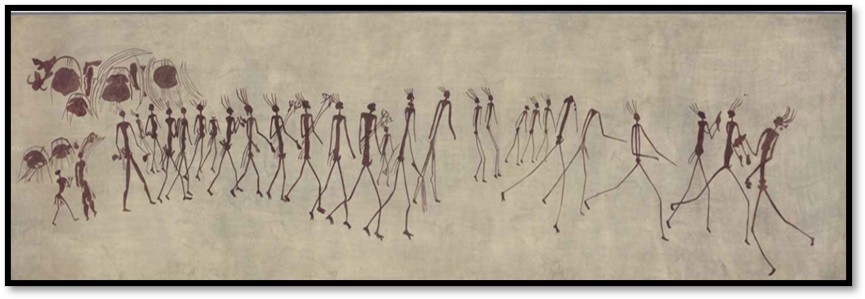
Frobenius Institute Frankfurt am Main; Procession, Zimbabwe, Chinamora, Masembura Communal Lands, 8,000 – 2,000 BCE. Watercolour by Elisabeth Mannsfeld, 1929. 65 x 202.5 cm
Despite much criticism of Frobenius’s conclusions that the rock-art of southern Africa was the product of foreigners and not locals, his approach to recording has often been praised. Peter Garlake writes, “In this sphere he showed extraordinary insight. He understood the ways visual art expresses ideas. He respected the artists and their beliefs, even if he did not know who and what they were. “He was a sensitive observer and a rigorous and methodical analyst who had an almost unerring eye for the significant in the art of Zimbabwe. The features he isolated and defined are indeed the most significant in the art — the oval designs, the fields of flecks, the association with trees, the distended and recumbent figures, the floating figures and those with pointed muzzles and large ears. His insights into the essential nature of the art, its basis in the expression of concepts derived from belief and from the mind, and in a precise vocabulary of visual forms, remain valid and must form the basis for understanding.”[12]
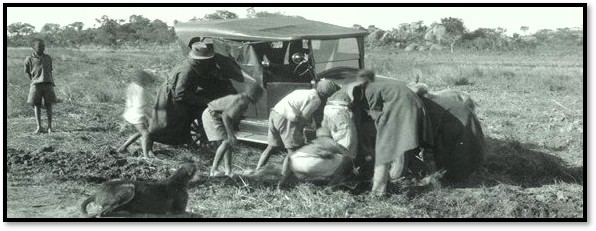
Frobenius Institute: extricating an expedition car from a muddy track
A permanent move to Southern Rhodesia (now Zimbabwe)
In late 1931 she married in Salisbury the British-born BSAP Sergeant (later Major) Leslie Blumenthal Goodall (1902–1974) whom she had met during the ninth expedition research journey and who remained her devoted supporter all his life. Here she initially continued working on behalf of the Frankfurt Institute illustrating rock-art paintings until in 1934 she began working with the Queen Victoria Museum, today the ZMHS. Garlake notes, “Over forty years, especially over the years 1940-1943, she produced watercolour copies of about 500 paintings, ranging from simple images to complete records of large panels.”[13]
She concentrated on Mashonaland rock-art at sites such as Chikupu, Makumbe, Mrewa and other sites. The Makumbe frieze is described by Peter Garlake as the finest in Zimbabwe but has been destroyed by the smoke from fires lit by Apostolic worshippers who camp in the cave. Elizabeth camped for three weeks in the cave and painted the thirty-two-foot frieze on behalf of the Africa archives of the Forschungsinstitut in Frankfurt demonstrating the series of superimpositions that characterized the frieze. Local African people in the remotest tribal trust lands took a great interest in her work and wherever she went she gained their co-operation and trust.[14] Laura de Harde writes, “In my reading of Goodall’s career, her work on the Makumbe panel marked a professional milestone, signifying her progression from apprentice or secondary specialist employed by Frobenius, to an independent archaeologist with a clearly defined research agenda.”[15]
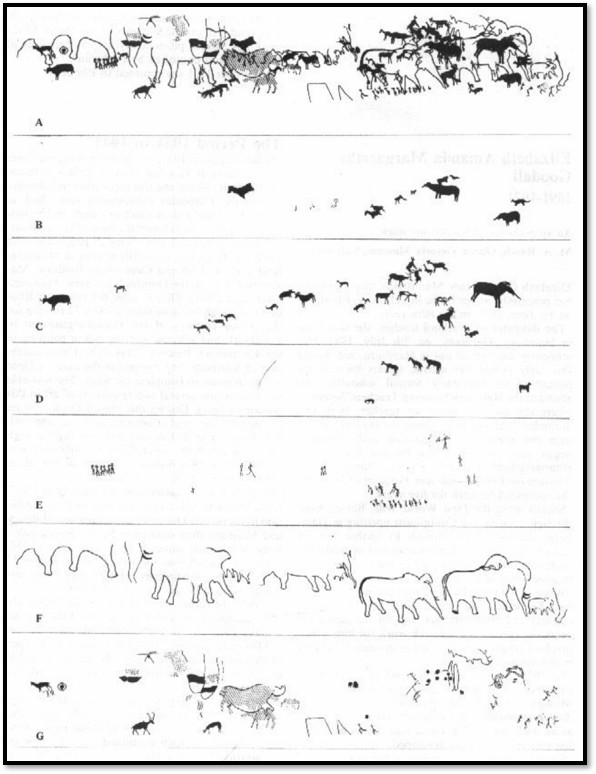
Elizabeth Goodall: superimposition at Makumbe Cave with each layer making up the final frieze – now unfortunately destroyed through smoke damage
Garlake says, “Her copies will probably never be matched for their skill, care and accuracy. They succeed more than any others in giving a sense of the character and quality of the originals though they translate these into watercolour painting on paper.” He goes on to say that she remained loyal to the skills she learnt from Frobenius “and because she was never fully at home in English, she wrote very little about the paintings. Her few contributions were a celebration, and not an analysis, of the art.”[16] Also, “She continued to classify the art thematically in the categories that Frobenius had established when she catalogued his copies. She followed his sequence of styles. Careful reading also makes it clear that she continued to adhere to Frobenius’ conviction that important elements in the art were ancient and exotic.”[17]
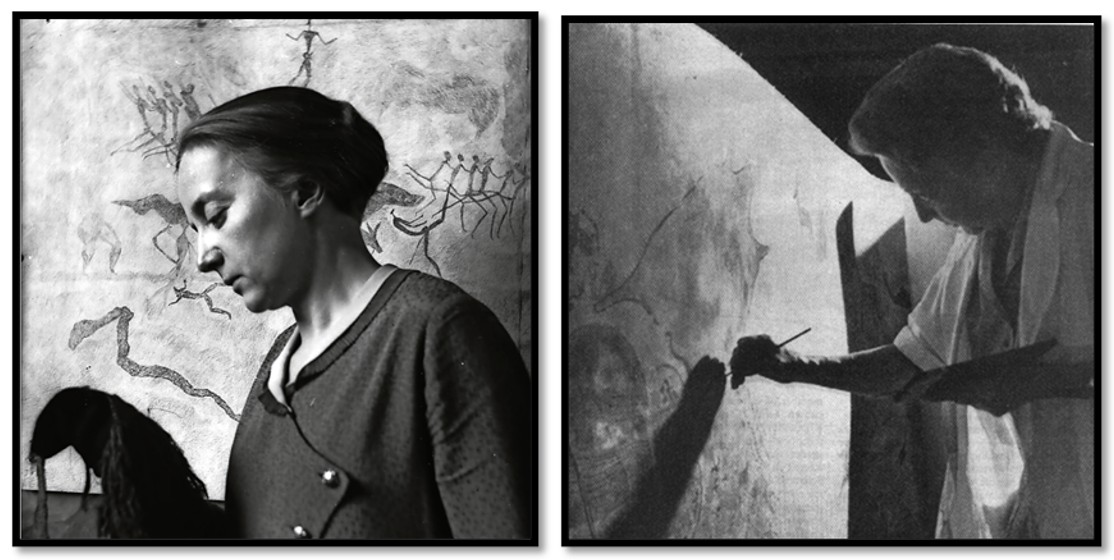
Two studies of a younger and older Elizabeth Goodall working on rock-art copies
Elizabeth had her first small presentation of twelve of her rock-art paintings in 1934, making the start of a decades-long collaboration between her and the Queen Victoria Memorial Library and Museum, then situated in Moffat Street. Over the following years, she was increasingly entrusted not only with further illustrations that she completed often in her spare time over weekends when she and her husband would drive to rock-art sites and camp out overnight, all at their own personal expense, but also with administrative and archival tasks and public tours and also with curatorial responsibilities.[18] Laura de Harde quotes Michael Raath in a letter saying, “in spite of her age [she] still used to go on occasional brief ‘expeditions’ into the bush in search of new rock art sites, to make detailed copies of the paintings. These outings were simple and private, on which she was usually accompanied only by her husband, and they were largely self-financed. But the copies she made she generously deposited in the museum’s archaeological collections (Michael Raath pers. comm. 2017).”[19] In 1935 she sold thirty-two of her rock-art painting copies to museum for £20 – a bargain basement price!
In 1937 she turned her attention to the World Heritage site[20] of the Matobo. One of the first painting copies she made was of the snake frieze in the Gulubahwe cave on the old Gwanda Road. Her copy was described by the keeper of Prehistory, Neville Jones, as “a wonderful reproduction of a wonderful painting.”[21]

Sketch of the snake frieze at Gulubahwe
The card-based rock-art database she began in 1939 for the Queen Victoria Museum and continuously expanded over decades[22] had detailed written descriptions and information on rock-art locations[23] throughout southern Rhodesia and continued until her death, although in later years Peggy Izzet helped update the records, and today it is part of the National Register of the National Museums and Monuments of Zimbabwe (NMMZ)¹²
Cran Cooke, a colleague and collaborator for many years describes in the same commemorative issue[24] ‘The Recording of Rock Art by Mrs E. Goodall.’ He describes her 192 record cards as “a meticulous and accurate record of the many sites she visited.” Her method was to have a written description on one side and drawings on the other. The card records were in addition to the large watercolour copies she made. Elizabeth wrote of her own methods, “As a means of reproducing detailed sections from cave walls, watercolour copies have been made after carefully tracing the paintings. The value of photographs is realised and some are used; but it has been the intention to give the clearest and most detailed reproductions possible, and only close and lengthy study, required by the drawing of the original, can produce such a result.”
Peter Garlake praises her efforts in The Hunter’s Vision saying her main concern was to reproduce the aesthetic qualities of the art, “She was happy to adjust compositions to strengthen their effect and to transpose the thick, dry, opaque pigments of the [original] artist into the much more fluid and transparent medium of watercolour.“
In Cooke’ section of the commemorative issue he reproduces twenty-six of her studies. Here just a few examples are given.
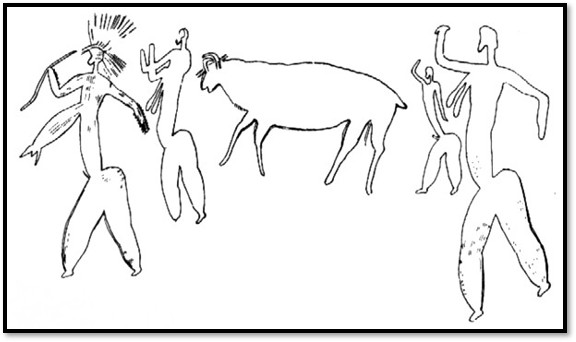
Card 181 reads: Mtoko. Large Cave at Rukwiza Hill.[25] At the centre-part of the large, curved cave wall, fairly low above the ground, is the most interesting scene of two men and two women driving along an animal (apparently domesticated) of the ox-type.
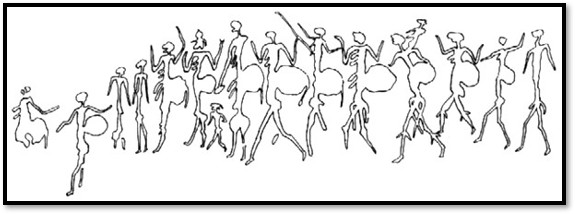
Card 64 reads: Domboshawa: detail of large cave, Chinamora Reserve. Procession of people, mainly women, 36 inches long. Eleven of the figures carry a heavy burden, which seems to be tightened round the body and fastened in front. (It may be skin bags, the tail still hanging down) Some wear a sort of dress round their loins, some have tied ornaments round their knees.
Site location details are, however, rather vague. For example: Salisbury East, Cranborne M.T.C. Plot, Mrs Senior. Take the Hatfield Widdicombe Road, just beyond the commonage gate, first plot left hand (about 3 miles) It is a pity they were not plotted onto the 1:50,000 scale maps.[26]
The War Years
With the absence of most men on war duties Elizabeth took on a much wider role and kept the Queen Victoria Museum functioning largely on her own efforts; a role that M.A. Raath writes was not generally known and for which she was not given credit for that included a weekly note on museum activities in the Friday edition of the Rhodesia Herald.[27]
In 1941 she was appointed ‘Honorary Keeper of the Rock Painting Section’ at the Queen Victoria Museum. Gradually she developed an interest in other fields of ethnographic inquiry including pottery and wood carvings and in 1942 she was designated ‘Keeper of the Rock painting Section and Hon. Keeper of Ethnology.’ Of course, being honorary positions meant they were carried out without pay, but this did not affect her enthusiasm in the slightest.
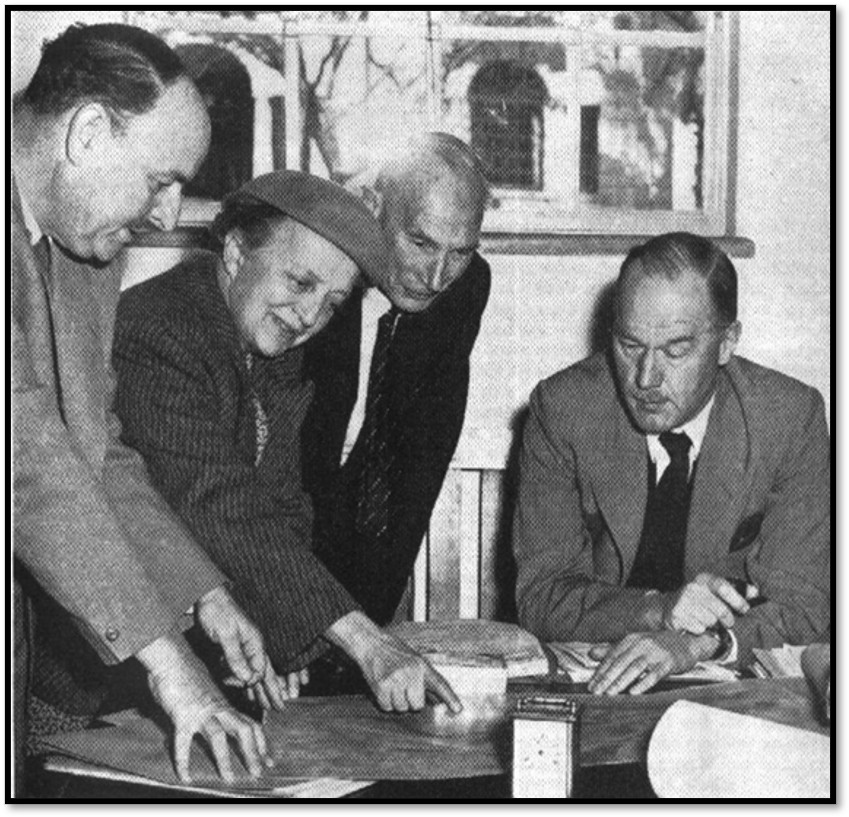
Commissioners on the Rhodesian Commission for the Preservation of Natural and Historical Monuments and Relics: (L-R) C.K. Cooke, E.A.M. Goodall, Dr A.M. MacGregor, R.F.H. Summers
Amongst some her successes were securing for the Queen Victoria Museum a considerable amount of pre-European gold bracelets, wire and foil from private individuals. Also, she matched two parts of a Great Zimbabwe soapstone bird that had become separated. The head had been donated by R.N. Hall in 1902 to the Queen Victoria Museum and Elizabeth recalled having read there was a column was at the Berlin Museum für Völkerkunde. She suspected they might fit; organised for plaster casts to be made that were exchanged and found to fit perfectly and the original column was returned to Southern Rhodesia. In 1950 she was able to obtain and present to the museum part of the Welcome collection of ethnographical items of weapons of African items.
From 1948 to 1951 when the Queen Victoria Museum came under the direction of the Board of Trustees of the National Museums of Southern Rhodesia, Elizabeth was curator and responsible for the entire operation and was for a long time its only european staff member.
In 1951 her husband, still in the BSAP, was transferred to Gwelo (Gweru) and later Gatooma (Kadoma) but Elizabeth still managed to assist in many of the Queen Victoria Museum’s activities, including as curator for a few months in 1955. The curators’ report for 1954 has as follows: Mrs E. Goodall gave invaluable advice on the choice of material to be displayed, helped to catalogue hitherto undisplayed material and added two large friezes to her already impressive collections of reproductions of Rhodesian Rock Art. It is hoped that as a result of these renovations, an even wider public will realise and appreciate the priceless contribution she has made during the past quarter century to the preservation of prehistoric art.
In 1954 she was elected to Fellowship of the Royal Anthropological Institute of Great Britain and Ireland (FRAI) and in 1956 she was appointed a Commissioner in the Historical Monuments Commission – a post she kept until her death.
Shortly before her retirement in 1958, she took over the lead at the archaeological excavations at Graniteside, on the southern side of Harare. This had initially been directed by Lt-Col H.L. Boultbee, the museum’s curator, until he retired. She succeeded in having the site proclaimed a national monument and in establishing a site museum for the public and was very opposed to its closure in 1969.
Her magnum opus was probably her contribution to the Mashonaland section of the book Prehistoric Rock Art of the Federation of Rhodesia and Nyasaland along with the authors C.K. Cooke, J Desmond Clark and R.F.H. Summers (editor) and was published in 1959 by the National Publications Trust. Long out of print it continues to be prized for the quality of the artwork and as a valuable source reference for today’s historians.
The Queen Victoria Library split from the Museum in 1959 with the museum moving into the temporary home of the old Rhodesia Children’s Home at the corner of Jameson Avenue and Rotten Row. This involved her assisting in the move of all the museum’s exhibits to their new home and then again when the museum moved to its present location at the Civic Centre, the present-day Zimbabwe Museum of Human Sciences. For the remainder of her life, she continued to collect information of rock-art sitings by members of the public and was always available to guide parties of visitors around the museum and gave many talks and demonstrations including at the annual Ranche House School of Archaeology.
In 1961 in the New Year Honours List, she was awarded the MBE.
For her many achievements at the Queen Victoria Museum, Elizabeth Mannsfeld was awarded with honorary titles and honorary memberships in several scholarly associations. She was a keen member of the Rhodesian Prehistory Society, the Royal Anthropological Institute of Great Britain and Ireland and an Honorary Life Member of the Rhodesia Scientific Association. ¹³
In addition, she attended specialist conferences, gave lectures on prehistoric rock-art research, and like her Frankfurt colleagues Agnes Schulz and Maria Weyersberg, wrote a number of scholarly articles including many in NADA,[28] and the Rhodesian Scientific Association[29], The Outpost[30], in Proceedings of the Third Pan-African Congress on Prehistory,[31] and the Mashonaland chapter in Prehistoric Rock Art of the Federation of Rhodesia and Nyasaland. Omitted from all references is the survey she carried out on the Portuguese trading posts on the Angwa river.[32]
Elizabeth Goodall (née Mannsfeld) died suddenly, but peacefully at her home in Salisbury, Rhodesia on the 1st of June 1971, in her eightieth year.
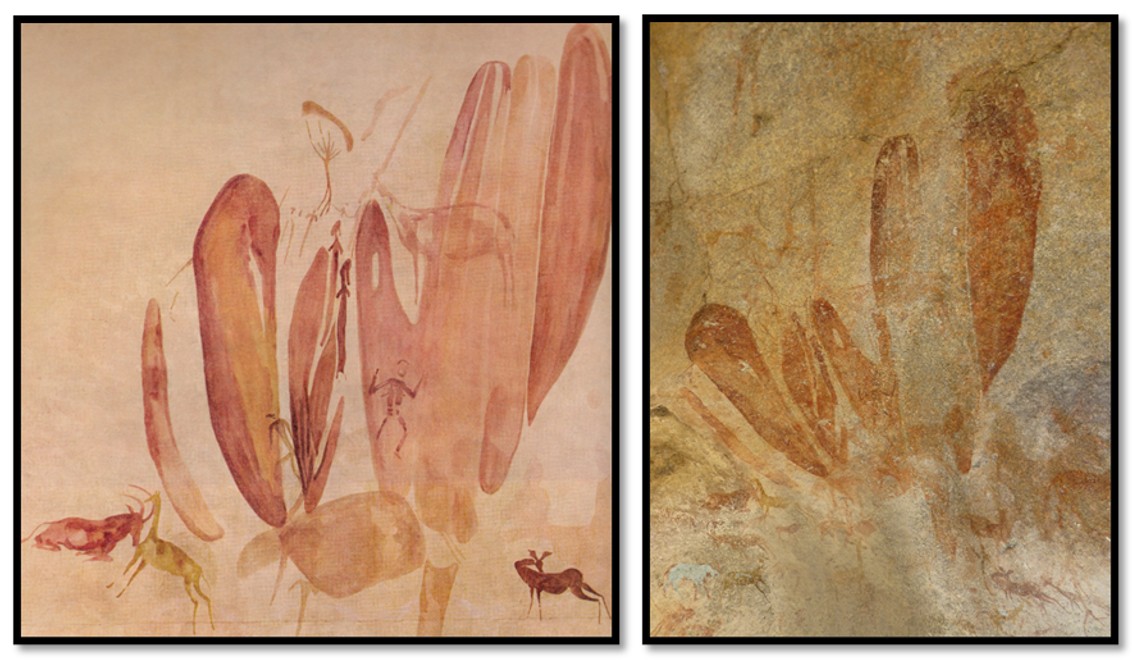
Macheke rock-art site: Goodall copy (L) author’s photo (R)
Frobenius Institute for research in Cultural Anthropology at Frankfurt am Main, Germany
The Institute has a huge archive of painted copies of rock art from southern Africa,[33] as well as the expedition notebooks, photographs and ethnographic objects that were collected during the 1928-30 expedition. I would like to thank Dr Richard Kuba for his help.
References
Kevin Davie. Finding Ha Baroana and Mutoko. Mail and Guardian 22 December 2022 – 5 January 2023. https://www.frobenius-institut.de/images/stories/Pressemitteilungen/Medienecho/Davie_Frobenius_MailGuardian%202022-23.pdf
Frobenius Institute for research in Cultural Anthropology. https://www.frobenius-institut.de/en/
P.S. Garlake. The First Eighty Years of Rock Art Studies in Zimbabwe 1890 to 1970, P9. Heritage of Zimbabwe Publication No 12, 1993
P.S. Garlake. The Hunter’s Vision. British Museum Press & Zimbabwe Publishing House, 1995
Elizabeth Goodall 1891 – 1971 Commemorative Issue, December 1971. Occasional papers of the National Museums of Rhodesia, Series A Human Sciences, Volume 4, Part 1.
(1) M.A. Raath. Elizabeth Goodall – An appreciation of her life and work, P1 - 7
(2) C.K. Cooke. The recording of Rock-Art by Mrs E. Goodall, P8 – 20
(3) T.N. Huffman. A guide to the Iron-Age of Mashonaland, P20 - 44
E. Goodall, R.F.H. Summers (ed.) C.K. Cooke, J.D. Clark. Prehistoric Rock Art of Rhodesia and Nyasaland. Published by National Publications Trust, Rhodesia and Nyasaland, 1959
Laura de Harde. Elizabeth Goodall and Walter Battiss: Inspired by the Art on the Rocks. Taylor & Francis Online. 21 Feb 2022, P75-102. https://www.tandfonline.com/doi/abs/10.1080/00043389.2021.2017118
Gisela Stappert. Elizabeth%20Goodall/Mansfeld_Katalog-Giersch_2019.pdf
Notes
[1] Elizabeth Goodall and Walter Battiss: Inspired by the Art on the Rocks, P25. While this may be true in Zimbabwe, the Frobenius Institute regularly exhibit her work. Peter Garlake, whose studies and writing on Zimbabwe Rock Art stand above all others, has more praise for Elizabeth Goodall that anyone else in this field
[2] Laura de Harde in her article Elizabeth Goodall and Walter Battiss: Inspired by the art on the rocks says it appears that her name Elisabeth was anglicized when she married in Southern Rhodesia to Elizabeth and so I change the spelling after 1931
[3] In this article referred to as Elisabeth or Elizabeth, rather than Mannsfeld, which is how the German sources reference her, or Goodall, which is how the Southern Rhodesian sources reference her
[4] In 1908 women were not yet admitted to the more prestigious Hamburg School of Arts and Crafts, later the University of Fine Arts
[5] Ethnology Professor Leo Frobenius made twelve expeditions to the African continent between 1904 – 1935. Despite his huge contribution to ethnography Frobenius took the view that the rockart was too advanced to have been done by San hunter-gatherers or anyone locally and had been carried out by Phoenicians or Egyptians or other early visitors. The Abbé Breuil took a similar view when he visited Southern Rhodesia between 1947-1950
[6] Elizabeth Goodall – An appreciation of her life and work, P1
[7] Frobenius, P38
[8] Leo Frobenius died in 1938 at his country home in Biganzolo on Lake Maggiore, Italy.
[9] The First Eighty Years of Rock Art Studies in Zimbabwe 1890 to 1970, P15
[10] Finding Ha Baroana and Mutoko, Part 1 of 3. These copies were left in the care of the South African Museum, the predecessor of the Iziko Museum
[11] The First Eighty Years of Rock Art Studies in Zimbabwe 1890 to 1970, P9
[12] The Hunter’s Vision, P30 - 34
[13] The First Eighty Years of Rock Art Studies in Zimbabwe 1890 to 1970, P15
[14] Elizabeth Goodall – An appreciation of her life and work, P1
[15] Elizabeth Goodall and Walter Battiss: Inspired by the Art on the Rocks, P7
[16] The Hunter’s Vision, P35
[17] The First Eighty Years of Rock Art Studies in Zimbabwe 1890 to 1970, P17
[18] Elizabeth reorganized many of the Queen Victoria’s collections in the 1950’s
[19] Elizabeth Goodall and Walter Battiss: Inspired by the Art on the Rocks, P10
[20] The Matobo were actually declared a UNESCO World Heritage site in 2003
[21] Neville Jones (1880 – 1955) major works focusing on Rhodesia (now Zimbabwe) included The Stone Age in Rhodesia (1926) and The Prehistory of Southern Rhodesia (1949)
[22] Many farmers responded with information on rock-art on their farms following articles that appeared in the Rhodesia Herald over the years
[23] A pen-sketch of the rockart at each site was recorded on the rear of each card to avoid confusion between sites
[24] Elizabeth Goodall – An appreciation of her life and work, P8-20
[25] Present-day name is Ruchera cave
[26] The 1:50,000 map series were first issued from 1953-4
[27] Ibid, P3
[28] Pictorial Documents of Prehistoric People, in: Nada, 24, 1947
[29] Some Observations on Rock Paintings observing Burial Rites (1946)
[30] Iron Smelting and Smithing in Africa (1944)
[31] Styles in Rock Paintings, Livingstone (1955) The Geometric Motif in Rock Art (1955)
[32] A Preliminary Report on Four Portuguese Forts in the Angwa Valley. Queen Victoria Museum, Salisbury, Rhodesia (1946)
[33] Many can be viewed digitally at http://Frobenius-institut.neuentwurf.de