
- Entry fee
- n/a
This article was inspired by two articles. The first was in the Rhodes Centenary Supplement published by the Chronicle in Bulawayo entitled The Centenary of Alfred Beit on the 3rd of July 1953, Page 43, the author was Dr H.O. Simon. The second was from the Bulawayo Chronicle Jubilee supplement of Friday, 6 September 1940 celebrating 50 years of achievement in Southern Rhodesia in an article entitled Alfred Beit’s Gift to the Nation, the author is not named. The articles reflect the attitudes and opinions that were prevalent at the time. Other relevant sources have also been accessed.
J.B. ‘Jim’ Taylor[1] (later a partner in Wernher Beit), writes in his book ‘A Pioneer Looks Back’ that “Alfred Beit had the kindest, most generous, and loveable nature of any man that ever drew breath. One could not help loving the dear man, for he was so perfectly natural and human and had such a broad outlook on life. He was very generous in rewarding anyone who introduced profitable business to him: consequently, most people who had propositions to offer, came to him before going to anyone else. He never bore any malice and never said an uncharitable thing about anyone. In all his activities, he had a most unselfish disposition and also was always thoughtful for others. He never forgot a friend.” He concluded that, “Beit was the best friend South Africa has ever had. He rendered more practical service to the country than any man I know of.”[2]
Seymour Fort, Beit’s biographer wrote, “it is true that Rhodes compelled the minds of those around him, and even possibly the mind of his age, to gather round his Imperial purpose and become its protagonist; but of all those whom he thus inspired to co-operate with him, Beit was the greatest in ability, in loyalty and in character. He alone, amongst the other disciples, possessed the same quality of imagination and visionary power as Rhodes; and he alone could realise in its entirety the purpose of this idealism. This alliance was always going to be invincible – yet amalgamation was neither straightforward nor easy.”[3]
Alfred Beit’s name, outside Zimbabwe, is hardly known compared with Cecil Rhodes, Barney Barnato, Paul Kruger and Dr Jameson as he was a very private person and kept out of the limelight.
Early days as a diamond buyer
Alfred Beit was born on 15th of February 1853, less than a week after Leander Star Jameson, and less than four months before Cecil John Rhodes. Twenty-two years later he was to meet the two others at Kimberley to form the strange and yet fascinating team that was to reshape the economic pattern and the political map of Southern Africa.
The eldest son of a Jewish merchant in Hamburg brought up as a Lutheran he brought “to the future partners’ pool of conflicting and complementary forces and gifts, a trained understanding of diamonds, an intuitive grasp of financial matters and access to German and English financiers.”[4] He learned the diamond trade at Amsterdam apprenticed to Jules Porgès & Cie and he was sent out to Kimberley in 1875 as a diamond buyer to work with relatives who owned the firm of David Lippert in Hamburg, with diamond and wool interests in South Africa.[5] These business connections were a great asset and included his securing the all-important land concession which his cousin, Eduard Amandus Lippert, had obtained from Lobengula for the British South Africa Company. [6]
“When I reached Kimberley,” he related in after-years, “I found that very few people knew anything about diamonds; they bought and sold at haphazard, and a great many of them really believed that the Cape diamonds were of a very inferior quality. Of course, I saw at once that some of the Cape stones were as good as any in the world; and I saw, too, that the buyers protected themselves against their own ignorance by offering one-tenth of what each stone was worth in Europe. It was plain that if one had a little money, there was a fortune to be made.”[7] Beit eventually employed his own knowledge of the European markets to invest in diamonds on his own account. He also bought land, erected a dozen iron shanties, and rented them out as offices for £1,800 per month and twelve years later sold the ground for £260,000.[8]
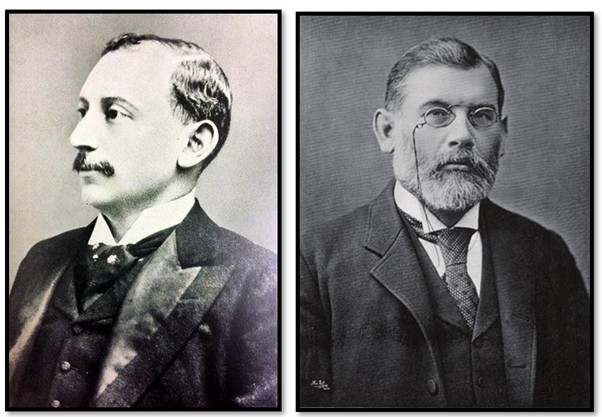
Alfred Beit at twenty-two years Julius Wernher (1850 – 1912)
After three years he was on his own, investing like hundreds of others, but with more luck, his profits in claims and shares. And it was not just luck. “Beit possessed remarkable qualities that soon marked him out in the diamond business: a prodigious memory, sound judgement about the quality of diamonds, and the ability to solve financial questions swiftly and soundly …knowing how to reduce the most tangled and complicated matters to their essentials and to express them in the simplest formula”[9] “In one respect, however, he differed from the remainder - he understood his business, and had acquired such an exact knowledge of diamonds that on one occasion, when he was offered a parcel of seventy stones, he thought definitely that he recognised some which had previously been offered to him; no explanation or contradiction could move him, and on inquiry it was actually found that he had been robbed of the stones by a dishonest employee.”[10]
If Beit lacked the visionary imagination of Rhodes, the adventurous spirit of Dr Jameson, the speculative vein of Barney Barnato[11] - although he had a touch of all these ingredients, his was the commercial knowledge, the instinct of the financier, the penetrating mind, the understanding of financial implications and complications. Rhodes is generally credited with the consolidation of different diamond businesses that led to the creation of De Beers but he could not have done it without Beit who had the contacts with the European financiers such as Jules Porgès & Cie and the Rothschilds and also the grasp of financial detail to put the schemes together.
At an early stage Beit realised that the future of the new industry belonged to businesses with accumulated capital and powerful combines. Rhodes and Barnato were just as shrewd. When Rhodes met Beit in 1879, he might have fought him, but as always preferred a diplomatic arrangement to a standoff and so that unique partnership merged, which never was reduced to deeds or documents and lasted to the death of Rhodes in 1902.
Beit meets Rhodes at Kimberley to form a life-long business partnership
When they met, Rhodes is supposed to have said, “Well, what's your game?” Beit supposedly replied that he intended to control the diamond output of Kimberley before he was too much older. “That's funny,” was Rhodes' response. “I have made up my own mind to do the same.” And, keeping absolutely in character, Rhodes proposed not to compete (as Robinson or Barnato might have done) Instead, he is said to have told Beit, “We had better join hands.”[12]
One particular quality which may have endeared Beit to Rhodes was an apparent indifference to wealth, while doing so well. What moved Beit most, Rhodes later declared, “was to be rich enough to give his mother £1,000 a year.”[13]
By the early 1880’s Beit was associated with Julius Wernher (1850 – 1912) and they became life-long friends. They met at Kimberley where they set up their own ‘German’ mess, similar to Rhodes’ ‘English’ mess. Meredith writes, “They made an odd couple. Werner was a huge, handsome former Dragoon who served in the Prussian cavalry. Beit was a dumpy figure, whose head appeared too large for his body; uncomfortable with strangers, he seemed a mass of nervous mannerisms, tugging at his collar, twisting his moustache and biting the corner of his handkerchief.”[14]
At the start Beit was a ‘koppie-walloper’ going from one digging to the next and buying rough stones and this made him aware of where the best diamonds came from. Quite quickly though he set up a canvas tent as an office and diggers brought their stones to him for evaluation and he quickly gained a reputation for offering fair prices. J.B. ‘Jim’ Taylor, later employed by Beit as a Kimberley diamond-buyer said it was a great advantage to have the first view of a parcel of diamonds, “We brokers always gave Beit the first chance. Prospectors also always went to him first; so did option holders and others.”[15]
Wernher, working for Jules Porgès and Cie, and Beit with his good knowledge of diamonds, quickly saw the possibilities of working together with Porgès’ firm supplying the capital and organising shipment of the stones from Kimberley to London. This loose partnership came even closer when Jules Porgès himself moved to Kimberley in December 1876 bringing Beit in closer touch with the famous firm, while he also was still free to operate on his own, and buy his own claims in the various mines.
Finally from 1880 Jules Porgès offered Beit a permanent position and Wernher and Beit began formally working together at Porgès & Co. Auerbach writes, “Both were prudent businessmen, but Beit was the more speculative and creative, with greater initiative, whilst Wernher saw to it that all their enterprises were placed on a firm financial basis with adequate reserves.”[16] With their trust in Beit’s judgement Porgès and Wernher returned to Europe in late 1880 leaving Beit in charge at Kimberley entrusted with buying stones, claims and shares for Porgès and Cie.
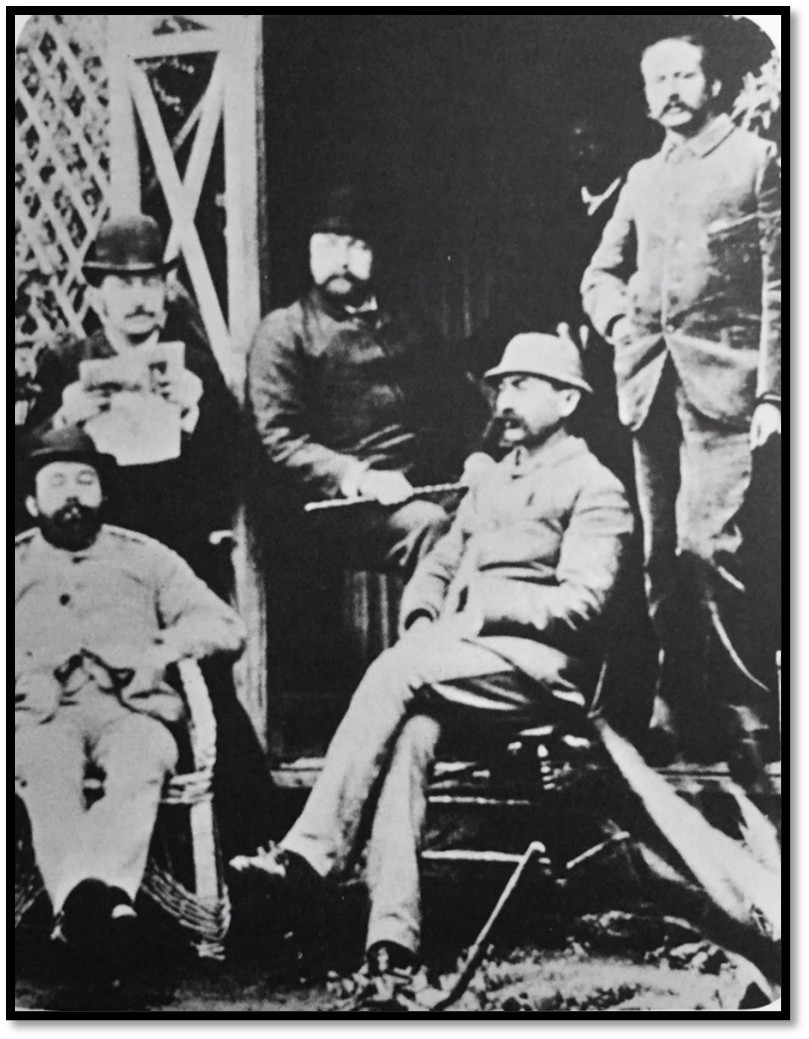
The ‘German Mess’ at Kimberley – Alfred Beit with newspaper, Herman Eckstein on his left
In 1884 Wernher left Kimberley for London and began to direct the operations of Jules Porgès & Cie and was also involved in establishing the London Diamond Syndicate[17] to stabilize the price of diamonds. Beit was left in charge at Kimberley and on the retirement of Porgès in 1889 the firm of Wernher, Beit & Co. of London was incorporated. The relationship between Wernher and Beit was ‘deep, based originally on their common nationality and appreciation of each other’s business abilities.’
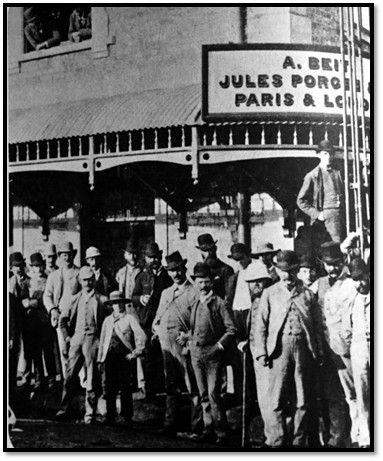
Beit’s office at Porgès and Co in Kimberley in the 1886
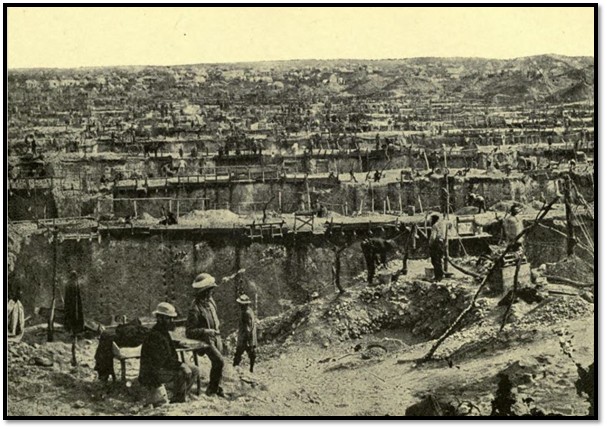
Kimberley Mine 1872
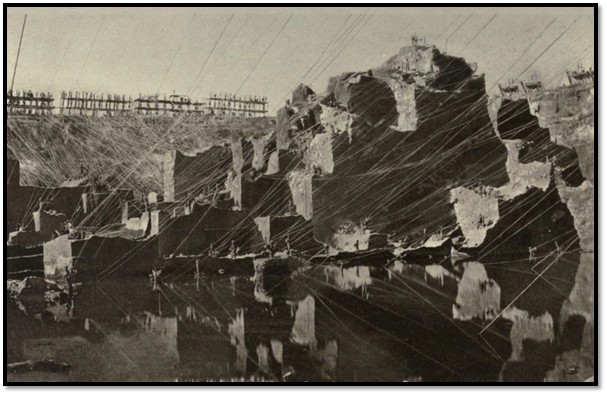
Kimberley Mine 1873/4
Kimberley at this time baked in the summer heat and was bitterly cold in winter and in the grip of sand storms. When it rained, the dust turned to thick mud. Dysentery was a common threat from the unsanitary conditions from ditches serving as toilets and the place was plagued by flies. Fruit and vegetables were in short supply and all the trees had been cut down to feed the steam boilers that pumped water from the diggings.
By 1872-3 within the 38 acres making up the area of the Kimberley Mine diamond pipe there were hundreds of independent miners working in their separate claims and the situation was becoming unworkable with dozens of individual claims all at different depths and narrow roadways in-between that were constantly collapsing and causing death and injuries to miners below. There were accidents also from the cableways hauling earth overhead and the flooding of the individual pits was a constant problem. Amalgamation was seen as the only remedy.
The formation of De Beers Consolidated Mines Limited
Diamonds had been discovered on the farm Vooruitzicht of Diederik and Johannes de Beer in 1871 and the resulting diamond rush and encroaching diggers forced them to sell their farm in the same year to merchant Alfred Johnson Ebden for £6,600. This would become the site of Kimberley’s the Big Hole and the De Beers Mine.
The same year an eighteen year old Rhodes abandoned farming in Natal and joined his brother at Kimberley. When Herbert left for England two weeks after Rhodes' arrival he supervised the working of the diamond claims with his brother Frank. In the following year Herbert sold his diamond claims to Cecil and left to mine gold at Barberton.
The supply of diamonds from South Africa caused a price collapse in 1874 and 1875 and the diamond fields fell into depression, but Rhodes and his business partner Charles Rudd were among those who stayed, although Rhodes in London wrote to Rudd that he was hesitant about buying more claims or property. “Do not plunge for much more at the Fields. We have sufficient block at De Beers to make a fortune if diamonds last and have enough property in Kimberley. If we make more money I would sooner say lend it or go in for a nest egg here at home.”[18] They believed diamonds could be found in the hard blue ground that underlay the softer, yellow layer nearer the surface. To help their cash flow, they obtained a contract to pump water from the mines and prevent them from flooding.
By 1885, the number of companies involved in diamond mining were 119 at Kimberley Mine, 10 at De Beers, 37 at Dutoitspan and 32 at Bultfontein.[19] The Rhodes - Rudd partnership built up the second largest shareholding in De Beers by buying up claims and consolidating with other claim holders and set their sights on gaining control of the entire mine. On 1 April 1880 they formed De Beers Mining Company and through buying up rival companies by 1887 only one remained; the Victoria headed by Francis Oats who refused to sell. However, Beit using connections through Jules Porges & Cie bought shares through London until by April 1887 through a combination of De Beers, Beit and Porgès they owned a majority shareholding and forced the merger to become the first of the diamond mines to be in the control of a single company.[20]
Alfred Beit’s intimate knowledge of the diamond market was to prove invaluable and in 1887 Beit and Rhodes set about acquiring the Kimberley Central Diamond Mining Company, which was mainly controlled by Barney Barnato. Backed by the Rothschilds a furious competition to buy up shares ended in their favour in 1888[21] and Barnato finally agreed to merge his company with Rhodes’s company after an all-night meeting in Rhodes’ corrugated-iron cottage. Barnato brought his nephew, Woolf Joel and Rhodes was supported by Beit. However, minority shareholders were not in favour of the planned amalgamation and won a court case. To work around the ruling, Kimberley Central was liquidated and the assets were purchased with a De Beers cheque for £5,338,650; part of which went to the minority shareholders.
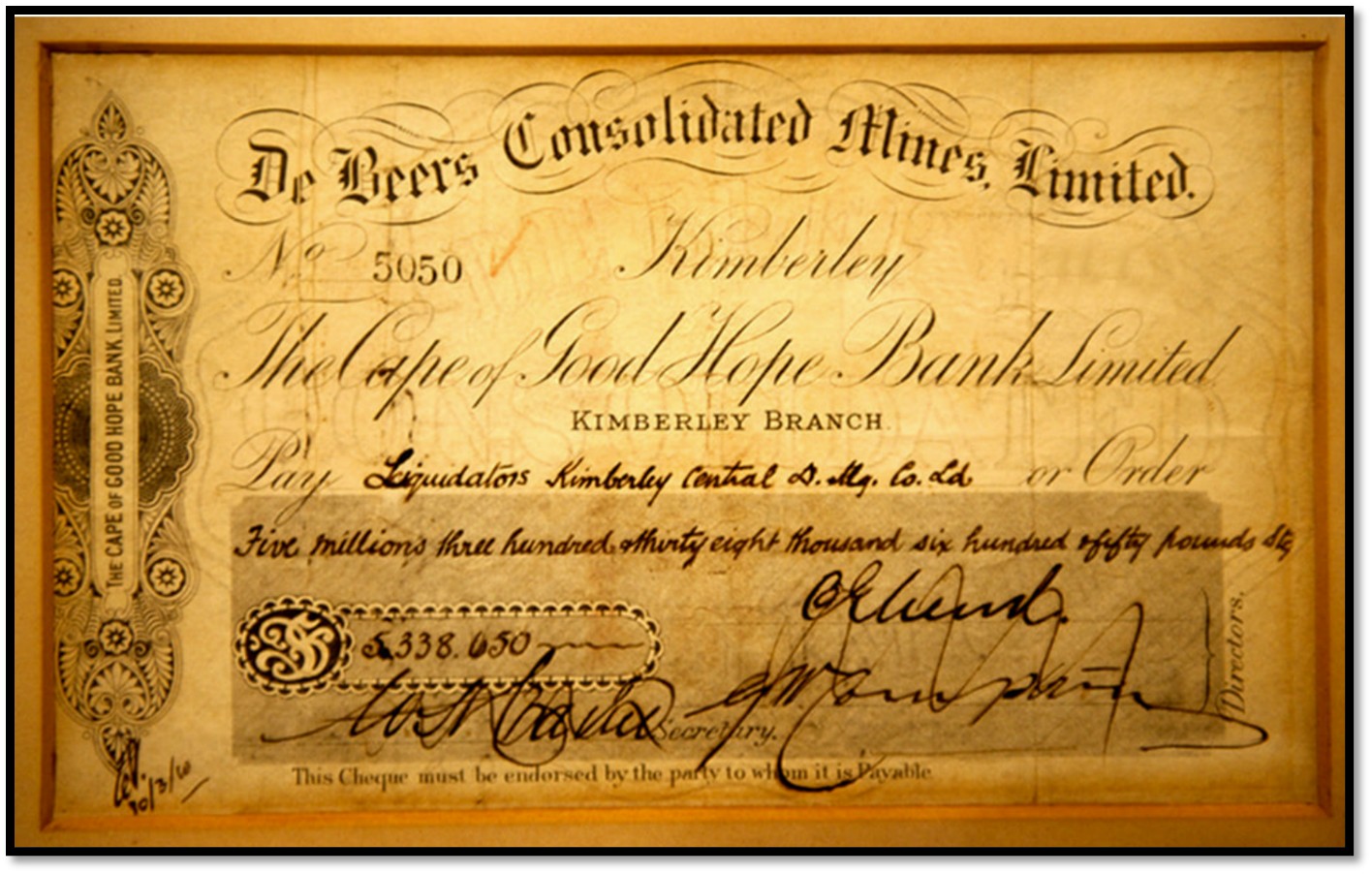
De Beers cheque for £5,338,650 to the Liquidators of Kimberley Central
If Barnato was not entirely convinced by Rhodes’ enthusiasm, he was by the financial figures of Beit.[22] The outcome was De Beers Consolidated Mines Limited which owned 100% of De Beer’s Mine, 60% of Kimberley Mine and had controlling interests in Dutoitspan and Bultfontein Mines. Rhodes, Barnato, Frederic Stow and Beit were made ‘Life Governors’ with each entitled to one-quarter of net dividends after a 36% dividend; the beginning of Beit’s accumulated fortune. After Barnato’s death in the Atlantic, Rhodes and Beit with the only life directors.[23]
Beit moves from South Africa to England
In 1888 Beit moved to London where he felt he was better able to manage his financial empire and support Rhodes in his Zambesia ambitions. He bought the estate of Tewin Water in Hertfordshire with 7,000 acres and had Aldford House built in Park Lane.[24] A few miles away from Tewin Water Julius Wernher bought Luton Hoo with 5,218 acres[25]
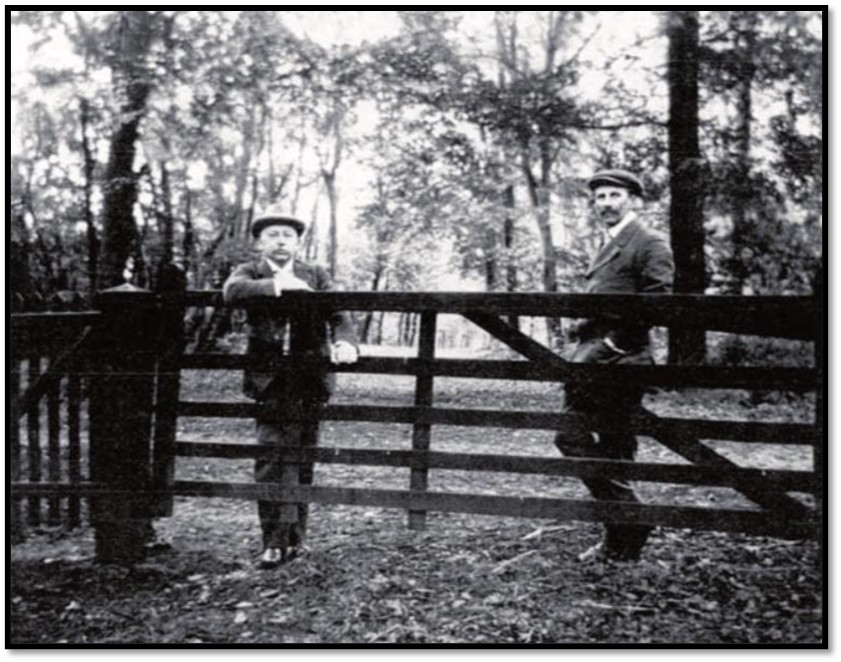
Alfred Beit and his early biographer Seymour Fort at his country seat of Tewin Water
Both Alfred Beit and Julius Wernher settled in England and eventually, in 1898, they both became British citizens. As members of the new plutocracy, known disparagingly as ‘Randlords,’ they were subject to ‘political malice and religious, racial and social prejudice.’ Part of this was due to their German and (in Beit’s case) Jewish origins and links.
Rhodes’ territorial ambitions lead to the formation of the British South Africa Company
The British South Africa Company (BSACo) was established following the amalgamation of Cecil Rhodes’ Central Search Association and the London-based Exploring Company Ltd. They had initially competed but united with the same common economic goals and to secure a Royal Charter over the territory of what was then known as Zambesia from the British government which was granted in 1889.
Rhodes and Beit played pivotal roles in the Chartered Company’s formation with both being leading shareholders, along with Barnato, Jameson, Rudd, Frank Thompson, Frank Johnson, Lord Rothschild and Sir Hercules Robinson. The achievement put Beit’s financial genius to a crucial test and he stood it triumphantly. They had a complementary partnership. Rhodes, ‘the intellectual posturer,’ admired the mental agility of the shy, gauche Beit who ‘envied and loved’ Rhodes’s ‘commanding and leonine personality.’[26] Even Doctor Jameson fell under Rhodes spell saying years later that it was Rhodes’ talk of his big schemes that he found so attractive and recalled, “I soon admitted to myself that for sheer natural power I had never met a man to come near Cecil Rhodes.”[27]
Beit was an original Director of the BSACo from its formation and responsible for much of the Chartered Company’s financial backing and its organisation. Although forced to resign as a director in June 1896 following the official inquiry into his role in the failed Jameson Raid he was re-elected to the board in 1898 and later served as vice-president. Following Rhodes death in 1902 he took on a more prominent role in managing the company and also was a trustee of Rhodes’ estate until his own death in 1906.
Other of Beit’s directorships included De Beers Consolidated Mines Ltd, Wernher, Beit and Co, Rand Mines Limited, Rhodesia Railways and Beira Mashonaland Railways.
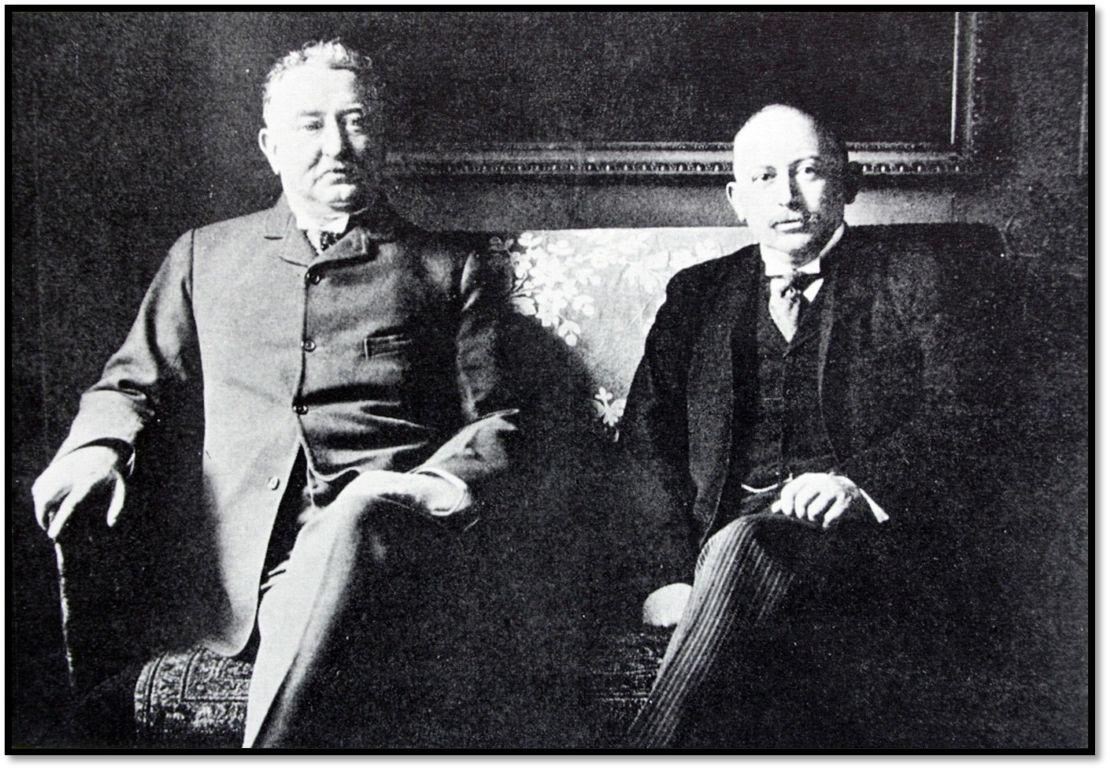
Cecil John Rhodes and Alfred Beit circa 1901
Gold discovery on the Witwatersrand
The discovery of gold on the Witwatersrand[28] would make the future Transvaal a land of unlimited opportunities. However, the previous roles of Rhodes, the enterprising man of mettle and dash, and Beit, the cautious businessman, came to be reversed. Rhodes was cautious because at Barberton there had been a rush – the Sheba Mine for a time was the most profitable in the world[29] – then followed a collapse as there were only pockets of good gold. Both Charles Rudd and Rhodes were overwhelmed by the need to crush tons of rock and gravel to obtain payable ounces of gold and adopted a cautious style. Dr Hans Sauer wrote, “Rhodes knew nothing of gold mining and still less of gold-bearing ore bodies, and in the back of his mind was the fear that the whole thing might turn out to be a frost.”[30]
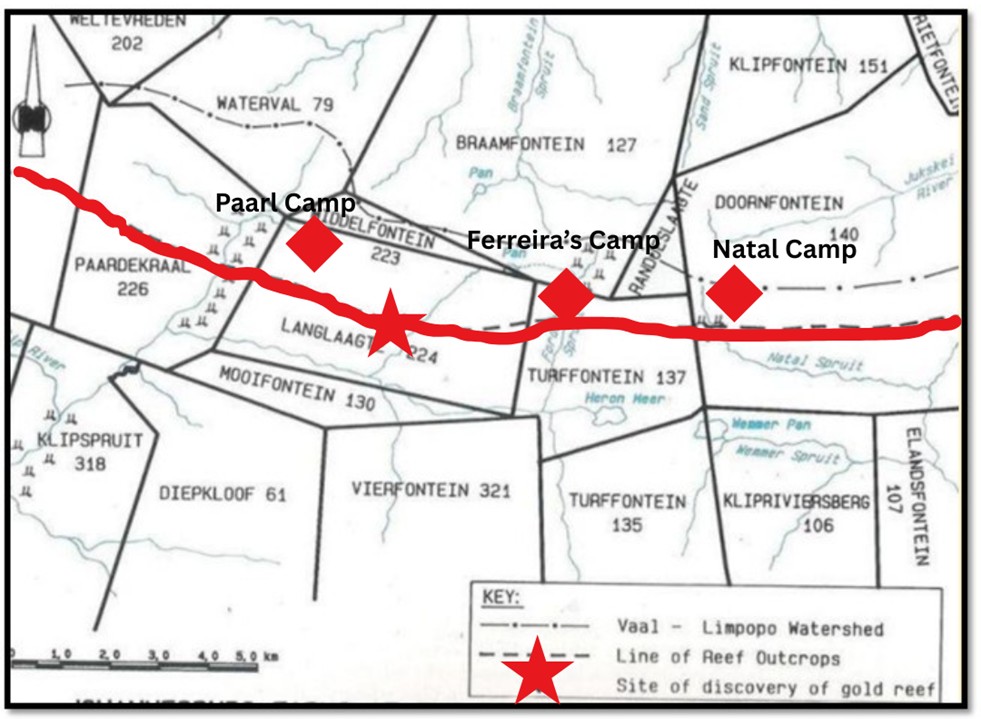
Heritage Portal: Johannesburg farms at the time gold was discovered (adapted)
Beit was in constant contact with Jim Taylor whom he had trained as a diamond buyer. Taylor became a share broker at Barberton and had learnt a good deal about gold mining and sampling and Beit now re-employed him as his agent. On Taylor’s advice Beit sold all his Barberton mining shares before the crash came.
Jim Taylor told his brother that the Struben brothers had told him that outcrops of Langlaagte farm on the Witwatersrand looked payable and William took samples from the main reef and sent them to Beit in Kimberley. Then Joseph B. Robinson who was down on his luck came and said he wanted to investigate the Witwatersrand. Beit lent him £20,000 to buy likely-looking gold prospects; in return Beit would have a one third share, the other two-thirds going to Robinson and his partner. This came to be known as the ‘Robinson Syndicate.’
Rhodes misses early opportunities on the Witwatersrand that Beit and Robinson take up
The journey from Kimberley took two days and nights by coach and Robinson and Sauer stayed with Petronella Oosthuizen, the owner of Langlaagte farm. Next day they examined a small, inclined shaft dug by a French prospector and then went to Ferreira’s Camp on Turffontein farm. Both sites yielded samples with good gold indications. Sauer then walked ten miles west along the reef outcrops with Mrs Oosthuizen’s son collecting samples.
Excited by his finds Sauer returned to Kimberley and tried to persuade Rhodes and Rudd to purchase a block of claims on the Witwatersrand’s main reef, but Rhodes would not. When asked why, he replied, “When I am in Kimberley and have nothing much to do, I often go and sit on the edge of the De Beers mine, and I look at the blue diamondiferous ground, reaching from the surface, a thousand feet down the open workings of the mine, and I reckon up the value of the diamonds in the ‘blue’ and the power conferred by them. In fact, every foot of blue ground means so much power. This I cannot do with your gold reefs.”[31]
Sauer did persuade Rhodes and Rudd to accompany him to the Witwatersrand, but fate also intervened. Neville Pickering was the first secretary of De Beers and Pickering and Rhodes shared a cottage opposite the Kimberley Club. Sauer was showing Rhodes and Rudd very early diggings on the Witwatersrand in August 1886 when news came from Dr Jameson that Pickering who had fallen off a horse in 1884 was near death. Rhodes rushed back to Kimberley and nursed Pickering faithfully for six weeks, ignoring any business interests before Pickering died in his arms and Rhodes wept openly at his funeral. Rhodes was well informed by Sauer of the early opportunities in gold mining but passed them up in favour of nursing Pickering.
Robinson purchased Langlaagte farm for £6,000 and bought the mineral rights on Turffontein farm, the site of the future Robinson Gold Mine, one of the richest mines the world has ever known and at Randfontein he bought seven farms and 40,000 acres for a total cost of £26,000, an area which would yield gold worth millions and millions. If Rhodes did not seize the chance, Beit on the advice of Jim Taylor would with his friends Julius Wernher and Herman Ekstein.
There was very little scope on the Witwatersrand for the individual digger as expensive mining machinery was required to work the gold claims. At the start, there was much fraud with many promoters eager to make money quickly and there were equally many managers who knew very little about underground mining operations. Indeed, Gardner Williams, appointed general manager at Kimberley in 1887, stated the Witwatersrand would only be a passing phase like Barberton and Pilgrim’s Rest and that there were no paying goldfields in South Africa.
The Witwatersrand in South Africa was to become the world’s largest and richest known gold field, having produced over 1.6 billion to 2 billion ounces of gold since 1886 accounting for 40% - 50% of all gold ever mined on Earth.[32]
Beit and the deep-level gold mines of the Witwatersrand
Initially very little mining could be done as the hard rock outcrops could not be crushed. Stamp mills were required; they cost £10,000 each and had to be ordered from England or America and transported by sea and then by ox-wagon from the coast; the first ten stamp mill began operations at the Robinson Mine in September 1886.
Beit’s representatives and close friends at the Witwatersrand were Hermann Eckstein and Jim Taylor and later Lionel Phillips. Behind Beit was Jules Porgès and his partner Julius Wernher.[33] Through the firms, Wernher, Beit and Co,[34] and H. Eckstein and Co, Beit gave the lead in the financial organisation and exploitation of the gold mines, in the methods of raising capital, the administrative set-up and the pioneering techniques of deep-shaft mining. The firms no longer exist, but the Central Mining and Investment Corporation, which succeeded them and the group associated with Rand Mines Limited[35] and the Corner House Group[36] became examples of his sound planning. The need for concentration and amalgamation was even more obvious than at the diamond diggings as the costs of deep-level gold mining and sinking vertical shafts to depths of 1,000 feet and more were enormous, with no guarantee of striking the main reef.
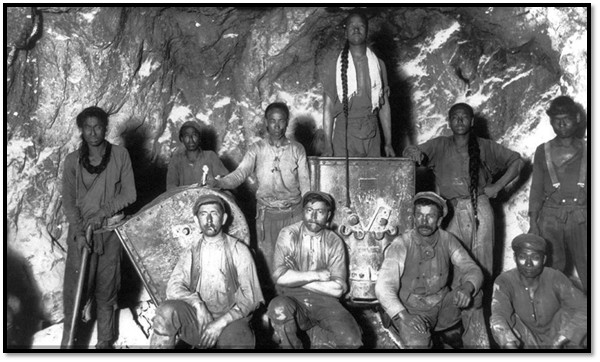
Early underground gold mining on the Witwatersrand – note the Chinese miners employed between 1904 - 1908
Eckstein and Taylor found it extremely difficult working with Robinson and Marcus and when Robinson suggested they break-up the syndicate, Beit was delighted, and they parted company in 1888. Beit kept the central and eastern parts of the Syndicate’s properties, including the Robinson, for £250,000. This eventually earned the firm of Wernher, Beit and Co over £100 million[37]
From the first Beit resolved that the mines under his firm’s control were not to be run for share-making and marketing purposes. Shares were not issued to the public, rather selected business partners were asked if they wanted to be investors. Working capital was financed through borrowing until they became dividend paying. The shareholders were informed monthly of everything that happened on the mines — nothing was hidden.[38] Only when the financial world saw that it was not another speculative boom did the international banks have the confidence to invest in the Witwatersrand. In 1892 Hamilton Smith who had gained great practical experience in the goldfields of Alaska was sent to South Africa by Rothschilds to report on the prospects of mining at deep-levels, and on his advice, Rothschilds took a financial interest in a number of the deep-level mines owned by Wernher Beit & Co.
In 1889 Joseph Storey Curtis, a mining engineer employed by Werner Beit, “bored earth 1,000 feet south of the outcrop: his drills struck rich ores at 571 feet and the main reef at more than 600 feet. By late 1893, his laborious drilling had established that the main reef continued underneath what became Crown Deep, 1,600 feet from the outcrop, and that the gold there was very rich - nearly 14 ounces to the ton milled.[39] On the evidence of the core results that the main reef dipped out of vertical south of the outcrop, Lionel Phillips and Curtis began buying up farms south of the main reef in secret, and were backed by Beit and Eckstein.[40]
Beit wrote to Lionel Phillips in March 1892, “I have thought a good deal about the deep-level speculation and studied the plans and the more I go into it the more I see the importance of acquiring the remaining blocks like Lippert’s and Van Diggelen’s township…It would not be too much for our firm to invest £100,000 in this enterprise. It would not matter if eventually the £200,000 was exceeded. I feel confident that we will soon see good time and that you and we all will be rewarded for all the anxiety and worry we have had for the last seven years. I have the greatest confidence in your capacity and am very appreciative of your zeal and I have no doubt that before the year is out you will be able to give us a good account of your stewardship.”
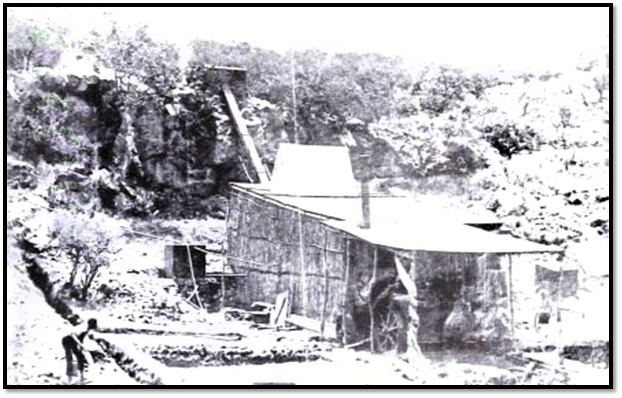
Heritage Portal: very early crushing plant on the Witwatersrand
Early crushing plant extracted gold by passing milled ore over a copper plate coated with mercury. When pyritic ores, which were harder, were encountered on the Witwatersrand below 100 feet the ore had to be crushed more thoroughly and treated in chlorination plants which raised the cost, reducing profits, and by March 1890 the value of many gold shares had dropped more than 60 percent bankrupting investors and banks.
Wernher Beit bought up additional properties during the resulting slump and became one of the first gold miners to use the new cyanide process for treating gold ore – tests resulted in recoveries of 90%, higher than those from mercury extraction.[41]
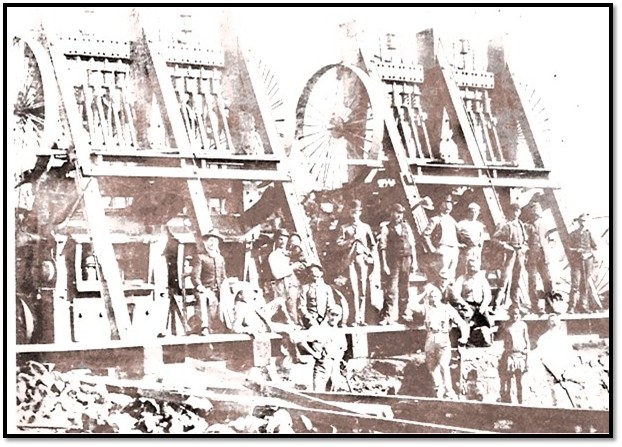
Heritage Portal: newly erected sixteen stamp mill on the Witwatersrand
Beit gives Rhodes a shareholding in Rand Mines Ltd
Until 1887 Rhodes had tried to dissuade Beit from investing on the Witwatersrand. He had sent his general manager at De Beers, Gardner Williams, to investigate the possibilities. Williams spent ten days with Sauer and when asked for his assessment of the possibilities said, “Dr Sauer, “if I rode over these reefs in America, I would not get off my horse to look at them. In my opinion, they are not worth hell room.”[42]
Rhodes’ business partner Charles Rudd believed many of the samples he was sent by Beit were salted and did not believe they were genuine. He turned down an opportunity to purchase a mile-long stretch of claims at £40 each to the east of Ferreira's camp that proved to be fabulously rich in gold, later supporting six highly profitable mines.
Rhodes and Charles Rudd only realised the economic value of deep-level gold mining long after Beit.[43] Subsequently, Rhodes then asked for “an interest” in Beit’s Rand Mines Ltd and Beit agreed in 1892, six years after the gold discoveries! Rotberg suggests that Beit wanted the solid backing of his old friend and fellow schemer, especially now that Rhodes had become so well-placed politically.[44] Beit said that he would “make some arrangement with Rhodes and Rudd. I think it would be wise to do so. Rhodes’ brains are not to be despised, and if we had interests apart from theirs there would always be friction.”[45] On its 1,357 claims Rand Mines Ltd established ten gold mines; an original £1 share in 1893 would be worth £45 within five years[46]. In 1899, the company paid its shareholders a dividend of 100 percent. After the negotiations, the shareholdings of Rand Mines Ltd were Gold Fields 10%, Rothschilds 20%, Wernher Beit 60%, others 10%.[47]
The Jameson Raid
Rhodes and Jameson had enjoyed a run of successes; the subjection of Mashonaland by the Pioneer Column in 1890,[48] the conquest of Matabeleland in 1893,[49] the grabbing of trans-Zambezia. “Their hubris was to assume that the smash-and-grab tactics that worked across the Limpopo would work across the Vaal…and Jameson crossed the border confident that he would stir Johannesburg to revolt and that the British Government would have to back him.”[50]
Up to the 1890’s Beit’s friendship with Rhodes had brought him luck and fortune (In the mid 1890’s, Beit was alleged to be the richest man in the world with shareholdings of some £10 million)[51] it was now to be Beit’s misfortune. Johannesburg had grown rapidly and within nine years had far outstripped Pretoria, the seat of government. However, President Kruger steadfastly refused to give foreigners (i.e. non-Boers) the vote or any representation fearing that their numbers would swamp the Boer population in the South African Republic (Zuid-Afrikaansche Republiek or ZAR) Until then Beit had kept away from political controversies and activities but was persuaded by Rhodes to take a hand in preparing the movement in support of the Uitlanders and financed it with his money.[52]
Beit had deep reservations about the scheme; however he agreed to help finance the buying of arms and ammunition. Rhodes, now the Prime Minister of Cape Colony,[53] could not attend to details, with the result that neither of them knew exactly what was being planned and it resulted in the disastrous Jameson Raid.[54] Later, together with Rhodes, he generously paid the fines into which the death and prison sentences of the Reformers had been commuted. Rhodes subsequently admitted that the Jameson Raid had cost Beit and himself £400,000 each.[55]
On 17 December 1895 Beit arrived in Cape Town from London but felt too ill to proceed to Johannesburg. At Rhodes’s request, he stayed at the latter’s cottage at Muizenberg. Everyone who had had any knowledge of the Raid was bound to be heavily hit by its outcome; for a man so easily affected as Beit it was a blow from which he never entirely recovered. He immediately returned to London and there had “to face a bewildering and ever-increasing number of financial obligations and entanglements in which he himself and his firm and the Chartered Company found themselves as the result of the Raid.”[56]
The Select Committee of the House of Commons reported, “In June 1895, Mr Rhodes and Mr Beit formed a plan for organising the discontent at Johannesburg, providing the necessary money and arms for the purpose of an insurrection there, and placing a force under Dr Jameson on the frontier of the Transvaal to assist and support it” and they included Beit in the censure passed upon Rhodes, though attesting to his personal integrity (and lack of profit motive) and he had to resign his directorship of the Chartered Company in mid-1896. In addition he suffered a nervous breakdown and was fined £200,000. Beit did support the 1899-1902 South African War, providing funds for the Imperial Light Horse and the Imperial Yeomanry.
Death on 16 July 1906
When Beit was reinstated eight years later to the Board of the Chartered Company, he once again in 1905 set out to visit Rhodesia, but a stroke put an end to this journey and he returned to his recently acquired English estate Tewin Water. In the following summer Alfred Beit died at his home on 16 July 1906 and was buried in the local churchyard at St Peter’s Church, Tewin, Hertfordshire.
“Certainly, he was a very rich man, who lived in great style as befitted his means, but he ever remained modest, unassuming, and in public even almost nervously shy. As a young man he had not even the burning ambition which fires so many, to become very rich; according to Rhodes ‘all that Beit wanted was to be rich enough to give his mother a thousand a year.”[57]
Rotberg writes, “Beit was worth about £8 million - more than twice as much as Rhodes - when he died in 1908. (sic) He was a wise speculator and, like Rudd, was steady, solid, sober, free from scandal and loyal. Again, it is hard to conceive that Rhodes would have achieved as much as he did in the world of commerce without Beit. Had he not had Beit’s help, there would have been no consolidation of diamond mining interests, no (or a much smaller) stake in gold, few other corporate victories and no surplus resources for Rhodesia and the rest.”[58]
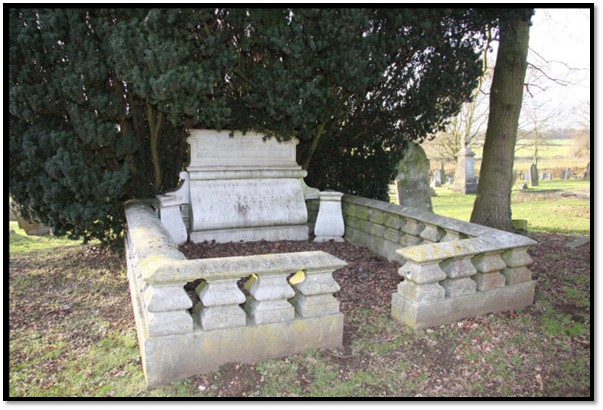
https://www.findagrave.com/memorial/47426590/alfred-beit#view-photo=25340193
Like Rhodes and Jameson, Beit never married. His name never triggered controversy but also did not gain the lustre of those of his associates. One reason was that, with the one unhappy exception of the Jameson Raid, he refrained from entering political life and strife; the other was the tact and modesty with which he shunned publicity and the limelight and left the others the star parts on the public scene, which they could not have performed without the quiet financier in the background.
Last word to Percy Fitzpatrick, author of Jock of the Bushveld who said, “There can be no doubt whatever that Beit was Rhodes financial genius, and without him the great creations which are credited to Rhodes would not have been accomplished. But there was more than that; there was a strong personal affection and almost passionate devotion on Beit’s part that enabled these two very different characters to act as one.”
For information on Alfred Beit’s philanthropy see the article Alfred Beit’s Legacy to Zimbabwe, Zambia and Malawi
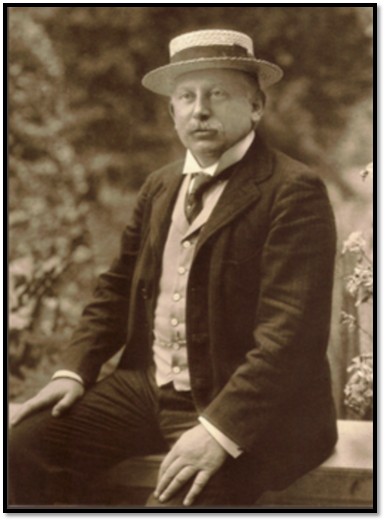
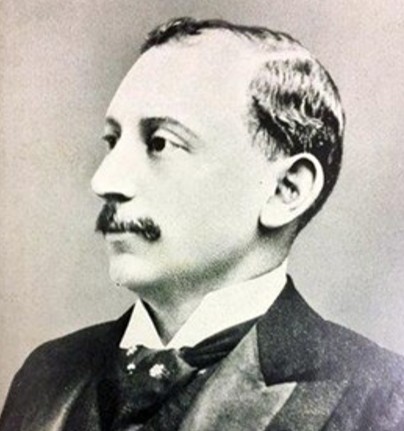
Alfred Beit (1853 – 1906)
References
H. Albrecht. Alfred Beit: the Hamburg Diamond King. Hamburgische Wissenschaftliche Stiftung gegründet 1907
Anon. Alfred Beit’s gift to the nation. The Bulawayo Chronicle Jubilee supplement of Friday, 6 September 1940 celebrating 50 years of achievement in Southern Rhodesia
Anon. Rhodes Scholarships. The Bulawayo Chronicle Jubilee supplement of Friday, 6 September 1940 celebrating 50 years of achievement in Southern Rhodesia
G. Auerback. Alfred Beit – South Africa’s Financial Genius
Part 1 https://kehilalinks.jewishgen.org/kimberley/Alfred_Beit.html
Part 2 https://www.chol.website/memoirs/Alfred%20Beit%20Part%202%20Transvaal%20and%20Rhodesia.pdf
P.H. Emden. Randlords. Hodder and Stoughton Ltd, 1933
M. Meredith. Diamonds, Gold and War: The British, the Boers and the making of South Africa. Public Affairs, New York 2007
J. Pellow. Donors to an Imperial Project: Randlords as benefactors to the Royal School of Mines, Imperial College of Science and Technology. https://www.imperial.ac.uk/media/imperial-college/administration-and-support-services/equality/public/history-group/Appendix-9---Alfred-Beit,-Otto-Beit-and-Julius-Wernher.pdf
R.I. Rotberg. The Founder: Cecil Rhodes and the Pursuit of Power. Oxford University Press, 1988
G. Seymour Fort. Alfred Beit : A Study of the Man and his Work. Ivor Nicholson & Watson, London 1932. https://archive.org/details/alfredbeit0000gsey/page/n7/mode/2up
Dr H.O. Simon. The Centenary of Alfred Beit. The Chronicle. 3 July 1953. Rhodes Centennial Supplement, Page 43
J.B. Taylor. A Pioneer looks back. Hutchinson & Co, London, 1939
The Beit Trust. https://beittrust.org.uk/
Wikipedia – Alfred Beit
Notes
[1] J.B. Taylor was a protégé of Beit’s and became a Randlord himself
[2] Alfred Beit – South Africa’s Financial Genius
[3] Alfred Beit : A Study of the Man and his Work
[4] The Founder, P67
[5] Beit’s Lippert cousins Ludwig, Eduard and Wilhelm had set branches in Port Elizabeth, Cape Town and Durban
[6] See the article Land and the British South Africa Company - the Renny-Tailyour and Lippert concessions under Harare on the website www.zimfieldguide.com
[7] Diamonds, Gold and War, P122
[8] Ibid
[9] Donors to an Imperial Project
[10] Ibid, P154
[11] Rhodes’ great rival, Barnato was born Barnet Isaacs in Aldgate, London in 1851. His mother died the following year; their father, Isaac Isaacs made a living in Whitechapel by selling second hand clothing and fabric remnants
[12] The Founder, P114. Both were twenty-six years old at this time
[13] Ibid, P115
[14] Diamonds, Gold and War, P123
[15] A Pioneer looks back
[16] South Africa’s Financial Genius
[17] The London Diamond Syndicate was a consortium of ten Hatton Garden diamond merchants formed to buy and control the distribution of rough diamonds from De Beers. Clearly this was an attempt to establish a monopoly by controlling diamond supply and later became the Central Selling Organisation (CSO) and later the Diamond Trading Company (DTC)
[18] Diamonds, Gold and War, P58
[19] Ibid, 154
[20] Ibid, P155
[21] Speculators drove up the share prices in Central and De Beers and both Barnato and Rhodes realised that things were becoming out of hand. De Beers’ shares worth £3.10s in January 1885 reached £47 in March 1888
[22] Rhodes sweetened the deal by overcoming anti-Jewish prejudice and getting Barnato elected for membership of the Kimberley Club and they met for drinks and had lunch together
[23] Barnato was lost overboard a ship on 14 June 1897 near the island of Madeira while sailing to England. A crew member giving evidence at his inquest stated Barnato had been walking round the deck with his nephew Solly Joel at the time and, as he fell overboard, his last word was "murder!" He had been the largest individual shareholder in De Beers
[24] Wikipedia: Aldford House built 1894-7, demolished 1929
[25] Wikipedia – Alfred Beit
[26] Donors to an Imperial Project
[27] Diamonds, Gold and War, P122
[28] The Witwatersrand ‘ridge of white waters’ is the ridge of gold-bearing rock in the Transvaal (now Gauteng) and forms the watershed between the Vaal and Limpopo rivers
[29] The first 13,000 tons of ore at the Sheba gave 50,000 ounces of gold and £1 nominal shares rose to £105
[30] Diamonds, Gold and War, P180
[31] The Founder, P193
[32] Wikipedia - Witwatersrand
[33] Diamonds, Gold and War, P187
[34] Due to the failing health of Sir Julius Wernher and the death of Alfred Beit earlier in 1906, the partnership was dissolved on 31 December 1911.
[35] Rand Mines Limited, once a major South African mining finance company now exists only as a holding company for a minority shareholding in Ingwe Coal Corporation Ltd
[36] The name Corner House comes from the surname of Hermann Eckstein as Eckstein means "cornerstone" in German. The first building on the site at 77 Commissioner Street, Johannesburg was built in 1886 and made of corrugated iron and wood and known as "Beit's house" although a sign said H. Eckstein. In 1893, a much grander two-story building was erected with balconies, cast iron railings and a copper and green-tiled cupola. In 1903 the present Corner House was commissioned by Eckstein and Co. On completion at nine stories it was the tallest commercial building in South Africa with five elevators powered by its own electric power plant and a strong room on each floor. Initially housing H. Eckstein and Co, in 1905 the Central Mining and Investment Corporation took offices. Corner House is still a notable landmark in Johannesburg
[37] Alfred Beit – South Africa’s Financial Genius
[38] Randlords, P160
[39] The Founder, P502
[40] Claims on these farms resulted in some of the richest mines; Jumpers Deep, Nourse Deep, Glen Deep, Rose Deep, Village Deep, Crown Deep, Ferreira Deep and Geldenhuis Deep
[41] Diamonds, Gold and War, P192-3
[42] Alfred Beit – South Africa’s Financial Genius
[43] Rhodes’ primary gold mining company was Gold Fields of South Africa Limited formed on 9 February 1887 by Rhodes and Charles Rudd that held their mining interests in Robinson Deep and the Simmer and Jack Mines on the Transvaal's Witwatersrand, later in 1892 becoming Consolidated Goldfields of South Africa
[44] Rhodes entered the Cape Parliament in 1881 after his election as a member for Barkly West which re-elected him until his death in 1902. He became prime minister of the Cape Colony in 1889
[45] The Founder, P502
[46] Diamonds, Gold and War, P303
[47] Ibid, P504
[48] See the article The Pioneer Column’s march detailed on maps under Masvingo Province on the website www.zimfieldguide.com
[49] See the article Iron Mine Hill (Ntabasinsimbe) and the first casualty of the 1893 Matabele War under Masvingo Province on the website www.zimfieldguide.com
[50] The Founder, P519
[51] Donors to an Imperial Project
[52] The Jameson Raid was said to have been planned from the Corner House at 77 Commissioner Street
[53] Rhodes served as Prime Minister of the Cape Colony for nearly six years from 17 July 1890 to 13 January 1896 resigning after the Jameson Raid
[54] See the article The Jameson Raid under Bulawayo on the website www.zimfieldguide.com
[55] Diamonds, Gold and War, P350
[56] The Founder, P165
[57] Ibid, P152
[58] The Founder, P684