
The arrival in Bulawayo of the first train
This article is taken from the Rhodes Centenary Supplement published by the Chronicle in Bulawayo on the 3rd of July 1953 Page 9 and was written by Lieut-Col H.R. Everard.[1] The article reflects the attitudes and opinions that were prevalent at the time. Other sources have been used and notes added.
A Chronicle reporter went out to the old Bulawayo Athletic Club ground on Tuesday afternoon,[2] shortly after 2pm and sat with the number of others on the bank between the cuttings to await the arrival of the first construction train. The work of laying the rails, which are now some distance to the town side of the refreshment room, was going on cheerily and expeditiously at the feet of the expectant watchers.
All eyes were turned towards the rise to the south of the town over which it was known the train must travel. Suddenly, someone said, “There she comes!” Everyone rose to their feet and could just discern a faint column of smoke over the crest of the rise. It advanced rapidly and presently the train emerged from the bush and became visible, a shrill whistle demonstrating to another sense its approach almost at the same time. At about 3pm, the train drew up at the temporary siding about half a mile from the station site to which place for the next month or six weeks, goods and passengers will be brought commencing before the week is out.
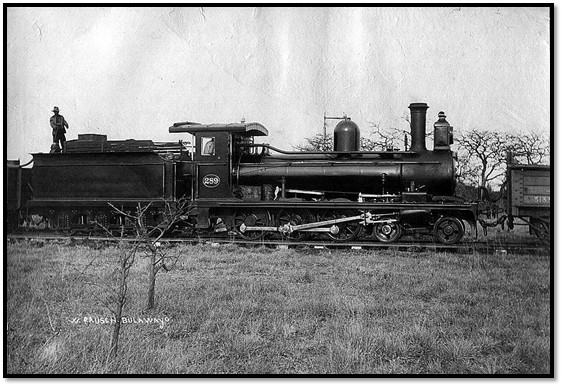
No. 289 with extended smokebox and Salter safety valve, c. 1897[3]
The train tarried here so long that the Chronicle reporter became impatient, and risking punctures, cycled down to the loop where the train was standing. Here he found that it consisted of a saloon car, a cattle truck and four or five ordinary trucks. The engine, the same one that had been used for the plate laying all the way from Lobatsi,[4] was gaily decorated with bunting and greenery.[5] On the front were the words ‘Advance Rhodesia,’ surmounted by the arms of the British South Africa Company. Miniature Union Jacks, Stars and Stripes, and the harp of Erin adorned the escape pipe and a variety of flags were wreathed gracefully around the iron monster.
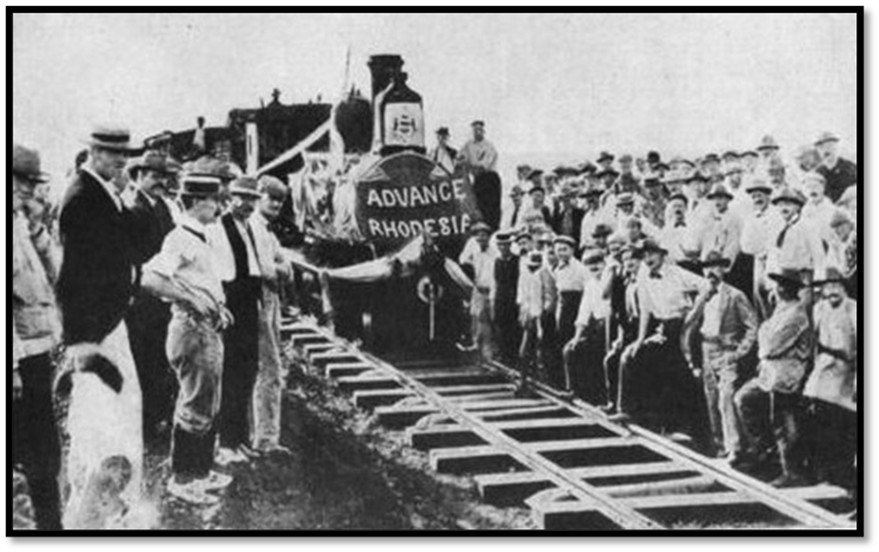
THL Image Collection: N&T photo: the official opening of the railway: Bulawayo, 4 November 1897
The report concludes; “After gazing awhile on the wonderful invention, which brings Bulawayo within four or five days of sea breezes and makes progress with giant strides of possibility, the crowd dispersed.”
It is probable that the railway will not be taken over by the Cape government until the end of the year. But it is here at last. The contractor,[6] despite immense difficulties, has accomplished his work well under the specified time, and coaches and ox-wagons along the great artery from Cape Town to Bulawayo, are almost things of the past.
The line from the East[7]
1891 was also an important year for the railways as on 11 June the Portuguese government agreed to build a line between Fontesvilla[8] on the Pungwe river to Umtali. In October of that year Rhodes travelled by sea to Beira and overland on foot and wagon to Salisbury and saw for himself the possibilities of a rail connection. Construction began in September 1892 at Fontesvilla and Umtali was reached in February 1898 but only at a horrendous cost in human lives.
Thomas W. Rudland[9] worked on the Beira railway acting as Arthur Lawley’s chief construction engineer for nine months. He writes, “the Pungwe flooded hundreds of square miles of the flats, and the workers suffered appalling bouts of fever. Labour shortages, derailments, and fever — always the fever — continued to dog us. At the end of the first eight months there were only four of us left of the original staff. Some had given up the job, most had died… In April 1898, the first section to Umtali was completed. We celebrated with a "Railway Banquet" — and compared the spread with our former rice rations. When we drank the toast to the 400 men who had laid down their lives, we thought of the labourers from India who had died almost to a man; we knew that no other railway in the world had had such a high mortality rate. But we had built the longest narrow-gauge railway in the world!”[10]
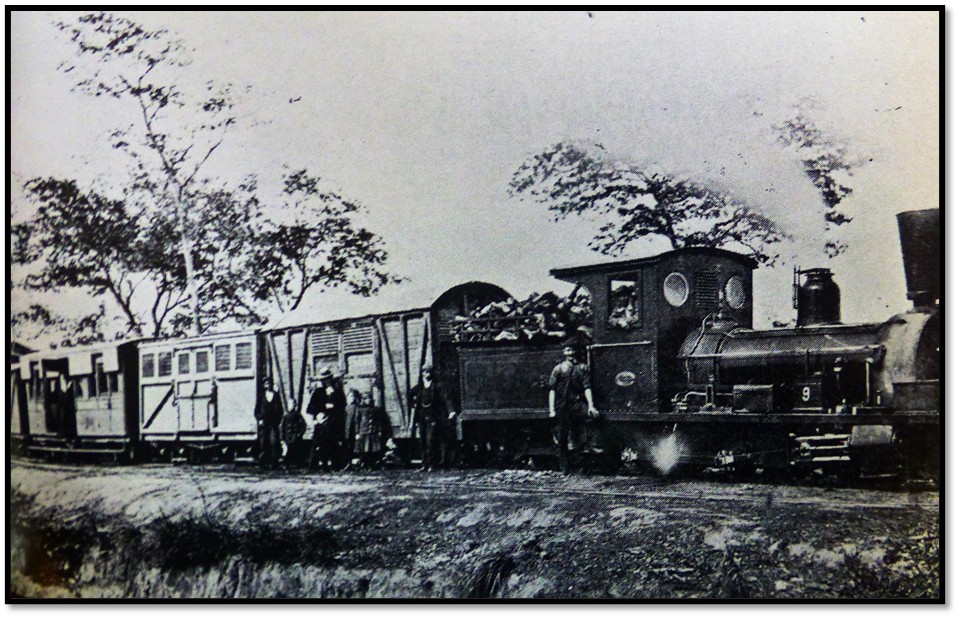
Courtesy of Railways of Zimbabwe – a narrow-gauge mixed train behind a Beira Railways 4-4-0 at a siding in 1895
Mr Rudland quotes this poem by Cullen Gouldsbury who wrote the ballad of the Beira Mashonaland Railway (B.M.R.) in “Rhodesian Rhymes” in 1912:
Down in the land where the heathens are,
Down in the swamps where white men stew,
Amid the woods that stretch afar,
Amid the creepers rank with dew,
The Line ran out — perchance, askew,
And drunkenly designed — but, ah!
In days gone by was work to do
Upon the lonely B.M.R.!
The Gates of Death were held ajar —
The pegs that marked the mileage too
Have stood for tombstones — near and far
Ghosts of a grimy shrivelled crew.
The sun looked down from out the blue—
Out of the night looked down the star,
And marked where men had drifted through
The death-trap of the B.M.R.
Each bolt, each nut, each metal bar,
Could tell a story — grim but true —
And where the gangers' houses are
Maybe are ghosts of dead men too —
Ghosts of men who worked and knew
The fever swamp, the sickening jar
That came when life was rusted through
Upon the Lonely B.M.R.
L‘Envoi Lo! — we may scoff — we often do —
And jest at engine, truck and car —
But— must we then forget the few
Who made for us the B.M.R.
The line was built to the 2ft (610mm) gauge and construction material and other traffic was landed at Beira from overseas and conveyed up the Pungwe River[11] to Fontesvilla. Shortly afterwards, however, it was found desirable, to connect Fontesvilla with Beira by rail, and a new company, the Beira Junction Railway Company (amalgamated with the Beira Railway Company in 1930) was formed to carry out this construction, the line being completed in October 1896.
In the meantime the limited capacity of the original line and the difficulties of transhipment to the 3ft 6inch gauge line, which was being built from Umtali onwards, led to its conversion to the latter standard, and by August 1, 1900, a 3ft 6inch railway was in existence over the whole distance between Beira and Umtali.
The story has often been told of the difficulties under which the first engineers laboured. Despite the fact that floods frequently hampered operations and the death toll was heavy, the engineers, Sir George Bruce and Sir Charles Metcalfe, certified the Beira-Fontesville line as complete on 29 October 1896. The names of George Pauling and Arthur L. Lawley will long be remembered as being intimately connected with port and railway development in the Beira-Umtali area.
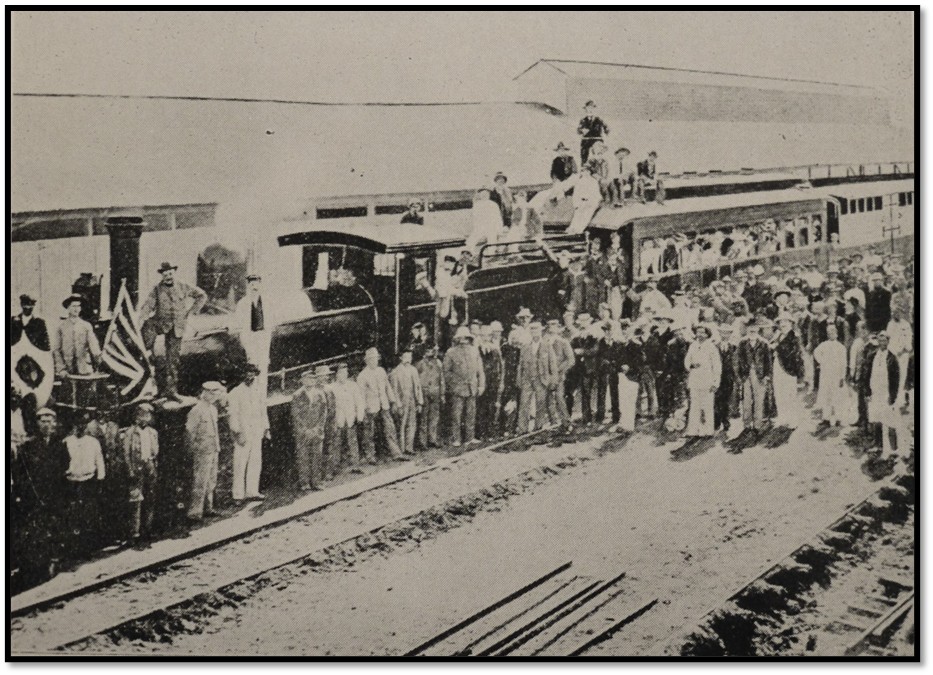
NAZ - the first train at Beira at the opening of the standard gauge on the Beira and Mashonaland Railway – 1 August 1900
Connecting Umtali and Bulawayo
At the end of 1897 there was still a gap of 300 miles between these towns. Construction of the rail line from Umtali was pushed forward and Salisbury reached on 22 May 1899 in the same month the extension of the line from Bulawayo to Gwelo was begun.
Construction had reached a point near Insiza siding when the Anglo-Boer War broke out in October 1899 and construction came to a standstill with no material and stores coming through Bechuanaland. It was therefore decided to continue the line from Salisbury using the eastern rail route from Beirn for the necessary supplies. This extension was begun in 1900 and proceeded at a reasonable pace to Gwelo, at that time an important coaching centre, which was reached in May 1902; then on to Insiza railhead, where a link-up was effected five months later, on 6 October of that year, some six months after Rhodes had been buried in the Matobo.
In a letter written in Bulawayo on September 7, 1900, Rhodes said, "As to the commercial aspect, everyone supposes that the railway is being built with the only object that a human being may be able to get in at Cairo and get out at Cape Town. This is, of course, ridiculous. The object is to cut Africa through the centre and the railway will pick up trade all along the route. The junctions to the east and west coasts, which will occur in the future, will be outlets for the traffic obtained along the route of the line as it passes through the centre of Africa. At any rate, up to Bulawayo, where I am now, ii has been a payable undertaking, and I still think it will continue to be so as we advance into the far interior. We propose now to go and cross the Zambesi just below the Victoria Falls. I should like to have the spray of the water over the carriages."
References
H.B. Everard. Arrival in Bulawayo of the First Train. The Chronicle, P15. 3 July 1953. Rhodes Centennial Supplement
CGR 4th Class 4-6-0TT 1882 ‘Joy.’ https://en.wikipedia.org/wiki/CGR_4th_Class_4-6-0TT_1882_Joy
www.zimfieldguide.com The Railway comes to Bulawayo – the town’s festivities in November 1897
Rhodesia 1890 – 1950: A Record of Sixty years progress
https://archive.org/details/SouthernRhodesia1890-1950ARecordOfSixtyYearsProgress/page/n77/mode/2up
A.H. Croxton and R.A.H. Baxter. Railways of Zimbabwe. David and Charles, 1982
[1] General Manager of the Rhodesia railways
[2] Tuesday would have been 19 October 1897.
[3] No 289 was a Cape Government Railway (CGR) 4th Class 4-6-0TT 1882 Joy locomotive.
[4] Lobatsi (now Lobatse) is a town in southeast Botswana about 45 miles (72 kms) southwest of Gaberone and is on the main road and railway line between South Africa and Zimbabwe
[5] The locomotive was George Pauling’s construction engine No 289 seen in the photo above
[6] The contractor was George Pauling whose company was awarded the contract for the construction of the 644 kilometres line from Mafeking to Bulawayo that was completed within 440 day timetable
[7] This section written by Arthur Griffin (later Sir) general manager of Rhodesia railways in an article in Southern Rhodesia: 1890-1950 A Record of Sixty Years Progress P87
[8] Fontesvilla (also spelt Fontesville) was a place 35 miles (56 kms) up the Pungwe river and was its highest navigable point for the little tugboats that towed barges up the river. It was the starting point for the narrow-gauge (2 feet or 610 mm) track of the Beira Railway Company that ran from the western bank of the Pungwe river to Umtali. In 1891 the task of completing the railway line across the Pungwe flats, the swampy estuary of the Pungwe river between Beira and Fontesvilla was considered impossible
[9] In 1960 Mr T.W. Rudland was one of two survivors still alive who were present when the Union Jack was raided at Fort Salisbury on 13 September 1890
[10] Southern Rhodesia 1890-1950: A Record of Sixty Years Progress, P77-9
[11] On barges pulled by a tugboat often running aground on sandbars