
The Great Enclosure at Great Zimbabwe in photographs - 2025
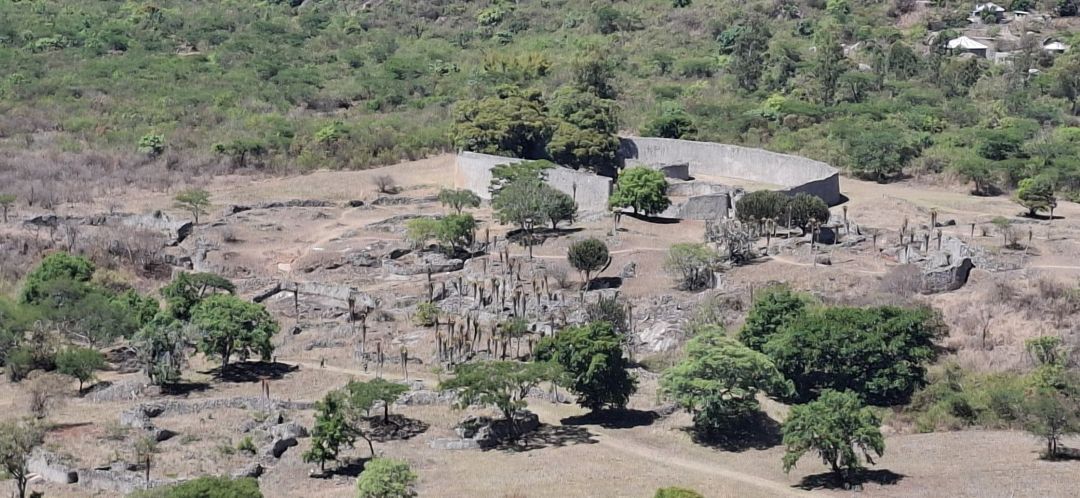
The Great Enclosure and Valley Complex as seen from the Hill Complex
Summers reveals the many names this building has had in the past. Karl Mauch in 1872-6 called it Mumbahuru (House / Palace of the Great Wife) other names include Circular Building (Bent 1892) Temple, Elliptical Temple (Hall 1905) Elliptical Building (White 1905: Schofield 1929; Caton-Thompson 1931) and then Great Enclosure (Summers 1958)
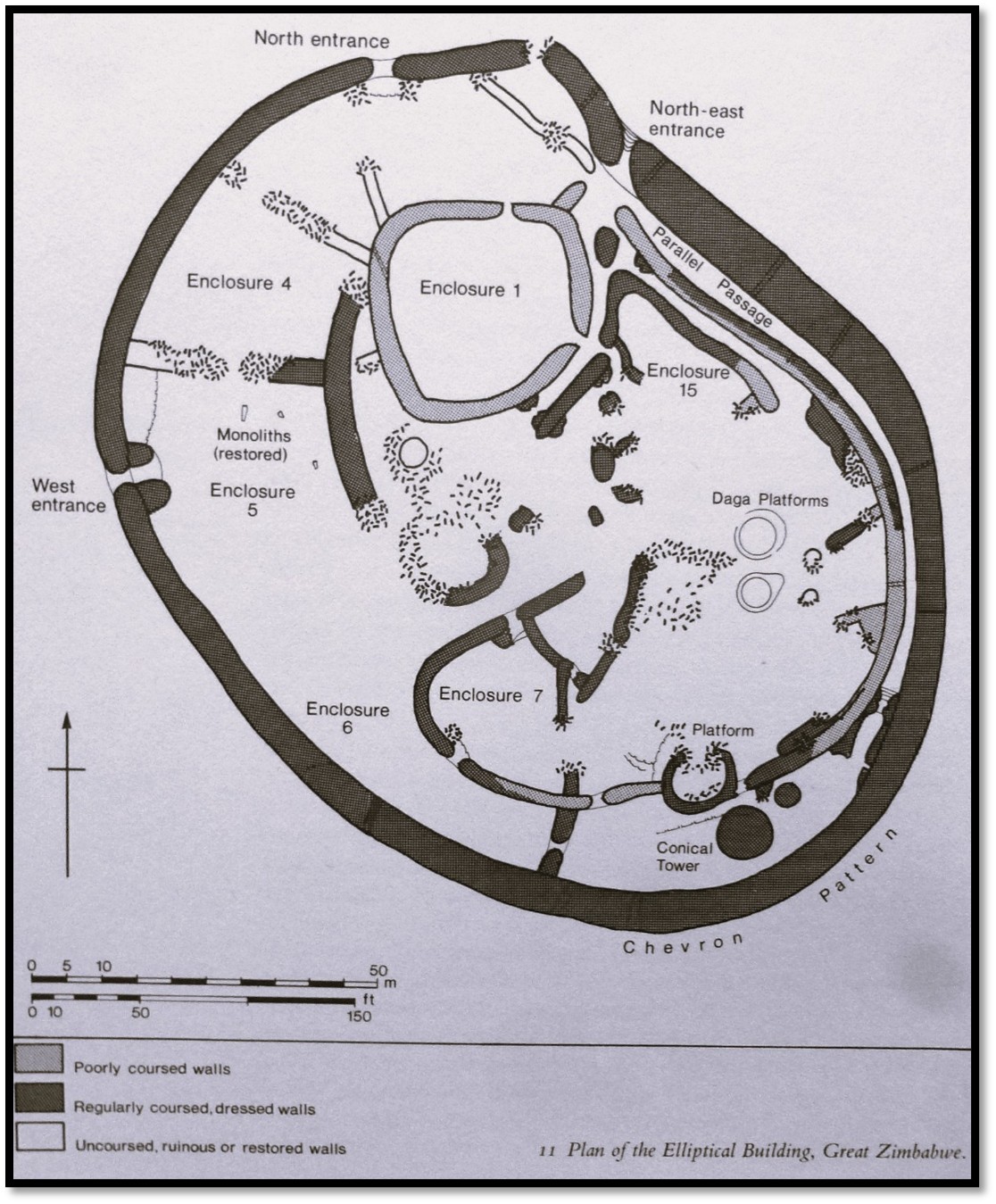
Garlake: plan of the Great Enclosure. Regularly coursed walls are in dark colour, poorly coursed walls are lightly hatched, uncoursed, ruined or restored walls are white. The first accurate plan by A. Whitty was made in 1956 and shows there was a completely enclosed structure within the Great Enclosure that was divided by a number of minor walls into six compartments.
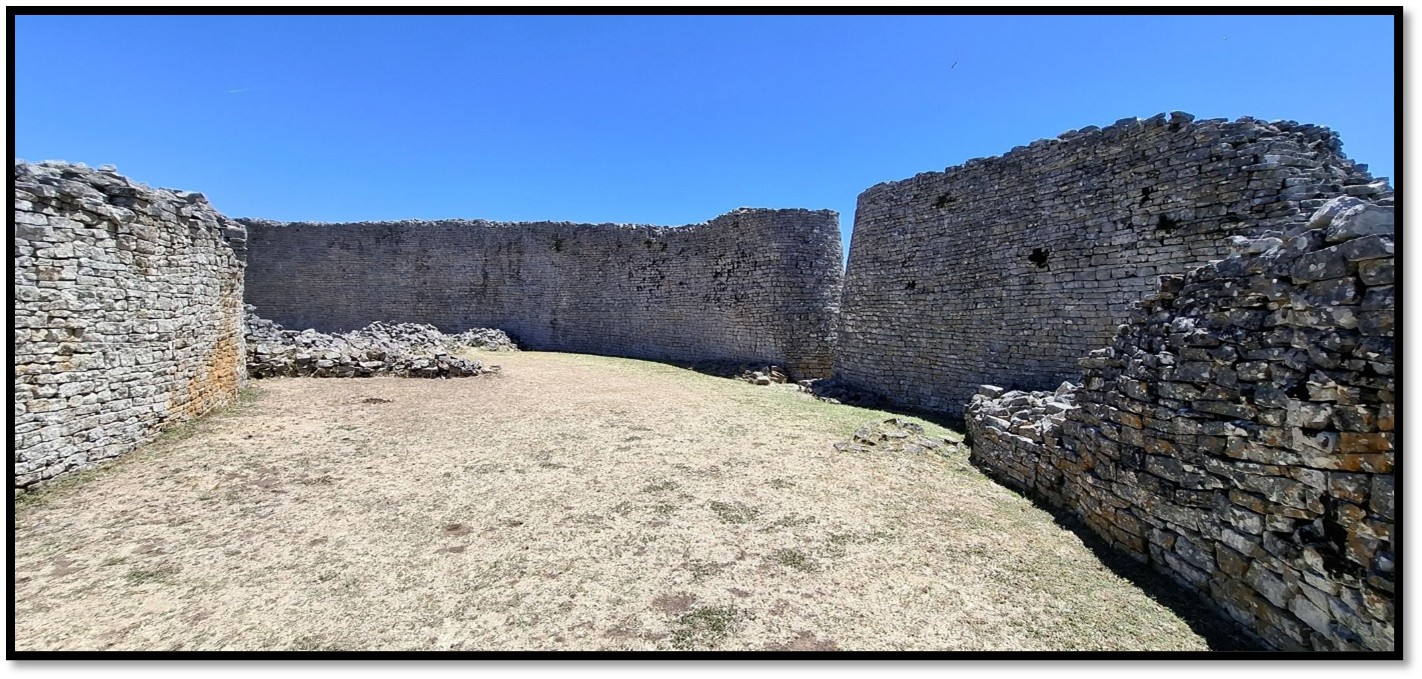
The Outer Perimeter walls on the western side of the Great Enclosure exposed the foundations of six pole and dhaka thatched huts and archaeologists know from Hall’s records that there were at least seven more as well as store huts and grain bins that were destroyed. Four succeeding pavements were exposed, although one was destroyed by Hall’s excavations. All were yellowish in colour and had red or brown wall debris on top representing the replacement and rebuilding of huts and courtyards over time.
Caton Thompson’s excavations at the Maund ruins in the Valley Complex revealed that some of these short walls butted up against the huts and probably were the height of the lower thatched roofs of the huts. Others were lower, about a metre high and probably marked boundaries sub-dividing a courtyard.
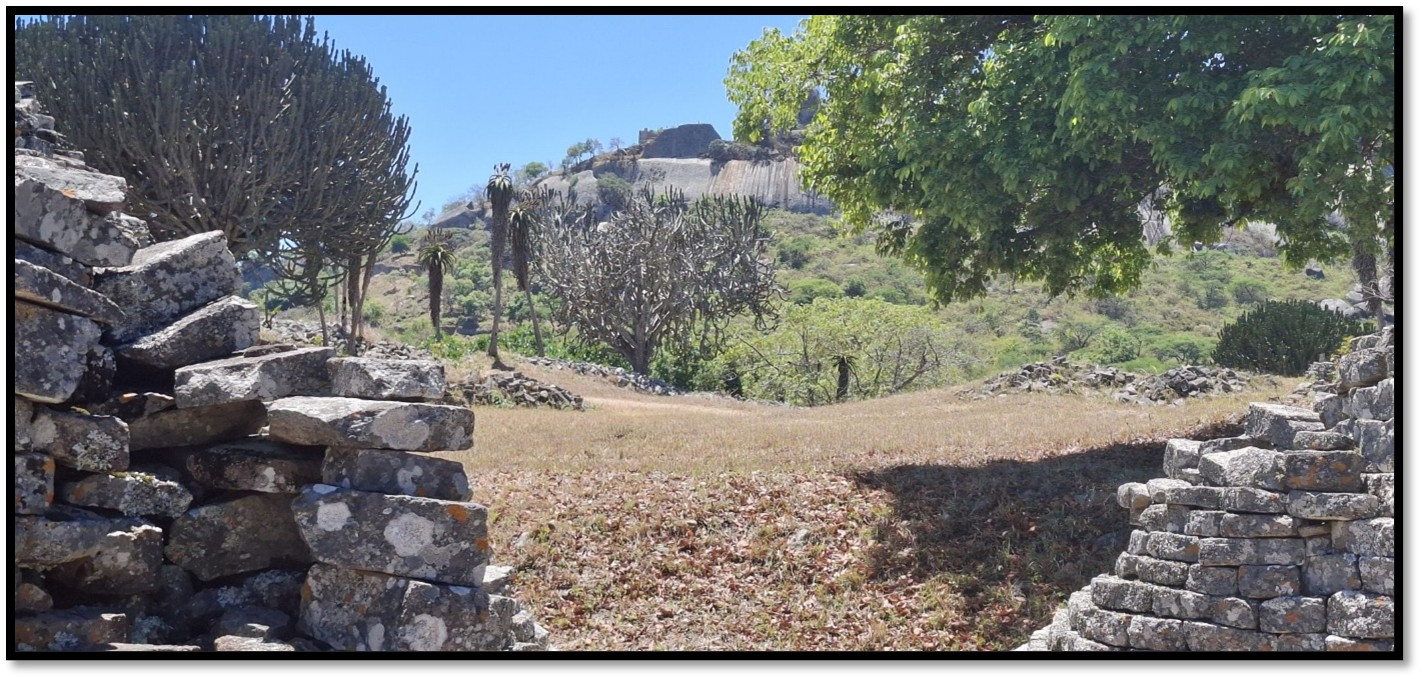
View of the Hill Complex from the outer perimeter walls of the Great Enclosure
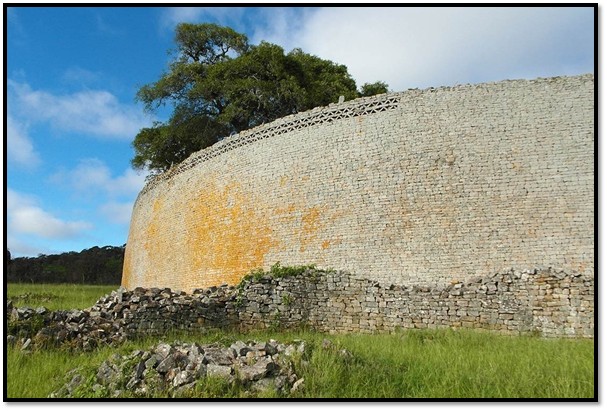
The Great Outer Wall of the Great Enclosure
The Great Outer Wall at Great Zimbabwe is the largest single prehistoric structure in sub-Saharan Africa: 250 metres (820 ft) long, 9.6 metres (32 ft) high at the most averaging 7 metres, dry-stone wall (i.e. no mortar or cement) that forms the eastern side of the Great Enclosure, the largest precolonial structure in sub-Saharan Africa. 5 metres (17 ft) thick at the base and tapers towards the top; it has a volume of 5,000 cubic metres (182,000 cubic ft) with nearly a million blocks of stone and was built between 11 – 15th Centuries.[1]
Summers writes its construction “can only have been organised by someone who had a wonderful head for administration., who had at his absolute disposal a large and varied labour force. And who was able to spend a number of years of a non to uninterrupted work on the project. It required both great wealth and long period of peace for its completion. And so it is a monument not only to a great architect, but also to a truly remarkable social system.”[2]
Garlake says one of the most notable features of the Great Outer Wall is the gradual change in its size and the quality of its workmanship. At its northwest end, the stone block courses are comparatively short and it is only half the height and width that it later achieves. As it curves round first to the south and then to the east the wall increases considerably in size and improves markedly in quality so that its eastern end it reaches its greatest height and width with the most regular stone coursing achieved at Great Zimbabwe.[3]
At the top of the Great Outer Wall is a band of double chevron decoration separated by a horizontal line 50 cms wide and running for nearly 80 metres. Of the six different patterns in stone (variegated, check, chequer, dentelle, cord and chevron) Summers says chevron is the most difficult to build and the example at the Great Enclosure is 9 metres above ground-level.[4]
There are six original drainage outlets in the north-east side of the Great Outer Wall. Five are roofed with stone but the widest drain had wooden beams that broke and caused the wall to subside.[5]
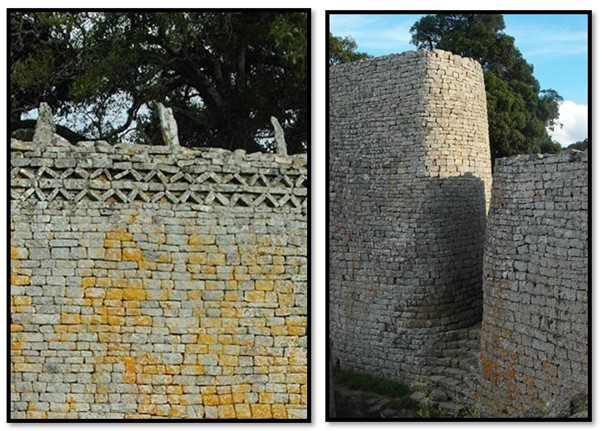
An important change was made in the restorations of the Great Enclosure. It proved impossible to rebuild the doorways with lintels and so the present open entrances with rounded edges were constructed on safety grounds to prevent falls of loose stones from the rough sides of the openings.
Summers writes that parts of the Valley Complex ruins were laid on a solid foundation of bare rock. “The stones were quarried from local granite that splits fairly easily into parallel face slabs which themselves break cleanly at right angles to these flat surfaces.”[6] The stone blocks were laid onto the bare rock and as Summers points out, follow the undulations of the rock’s surface. The builders had to correct the undulations by adding ‘false courses’ to ensure the walls ended up reasonably level.
He adds that many observers thought that behind the neat facing stones of (say) the Parallel Passage of the Great Enclosure there was a rubble infill. When Whitty and he dismantled one of these Style P-type walls they found the same courses inside as were seen on the outside and no sign of rubble infill. Generally they found that the thickness of the walling is between a quarter and a third of the height.
The very high quality of the stonework in the Great Outer Wall and the Conical Tower attracted comment from almost everyone who spent time there and this clearly gave rise to the ‘ancient’ origins of Great Zimbabwe suggested by Bent, Hall and others.[7] Dr David Randall-MacIver was the first to recognise that local people - the Shona – were responsible for the construction of Great Zimbabwe.
Amongst the features that Summers notes marked out the Great Outer Wall were several new and improved construction techniques[8] including:
- A foundation trench with levelled floor. Implying some form of levelling instrument
- Laying of a first course as an even pavement over the whole of the foundation trench
- Careful trimming of the facing stones and very strict selection of all the stones for thickness
- Levelling of all the courses
- Thick walls with inward slope faces, the slope (batter) being even, implying the use of a plumb line. On most of the Great Outer Wall there is a change in the in the slope of the wall about half-way up at a height of about four metres. Schofield took this to indicate two periods of construction but Whitty thought the wall was built to full hight in one building operation[9]
- Construction of wall patterns.
Summers believed the Great Outer Wall was most probably started at the main north entrance and built in a clockwise direction. He says the quality of construction deteriorates after the end of the chevron pattern is reached and this maybe because there was a deteriorating supply of stone or the original architect had been succeeded by another less skilled.
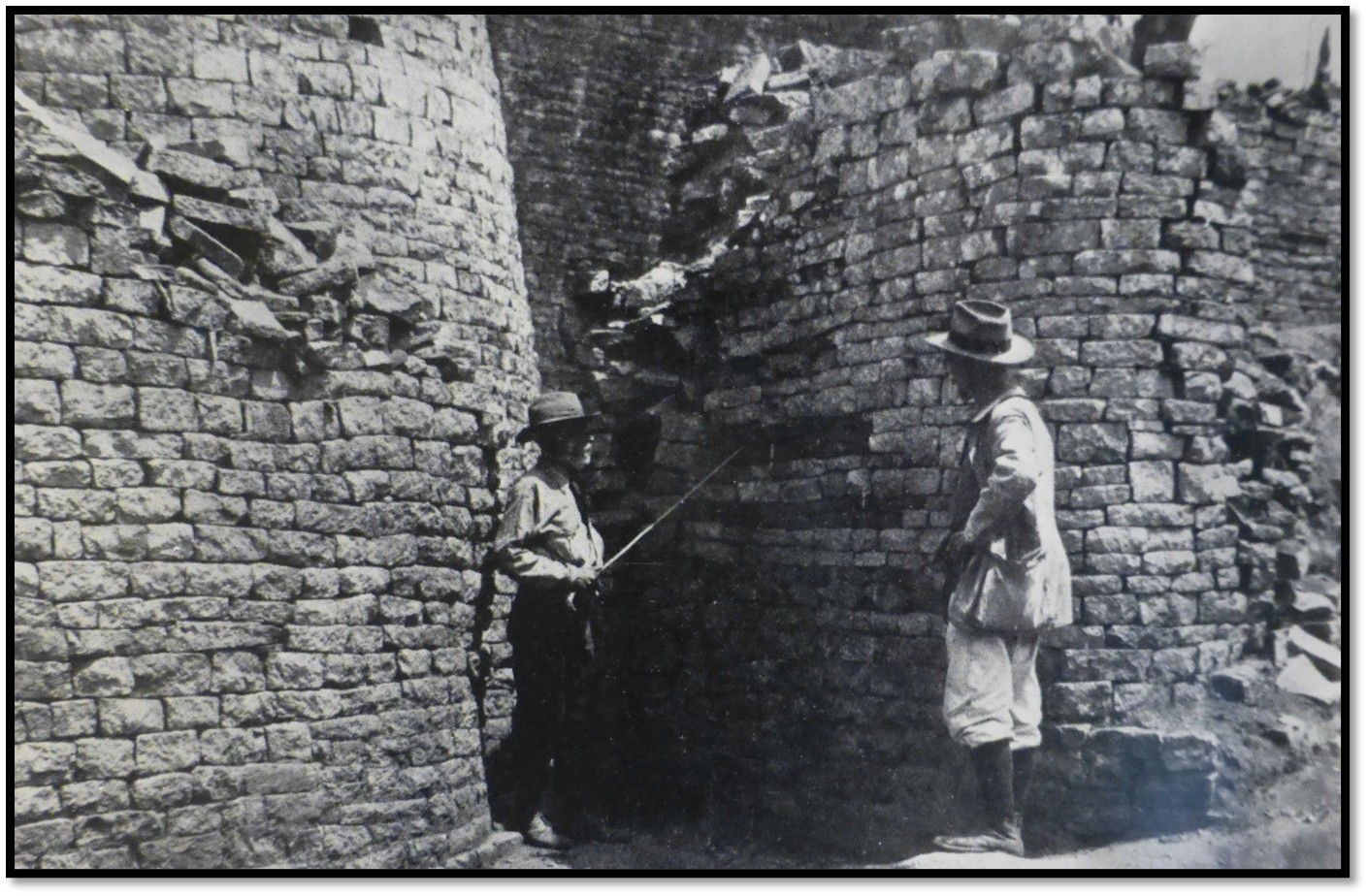
NAZ: Franklin White and Richard Hall at the Great Enclosure
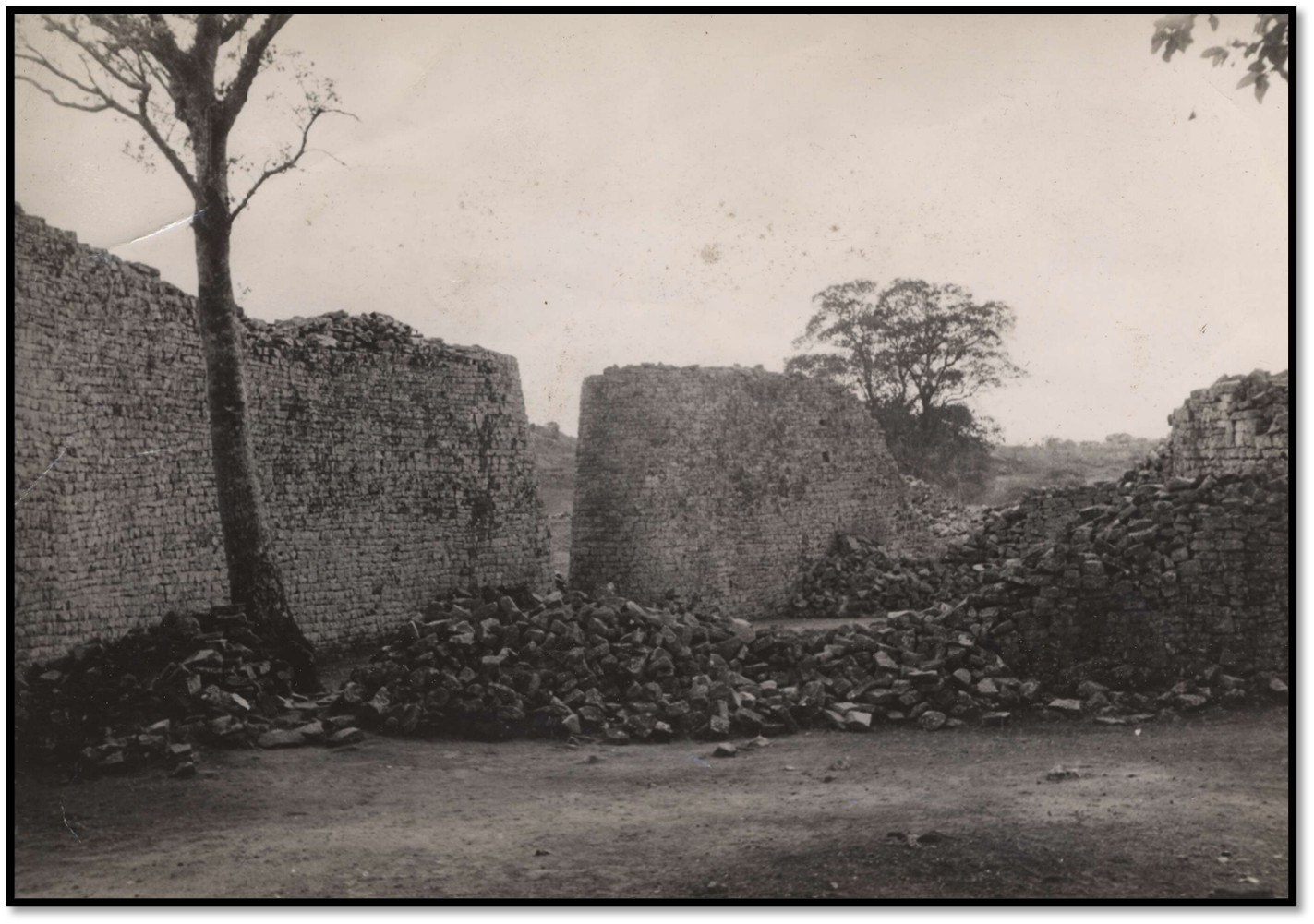
British Museum: Early 20th Century photo of the Great Enclosure at Great Zimbabwe
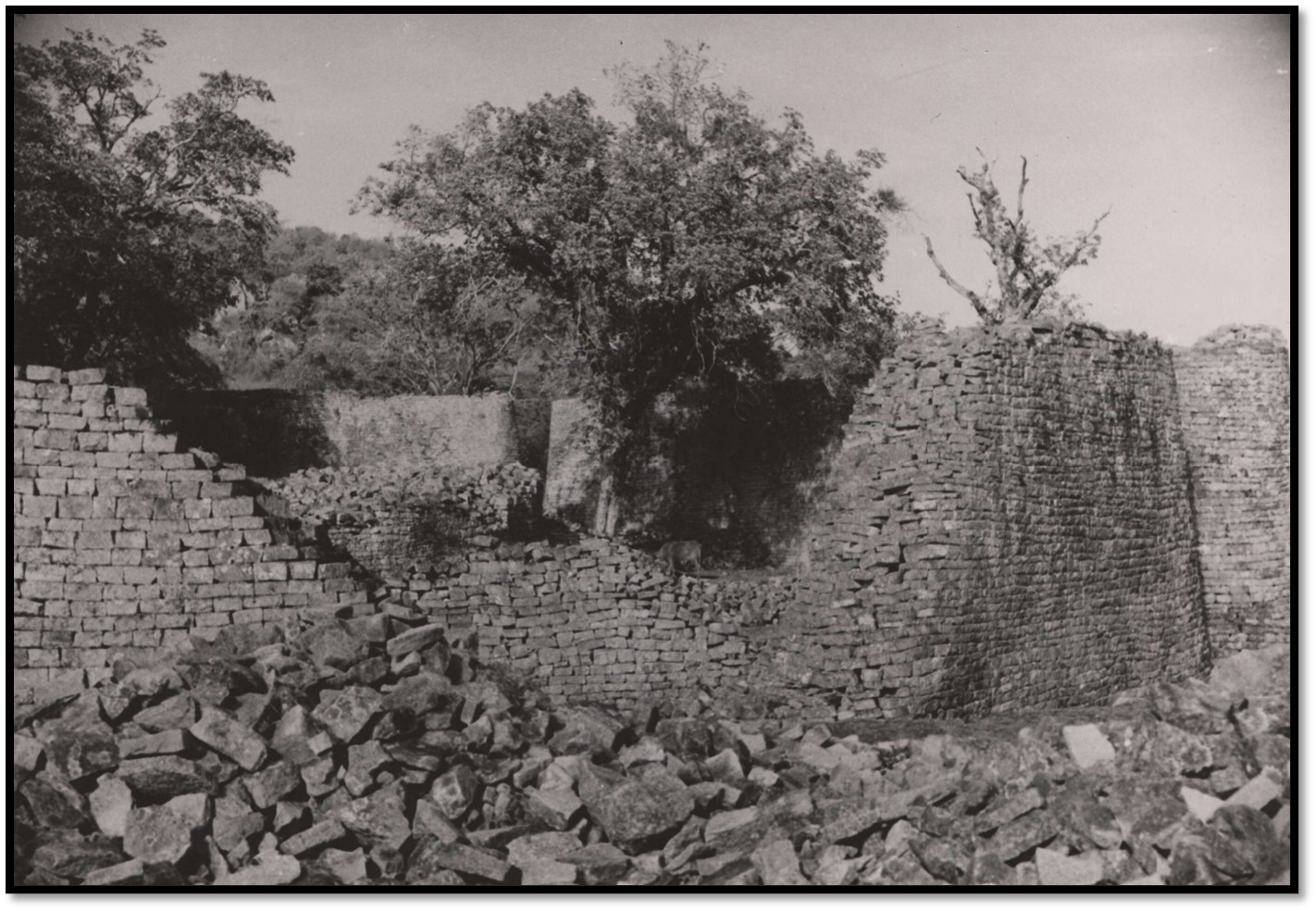
British Museum: Early 20th Century photo of the Great Enclosure at Great Zimbabwe
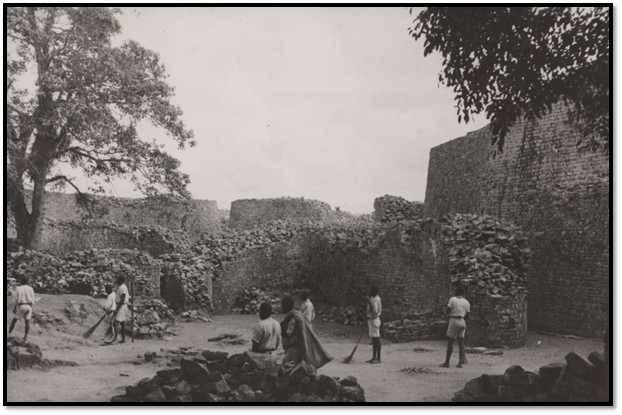
British Museum: Early 20th Century photo of the Great Enclosure at Great Zimbabwe
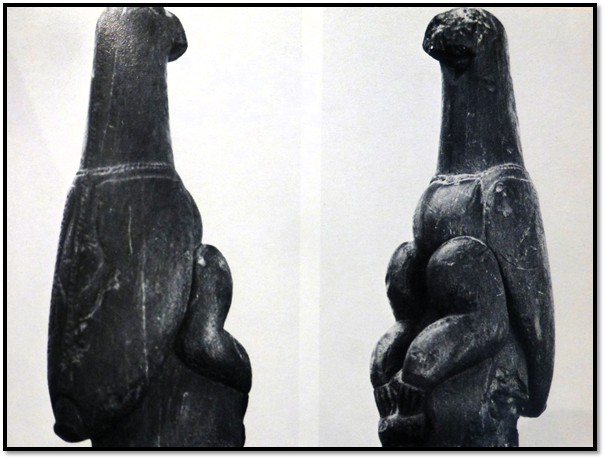
Rhodes Collection: the carved soapstone bird removed from Great Zimbabwe in 1889 by Willie Posselt and sold to Rhodes
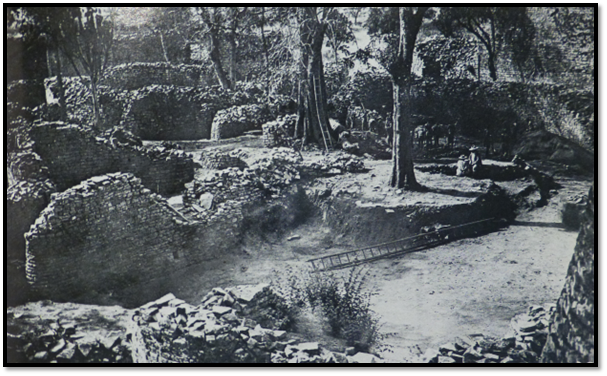
R.N. Hall’s excavations at the Great Enclosure in 1902: note the deposits around the trees giving an indication of the depth of soil removed
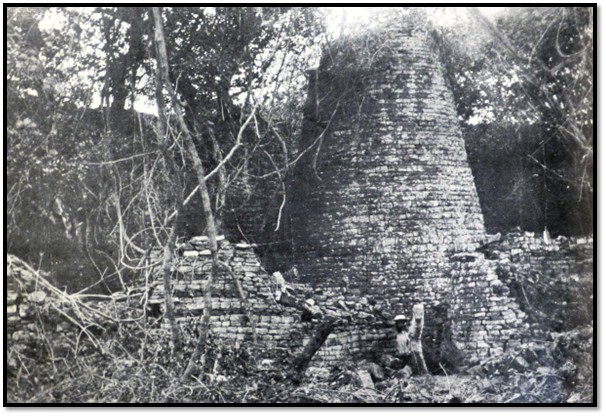
NAZ: Photo by Mabel Bent in 1902 of the Conical Tower in the Great Enclosure
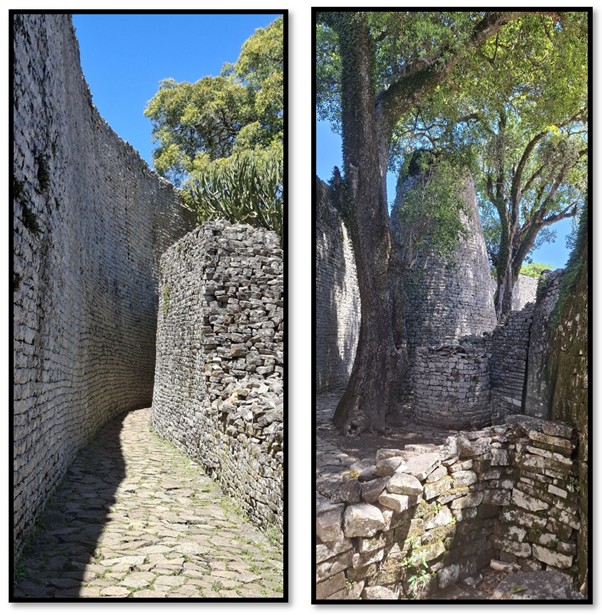
The inner passageway that leads from the northern entrance and follows the Great Outer Wall all the way around to the Conical Tower cutting off any views into the interiopr of the Great Enclosure.
The Conical Tower stands nearly 10 metres high and is a little higher than the Outer Wall at this point. It is plain and has sloping sides swelling slightly. Summers writes that there is some evidence to show it was built before the building of the Great Outer Wall.[10]
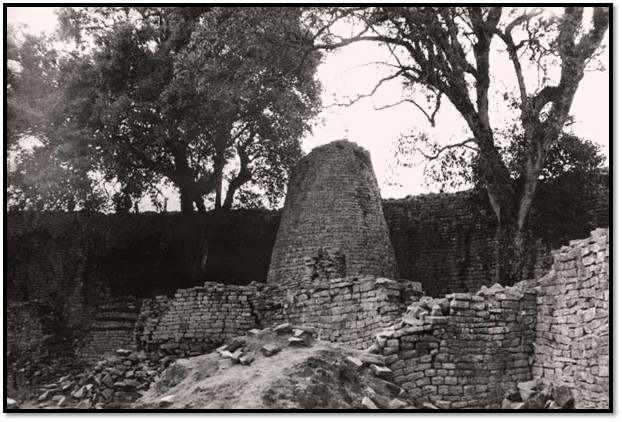
British Museum – early 20th Century photo of the Conical Tower
Summers writes that unfortunately the extensive previous diggings prevent us from knowing if the Conical Tower was built before or at the same time as the Great Outer Wall. The top of the Conical Tower once had a dentelle pattern which is now gone.
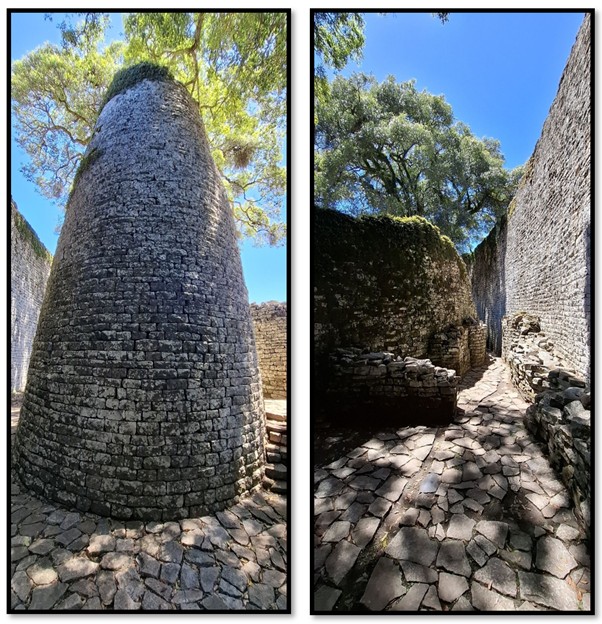
The slight swelling of the Conical Tower and the view looking back northwards from the Conical Tower along the Parallel Passage.
Garlake States that both visually and technically the Conical Tower forms the most important single feature and the architectural focus of the Great Enclosure in its final form. A doorway leading to it was inserted in the old wall and decorated on each side with courses of dark amphibolite. This in turn was flanked by a platform 7.6 metres (25 ft) across, the largest built at Great Zimbabwe that rises in steps to the top of the old wall into which it is also been inserted.[11]
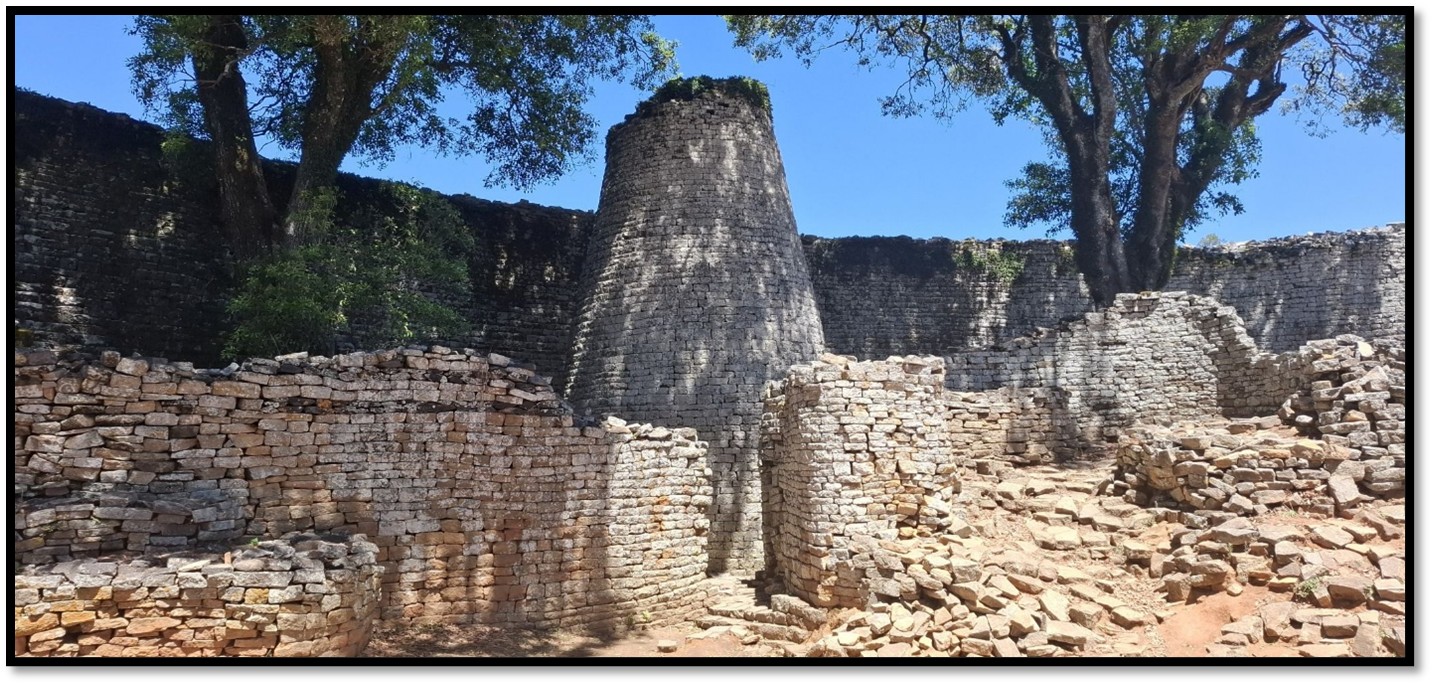
General view of the Conical Tower and inner walls of the Great Enclosure. Karl Mauch recorded on his plan at least six walls that are now either completely disappeared or remain as piles of stone and these can be seen on Summers plan as broken lines.
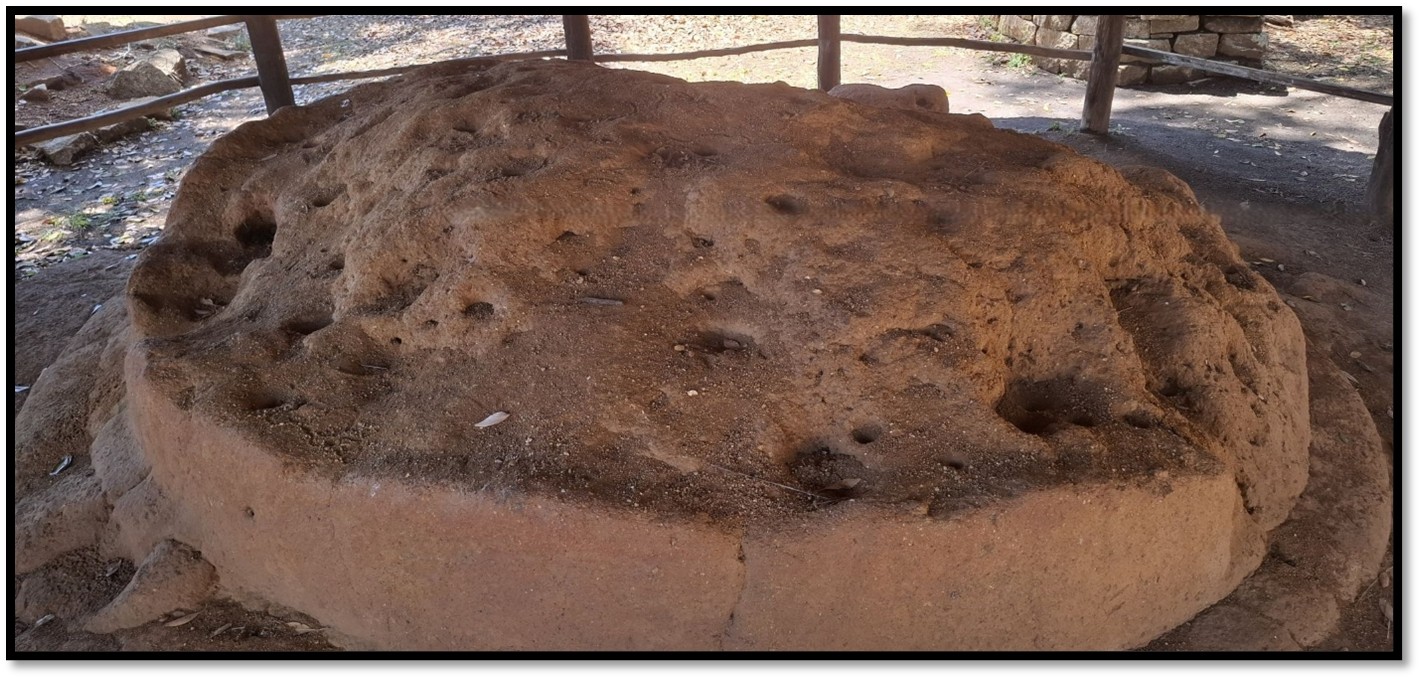
“…There can be little doubt concerning the material of these structures for low circular mounds of gravel mixed with clay, often in richly coloured reds and yellows, lie on the surface of many enclosures while every excavation has revealed layer after layer of similar deposits. This is dhaka, Africa's commonest indigenous building material, a puddled, clayey soil binding together a fine gravel aggregate. Outside the walls at Great Zimbabwe are several huge pits, over 200 feet (61 metres) across and 20 feet (6 metres) deep, from which dhaka has been dug.”[12]
This dhaka base was once the interior platform and floor of a pole and dhaka thatched hut, the walls having long crumbled away and then were cleared away by R.N. Hall who supervised the destruction of much of the remains of the huts, grain bins and storage huts whose remains lay within the Great Enclosure. This attempt to clear away the undergrowth and level the floors was done to make the place more accessible to tourists but destroyed much archaeological evidence.
In 1958 Caton-Thompson found an example of a solid dhaka around poles style of hut and another surviving example was excavated in the Maund ruins in the Valley Complex.
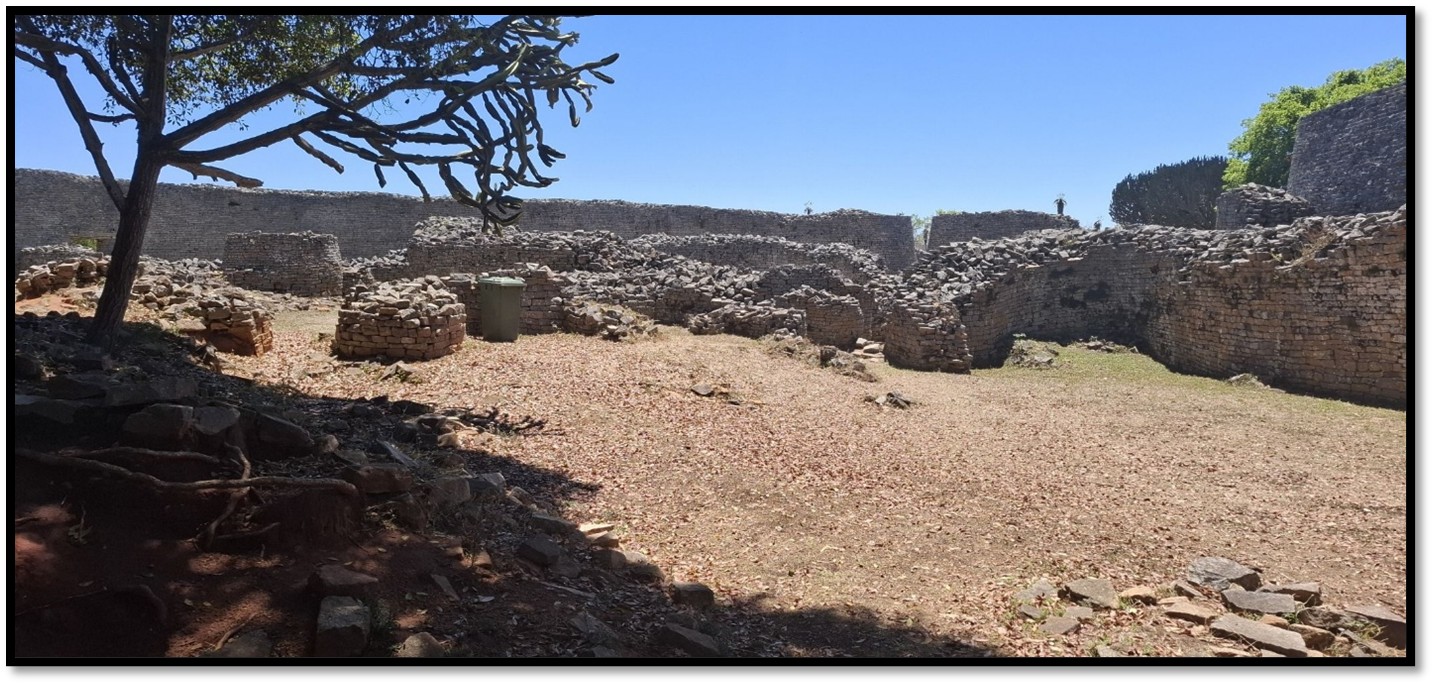
The inner walls viewed to the southern side of the Great Enclosure
“Separate enclosures within the complex are defined and surrounded by more or less continuous walls and their interiors all contain numerous short lengths of detached and isolated walls, often with one end carefully finished like the side of a doorway and the other a jumble of collapsed stone… The only way to make sense of these walls is to suppose that they abutted structures which have now disappeared, presumably built of less permanent materials than stone.”[13]
“The integral relationship of stone walls and dhaka structures was best demonstrated in the complete excavation of the Maund Ruin, a small, independent structure on the periphery of the ruin complex. This showed how some twenty-nine separate stone walls had been built up against ten circular structures of dhaka, from about 15 to 37 feet (4.6 – 11.3 metres) across and radiated from them to form nine separate small courtyards, each entered through one or more carefully constructed doorways in the stone walls.”[14]
“Early descriptions show that dhaka up to 18 inches (46 cms) thick once paved the interior of every courtyard or enclosure, often laid with raised kerbs and carefully graded slopes to conduct stormwater to the drains through the walls. Dhaka also covered stone steps, platforms and other small structures and was plastered against stone walls to form dados up to 7 feet (2.13 metres) high. With the weathering, erosion and disappearance of these dhaka finishes, the ruins have a quite different appearance to their original one.”[15]
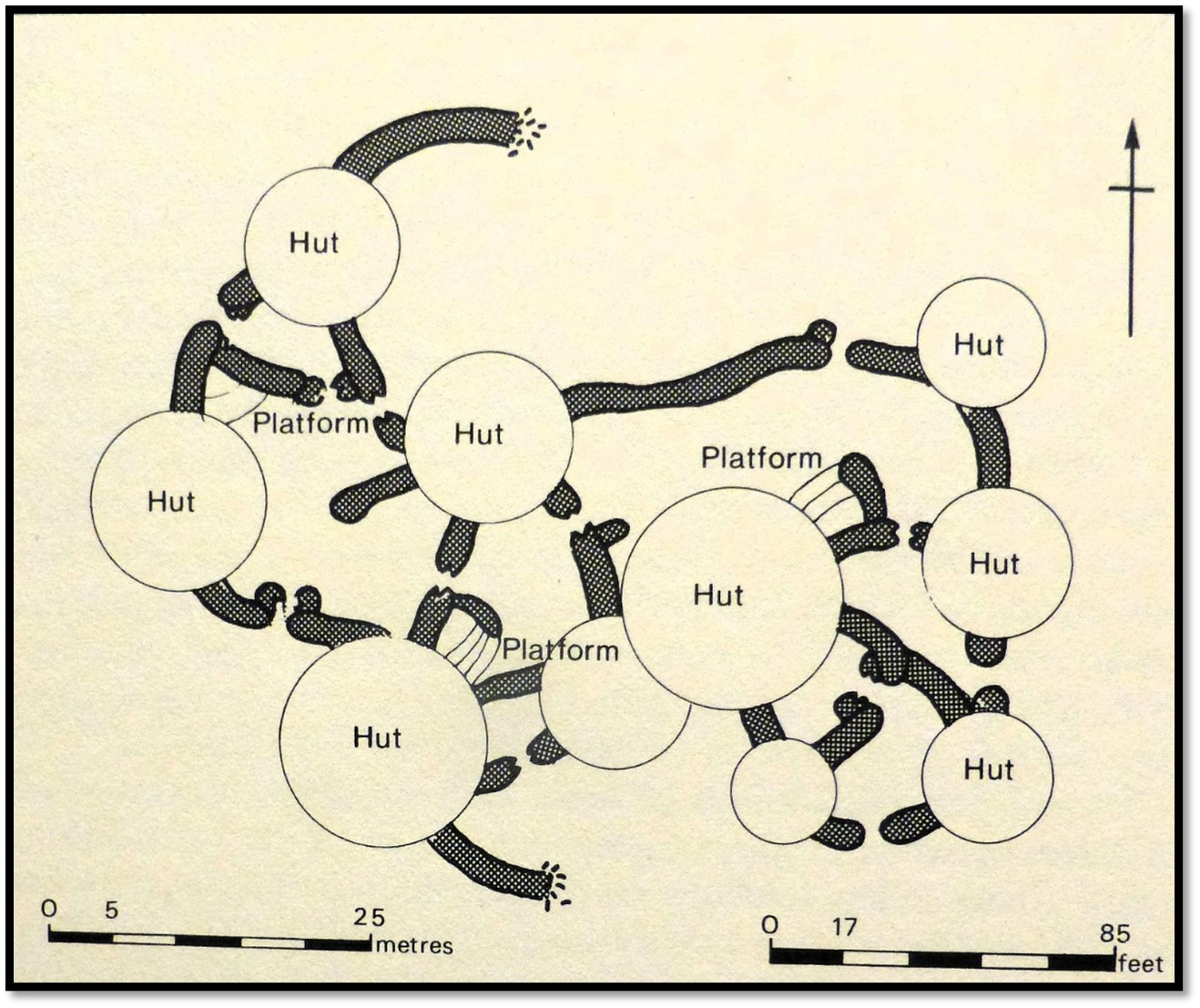
Caton-Thompson: Plan of the Maund Ruin showing the position of the original dhaka huts
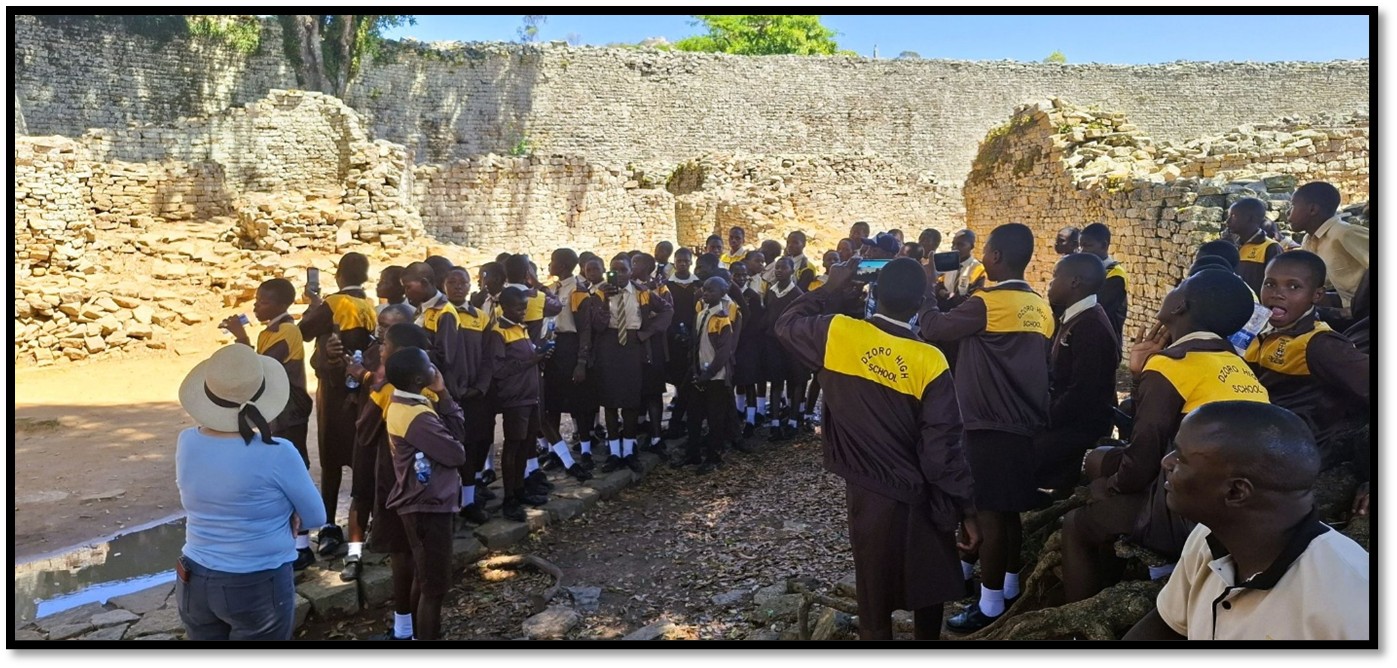
A school party being lectured on the meaning and purpose of the Great Enclosure
As can be seen from Whitty’s plan above the interior has only one complete walled enclosure (Enclosure 1) that is a rough circle, about 21 metres (70 ft) across with enough space for an estimated five dhaka huts.
Curving away from Enclosure 1 is a wall known as the inner wall of the Parallel Passage and was probably designed to enclose and shelter dhaka huts erected southeast of Enclosure 1.
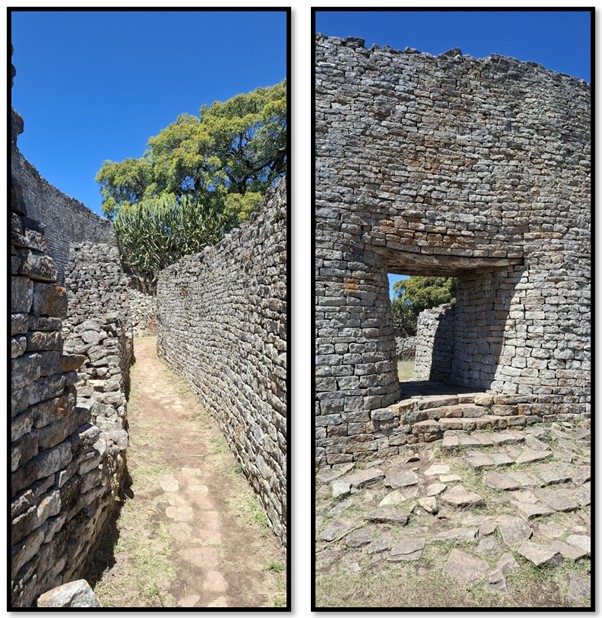
In 1872 Karl Mauch noted the existence of a doorway lintel still in position at the main entrance that he thought was Cedar but his description indicates it was actually a Tambootie tree (Spirostachys africana) Both he and Bent found th remains of burnt lintels in the north-west entrance. In both the main and north-west entrances the top half of the wall collapsed, but the bottom halves remained intact with little or no damage. Archaeologists think they probably collapsed slowly filling up the doorways with debris that protected the door jambs from damage.
Some points to note from Summers on the entrances.[16]
- Construction is exceptionally solid up to the top course of the doorway, generally 2.25 metres above the door sill
- Door jambs are rounded and particular care was taken to make them extremely solid so that they have not collapsed
- Wooden lintels were used, some probably weighing 600 kgs to a height of 3.5 metres above the ground. Summers believed that an inclined earth ramp was probably used to get them into place.
- The wooden lintels would have had to be longer on the outside because the door jambs are rounded and shorter on the inside
- The angle of the slope of the wall steepened above the doorways (5° below the doorway lintels and 10° above) and this was a deliberate design feature to lighten the load on the lintels.[17]
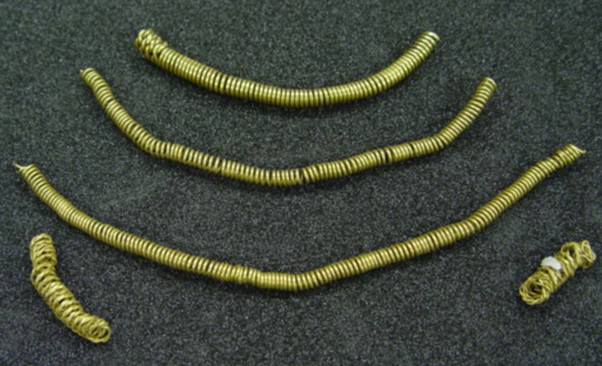
British Museum: Gold coiled wire ornament excavated at Great Zimbabwe
References
P.S. Garlake. Great Zimbabwe. Thames and Hudson, London 1973
I. Pikirayi. June 2013. Stone architecture and the development of power in the Zimbabwe tradition AD 1270 – 1830. Azania Archaeological Research in Africa 48(2):282-300. DOI:10.1080/0067270X.2013.789225
R. Summers. Ancient Ruins and Vanished Civilizations of Southern Africa. T.V. Bulpin, Cape Town 1971
Notes
[1] Great Zimbabwe, P27
[2] Ancient Ruins and Vanished Civilizations of Southern Africa, P13
[3] Great Zimbabwe, P27-9
[4] Ibid, P138
[5] Ibid, P130
[6] Ibid, P71
[7] See the article The controversy in the early 20th Century over whether the stone structures in Zimbabwe were old and built by foreigners or comparatively recent and built by the Mashona under Masvingo on the website www.zimfieldguide.com
[8] Ibid, P118
[9] Ibid, P131
[10] Ibid, P14
[11] Great Zimbabwe, P29
[12] Great Zimbabwe, P19
[13] Great Zimbabwe, P19
[14] Ibid
[15] P20-21
[16] Ibid, P133
[17] Ibid, P132-3