
Development of the Rhodesia Railways
This article is taken from the Rhodes Centenary Supplement published by the Chronicle in Bulawayo on the 3rd of July 1953 Page 9 and was written by Sir Arthur Griffin.[1] The article reflects the attitudes and opinions that were prevalent at the time. Other sources and notes have been added.
The Rhodesia Railways extend from Vryburg in South Africa and from Umtali (now Mutare) in the east of Southern Rhodesia (now Zimbabwe) through Bulawayo to the border of Northern Rhodesia (Zambia) and the Congo (now DRC) in the north.
There are 2,497 miles, the construction of which began in the later years of the 19th century. Various sections were built by different companies, all of which, except the Shabani Railway Company, which owned the 63 miles from Somabula, on the main line to Shabani (now Zvishavane) had by 1937 been absorbed by the Rhodesia Railways Limited. The Shabani has recently been purchased by the Rhodesia Railways.[2]
In 1947 the Southern Rhodesian government purchased the Rhodesia Railways Trust, the owner of Rhodesia Railways Limited, until then under the control and operation of the British South Africa Company (BSA Co) for £3.15 million. The purchase was financed out of a Southern Rhodesian government loan of £30 million of which £24 million was devoted to the purchase price and redemption of existing debentures, leaving a balance for capital development of about £6 million.
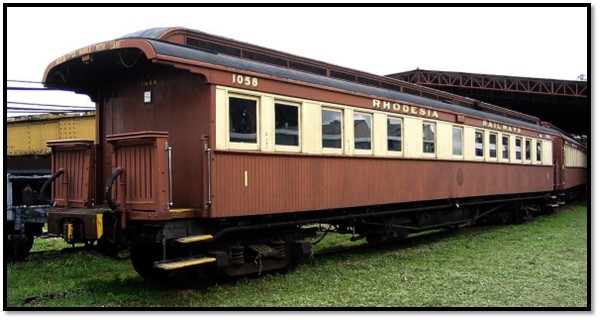
Rhodesia Railways passenger coach[3]
The Rhodesia Railway Act, 1949 was passed in Southern Rhodesia with parallel legislation in Northern Rhodesia and Bechuanaland (now Botswana) which regulated the administration and working of the railways. The policy and business of the undertaking were in the hands of a higher authority, consisting of the Prime Minister and a Minister of Southern Rhodesia, the Governor of Northern Rhodesia and the High Commissioner in the Union representing Bechuanaland through which the railway runs, and the Railway Board.
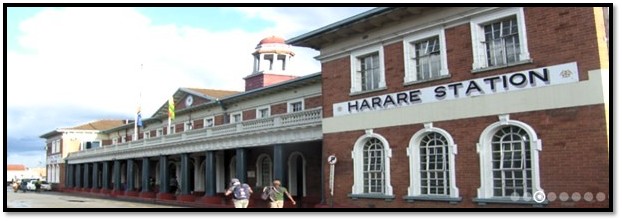
Harare railway station
The Rhodesia Railways Limited had worked the Beira Railway (Beira to Umtali) and the land side of the Beira port on behalf of the Beira Railway Company and Beira Works Limited. In January 1949, the Beira port was purchased by the Portuguese government and this was followed by the purchase of the Beira Railway. Since then the port and the railway from Barra have been managed by the Portuguese railway authorities in Lourenco Marques (now Maputo)
The objective from the date of purchase of the Rhodesia Railways has been to expand the capacity of the existing system to meet the heavy demands resulting from the rapid development of the territories served. Little central planning had been done by the late company and there were severe bottlenecks due to maintenance issues during World War II; there was insufficient railway infrastructure to support the rapid expansion of the economy and continued uncertainty[4] over the future of the BSA Co.
The initial £6 million available for capital expenditure was soon absorbed and various means had to be adopted to secure funds. A loan of £5 million was negotiated with Economic Cooperation Association[5] (ECA) the proceeds to be used for the capital programme and the movement of coal from the Wankie (now Hwange) Colliery to the copper mines in Northern Rhodesia.
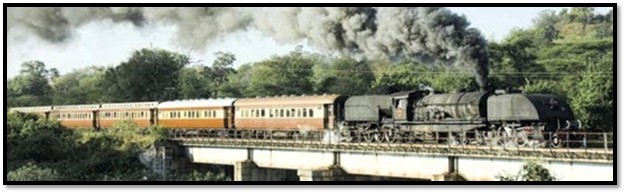
Class 15 4-6-4+4-6-4 Beyer-Garratt Locomotive hauling a passenger train
A further loan of £7 million was raised in London by Northern Rhodesia in 1951 and Southern Rhodesia has recently followed with a loan of £10 million of which £5 million has been made available for railway purposes. Negotiations have just being concluded with the International Bank for a loan equivalent to £5 million. Northern Rhodesia, in addition has lent £2 million from internal sources. Use is also being made of funds available and normally accruing to the railways pension funds under government guarantees as to payments of pensions. Including the initial loan of £30 million, the total obtained to date is over £57 million. Some of these loans are relatively short-term, and as repayment is an obligation of the railways, to be met out of revenue, there is a heavy burden to be faced.
Since 1946 capital expenditure on infrastructure development has been about £26 million. Rolling stock and locomotives are naturally a big part of this expenditure, but many extensive works have been completed or are in hand to increase capacity and improve working. Centralised Train Control (CTC) has been introduced for the first time in southern Africa and diesel-electric locomotives brought into operation, with many more to follow.
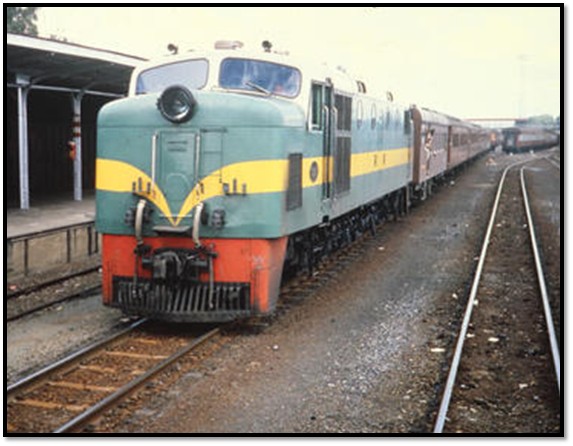
Mafeking, 1980. RR Class DE2 with passenger train at station platform.
An increase in staff, both European and African, presented the serious problem of housing, Several million pounds have been expended on this account, including in some cases, complete townships.
The present programme covering the three-year period to 1955-56 of works in hand and of new works and equipment, has a budget of over £27 million, but the problem of raising funds beyond those now contemplated has still to be solved.
The growth of traffic has been as phenomenal as the general development of the country. Tonnage has increased by 92% since 1946. Tonnages being moved of copper and chrome show increases of 62% and 96%, the increase in coal moved is 66%. Internal traffic, following industrial expansion and the increasing population, has strained resources and the high level of operating efficiency has been affected by the imposition of this burden of relatively short-haul traffic. Future increases of traffic are likely to involve the movement of large quantities of coal, the production of which is at present altogether inadequate.
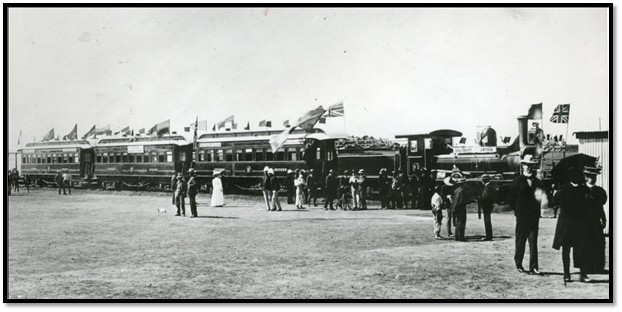
The first train arrived at Salisbury from Umtali on 22 May 1899. The locomotive is Mashonaland Railways No. 1, named “Cecil J. Rhodes” and is a wood-burning ex Cape Government Railways 4th class converted ‘Joy.’
To open up another outlet to the sea and to ease the position of the difficult section between Umtali and Beira, a new line is being constructed from Bannockburn on the Shabani branch towards Lourenco Marques: the Portuguese authorities are constructing their portion from the port to the frontier. This construction is well in hand, on both sides, and through communication should be established towards the end of 1955. This line provides the only outlet from the central plateau of the Rhodesia’s which does not have to negotiate steep escarpments.
Many hundreds of miles of survey have been carried out and one is being run through some of the most difficult country in Africa, that between Sinoia (now Chinhoyi) and Kafue or Lusaka which would provide a cut-off between Salisbury and Northern Rhodesia. This project, which should be extremely costly is to an extent dependent on whether the Kariba Gorge hydroelectric scheme is preceded with.[6]
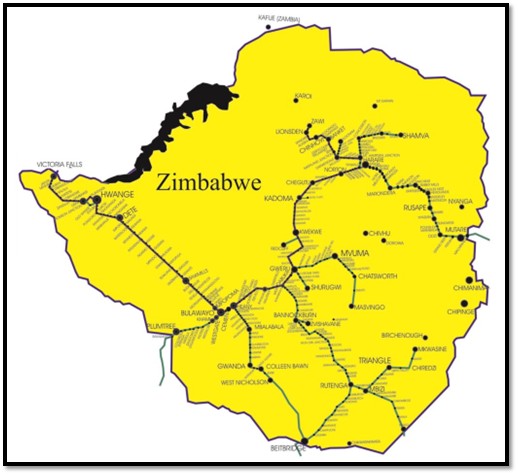
Network map of the National Railways of Zimbabwe
Mention must be made of the railways road services, of which there is a network in Southern Rhodesia. They have been the means of opening up the country as feeders to the railway. The increased activity over the last six years is clear by the tonnage carried having increased by no less than 117%.
The railway system has struggled against many difficulties and frustrations, but the progress made is outstanding, judged by any standards. It faces the future with confidence and it will be worthy of the country and its founder.
References
‘A. Griffin. Development of the Rhodesia Railways. The Chronicle, P15. 3 July 1953. Rhodes Centennial.
National Railways of Zimbabwe. https://nrz.co.zw/
[1] Chairman of the Rhodesia Railways Board
[2] The Shabani Railway Company link built in 1928 was originally privately owned to serve asbestos mines at Shabani and was acquired by Rhodesia Railways in 1953
[3] Rhodesia Railways carriages on the 3ft 6in (1,067 mm) Cape gauge system usually featured wood panelled interiors with green leather bunks and were built in the UK by firms like Gloucester Carriage and Wagon serving on the rail links between Bulawayo, Salisbury, Gwelo and Cape Town.
[4] The British South Africa Company Royal Charter was issued on 20 December 1889 and ran for an initial twenty-five years. It was extended by ten years in 1915 and expired in 1924
[5] The Economic Cooperation Administration (ECA) was a US government agency set up in 1948 to administer the Marshall Plan
[6] Clearly the Chinhoyi to Lusaka railway line was never constructed