
A look at present-day Marula, between Bulawayo and Plumtree
Marula owes its existence to the railway line. Early locomotives were steam powered and coal burning and ran on the standard 3ft 6in (1067mm) gauge in use throughout southern Africa. Ultimately, running out of water was always a serious risk, so railroad operations were meticulously planned around water availability to keep the trains running safely and on schedule. Uphill gradients and heavy loads consumed water much faster than running on flat track and although the altitude difference between Plumtree (1,374 metres – 4,508ft) and Bulawayo (1,358 metres – 4,455ft) was small, this takes no account of the gradient rises and falls along the track.
Railroads at the time typically had water stops (towers and tanks) every 10 to 20 miles (16 – 32 kms) to ensure that trains always had the opportunity to replenish their water supply that was vital for their boilers. The Plumtree to Bulawayo line was no exception and the water stops were evenly spread out. Plumtree to Marula was 31 km, Marula to Figtree was 32 km and Figtree to Bulawayo was 36 km.
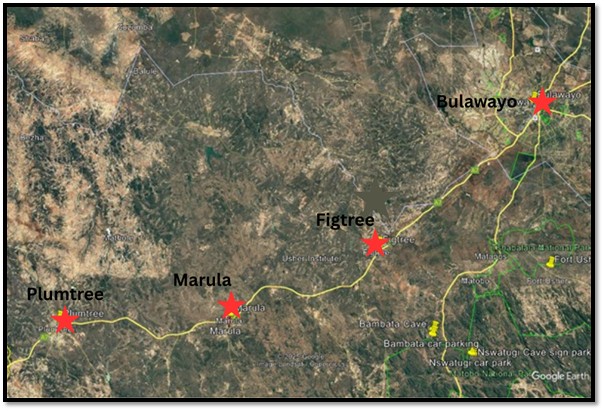
Google Earth graphic showing the Plumtree to Bulawayo railway line
The railway line between Plumtree and Bulawayo was completed in 1897. The first construction train, George Pauling’s No 289, arrived in Bulawayo on 19 October 1897, It had been used for the plate-laying of the line from Lobatse northwards, bringing rails and materials to the advancing railhead.
It was Cecil John Rhodes’ vision to have a railway traversing British ruled territories from the Cape to Cairo and in 1890 when the Pioneer Column arrived at Salisbury the railway only extended as far as Kimberley. As Prime Minister of Cape Colony Rhodes authorised the extension of the Cape Government’s railway from Kimberley to Vryburg in Bechuanaland. The extension was completed in December 1890.
To extend the railway further north outside the Cape Colony a new company, the Bechuanaland Railway Company, was incorporated in May 1893. The major planned stops for the new extension would then be at Mafeking, Palapye, Francistown and finally Bulawayo.
When Rhodes signed the construction contract the railhead was 492 miles (792 km) from Bulawayo and with George and Harold Pauling overseeing the construction of nearly 500 miles (804.5 km) this stretch of railway track was completed in 400 days; a marvellous achievement probably not equalled elsewhere.
The official opening ceremony at Bulawayo took place on 4 November 1897 with No 289 arriving decorated with flags and carrying a banner ‘Advance Rhodesia’ on the front topped off with the arms of the British South Africa Company.
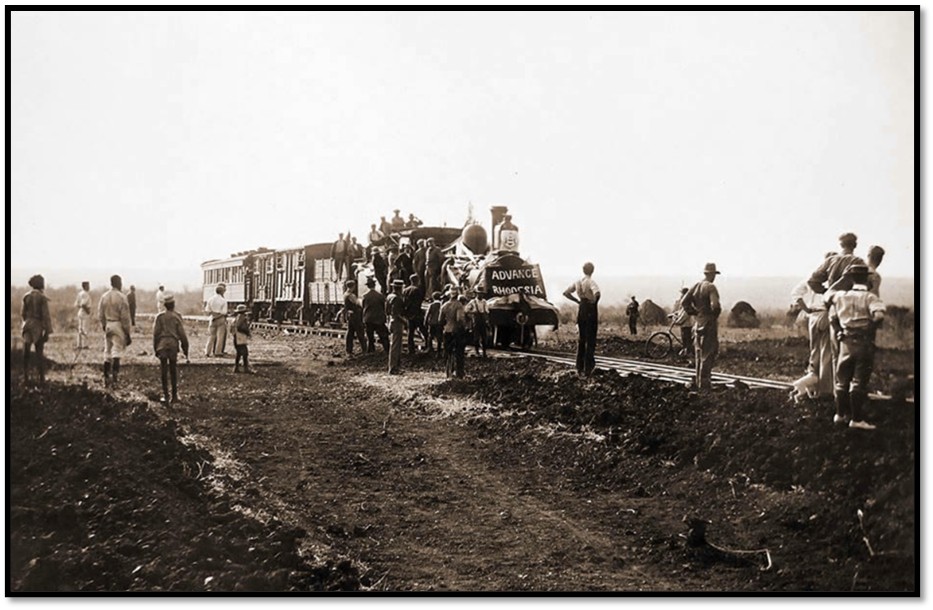
NAZ: Locomotive No 289 arriving at Bulawayo on 4 November 1897
The railway line from Vryburg to Bulawayo was built at a total capital cost of £2,270,628, or £3,681 per mile.[1] The speed of construction was truly remarkable especially considering that all the construction material and rolling stock had to be shipped from England and then transported by rail for over a thousand kilometres to the advancing railhead.[2]
“The first section, that from Mafeking to Mochudi, 123 miles [198 km] was opened to traffic on 1st March 1897 and from there the remainder of the line was built with extraordinary energy: Mochudi to Palapye, 136 miles [219 km] opened on 1st July 1897: Palapye to Francistown, 101½ miles [163 km] on 1st September 1897; and Francistown to Bulawayo, 122 miles [196 km] on 4th November 1897.”[3]
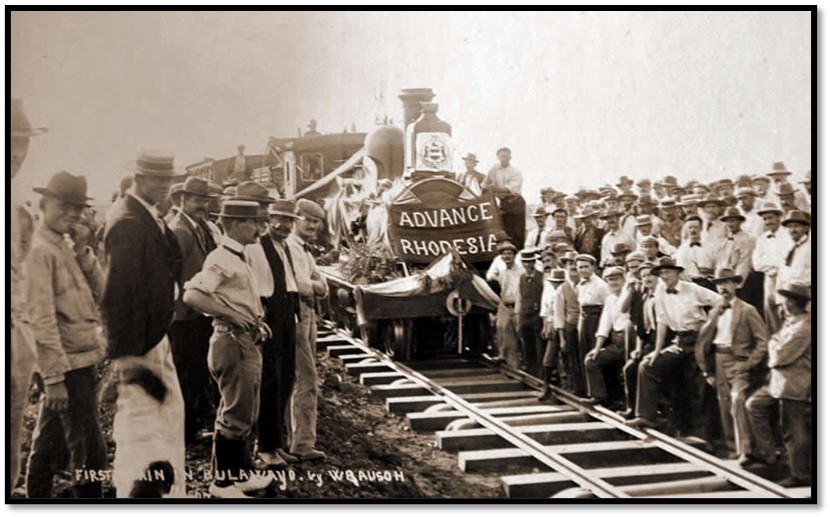
NAZ: The first train No 289 arrives in Bulawayo
The arrival of the railway line to Bulawayo was key to the development of the gold mining industry and opening up of Matabeleland and also the reason for Marula’s existence. Croxton wrote, “In completing 400 miles [644 km] of new railway in twelve months to the date of the arrival of the first train at Bulawayo, Harold Pauling had performed a feat to go down in the annals of railway history.”[4] This was a year earlier than the original contract date and inaugurated the transport links that the country needed so desperately as in the previous year rinderpest had killed an estimated 90% of the country’s cattle and most of the oxen that were the backbone of the country’s ox-wagon transport system until then.[5]
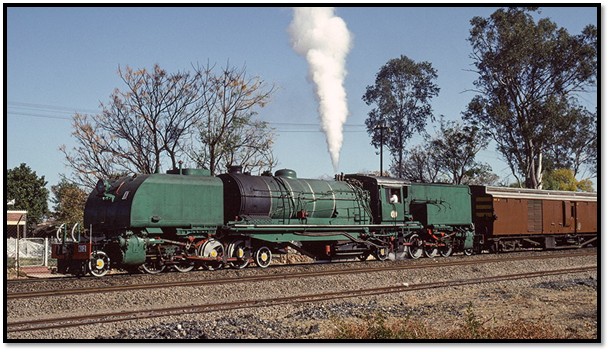
http://www.nigeltout.com/html/zimbabwe--towards-plumtree.html
At Syringa, Zimbabwe, just west of Marula, National Railways of Zimbabwe 'Garratt' steam locomotive 16A class 2-8-2+2-8-2 no. 612 (built by Beyer Peacock in 1938) was waiting and was attached to the rear of the 'Union Limited Zambezi' train for the return journey to Bulawayo, 1st August 1992.
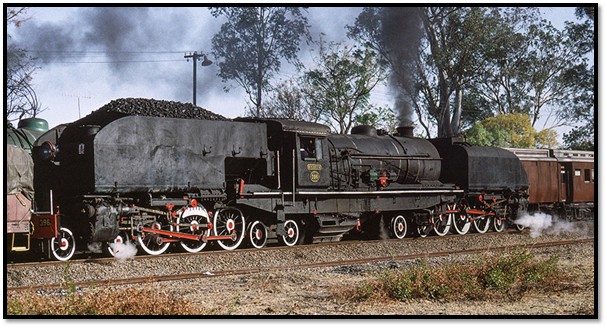
http://www.nigeltout.com/html/zimbabwe--towards-plumtree.html
The freight train which had arrived with 12th class 4-8-2 no. 190 on the front departs towards Botswana hauled by NRZ class 15A 4-6-4+4-6-4 'Garratt' locomotive no. 396 'Igogo' ('Klipspringer', built by Beyer Peacock in 1949/50) and passes the ‘Union Limited Zambezi’ train in the loop at Syringa, Zimbabwe, 1st August 1992.
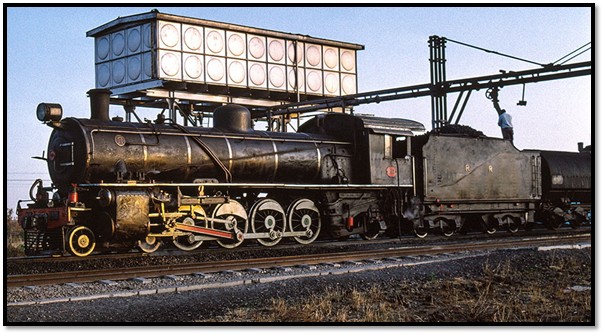
http://www.nigeltout.com/html/zimbabwe--towards-plumtree.html
Just before sunset, Rhodesian Railways 12th class 4-8-2 steam locomotive no. 190 (built by North British Locomotive Co. in 1926) takes water at a stop between Plumtree and Bulawayo, Zimbabwe, 1st August 1992.
Marula never became more than a small village serving the local cattle farming community and a railway stop and the A7 national road between Plumtree and Bulawayo. Marula Primary School serves the local student catchment area.
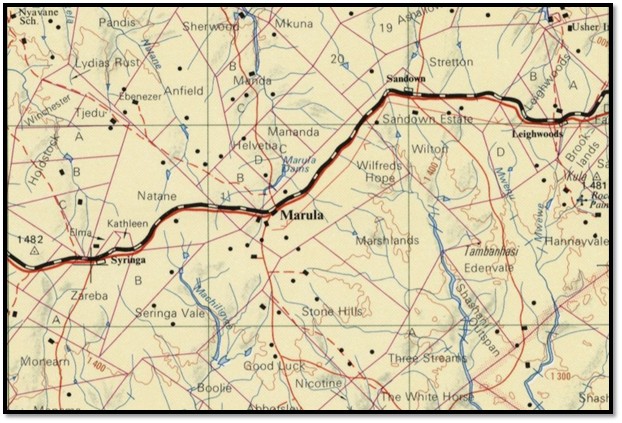
Marula and surrounding farms from the 1:250,000 map sheet SF-35-3 Plumtree published by the Surveyor-General, Rhodesia 1975
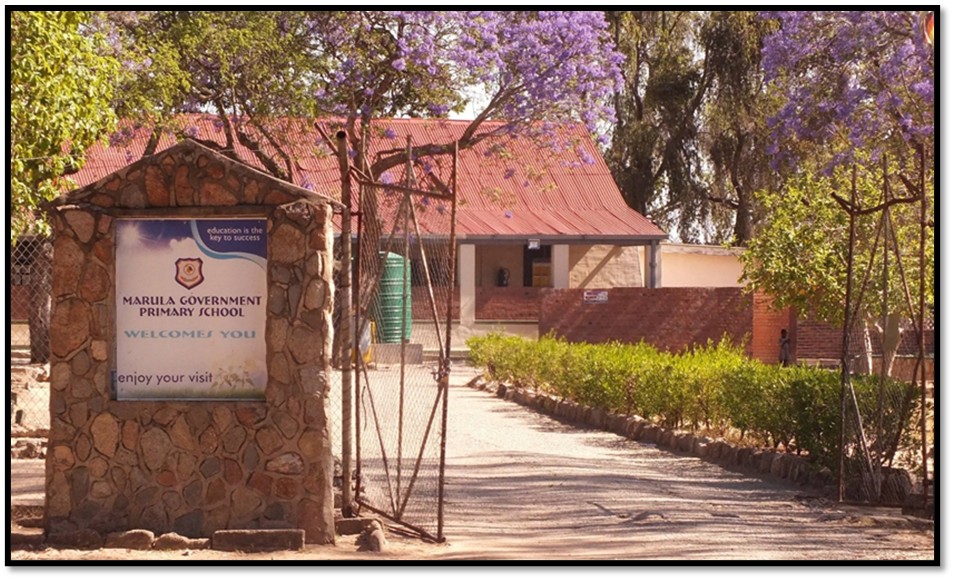
Marula Primary School
The name is taken from the Marula trees [Scelerocarya birrea] that are common in the area and bear fruit similar to plums. The Marula Tree Initiative is a women-led organization that processes and markets products from the marula tree
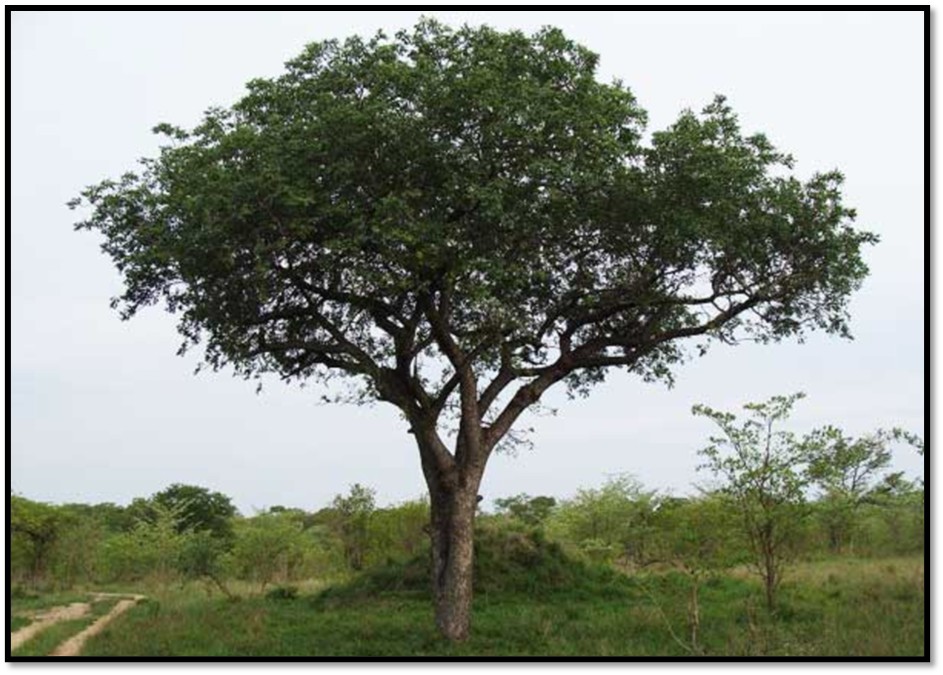
Marula Tree [Scelerocarya birrea]
The Marula was well-known in antiquity; its history extends back at least 10,000 years. Archaeological evidence shows that the marula fruit and its nut-like kernels were an important food source in Southern Africa in ancient times as they are rich in minerals and vitamins.[6]
They are indigenous trees growing up to 18 metres tall and belong to the mango/cashew/pistachio family. They grow on sandy loam soils in low to average altitudes and in open woodlands and can be found from Ethiopia to Kwazulu-Natal. They produce flowers from September to November and fruit from January to March.
The tree is deciduous, and also dioecious, which means it has a specific sex. This leads to an African belief that drinking an infusion of the bark of a male tree would lead to the birth of a boy child, or that of a female tree, to the birth of a girl child.
The marula fruit is the size of a small plum and has four times more Vitamin C than an orange. They fall to the ground when unripe and green in colour and then ripen to a yellow colour. It is delicious eaten fresh, or may be cooked to produce jams, juices, or alcoholic beverages. The liqueur Amarula is made from the marula fruit.
The Marula seed is a delicious nut rich in potassium, proteins, amino acids like leucine and sulphur-containing methionine, and cysteine with a predominance of glutamic acid and arginine, bringing it to “super-food status.”
Many parts of the tree are used in traditional medicines. The oil is used as a skin cosmetic. The green leaves are eaten to relieve heartburn. The bark contains antihistamines and is also used for cleansing by steeping in boiling water and inhaling the steam. The bark is crushed into a pulp, mixed with cold water and swallowed in the treatment of dysentery and diarrhoea. The bark also is used as a malaria prophylactic. Its extracts have antibacterial, antifungal, astringent, anticonvulsant, antihyperglycemic, anti-inflammatory, and antiatherogenic properties and the fruit has high levels of antioxidant activity compared to most other edible fruits.
Large Saturniid caterpillars that collect on the tree as well as the larvae of the Cerambycid wood boring beetle are often gathered and roasted.
The fruit is a favourite of elephants. But the legend that elephants get drunk after eating the fruit which then ferments in their stomach is a myth. Warthog, waterbuck, giraffe, kudu, baboons and monkeys will also eat the fruit and leaves of the tree.
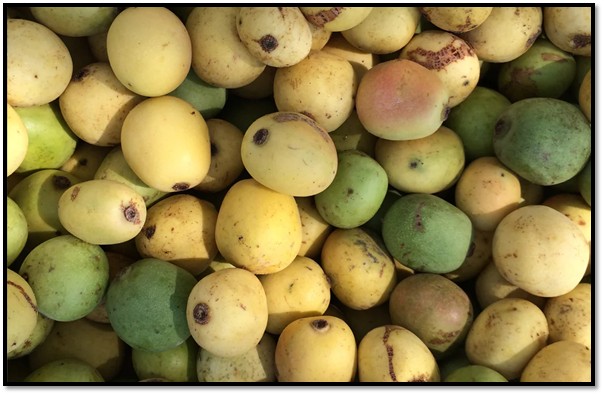
A mixture of ripe and unripe Marula fruits
Google AI states, “The film Shangani Patrol was filmed entirely on location in Rhodesia (now Zimbabwe) specifically in the Marula district about 60 miles from Bulawayo. The filming took place in the area where the historical Shangani Patrol engagement occurred during the First Matabele War.”
The part about the filming taking place at Marula is correct, but the Shangani Patrol took place just north of the Shangani River at Pupu, 160 kilometres north of Bulawayo, east of Lupane and not at Marula.
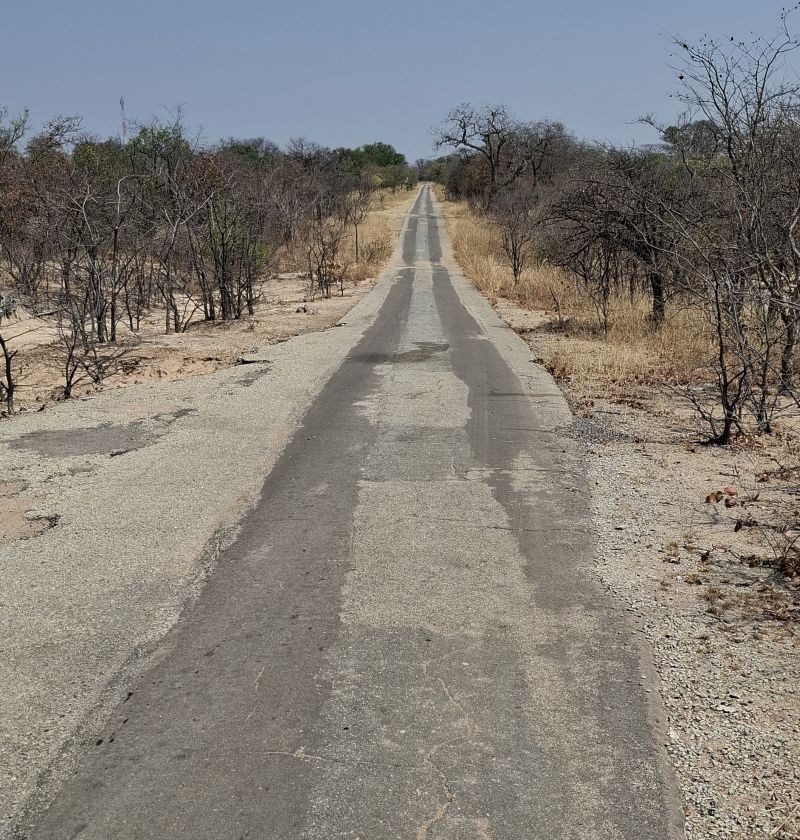
When you drive from Bulawayo the road to Marula village leaves the A7 national road 1.6 kilometres from the village and takes vehicles on the old strip road that passed directly through the village; the A7 skirts slightly to the south of the village and railway line
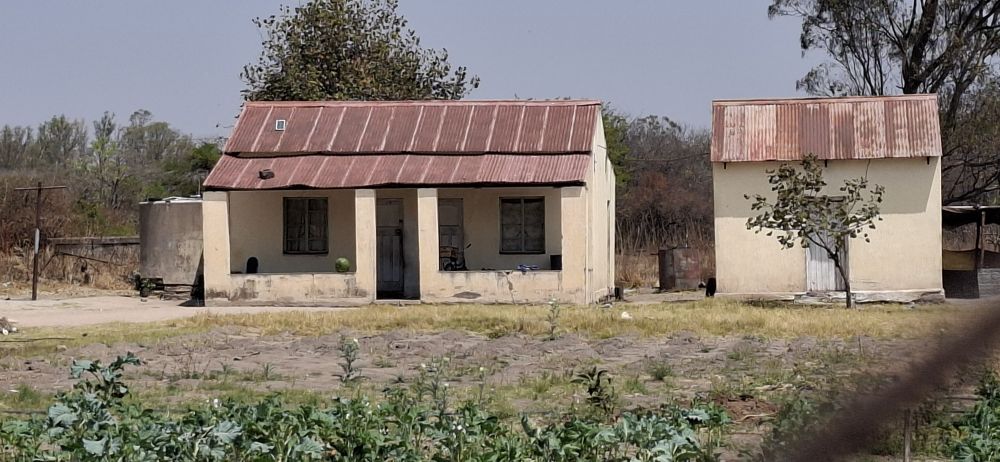
An old house at Marula, probably once used by railway workers
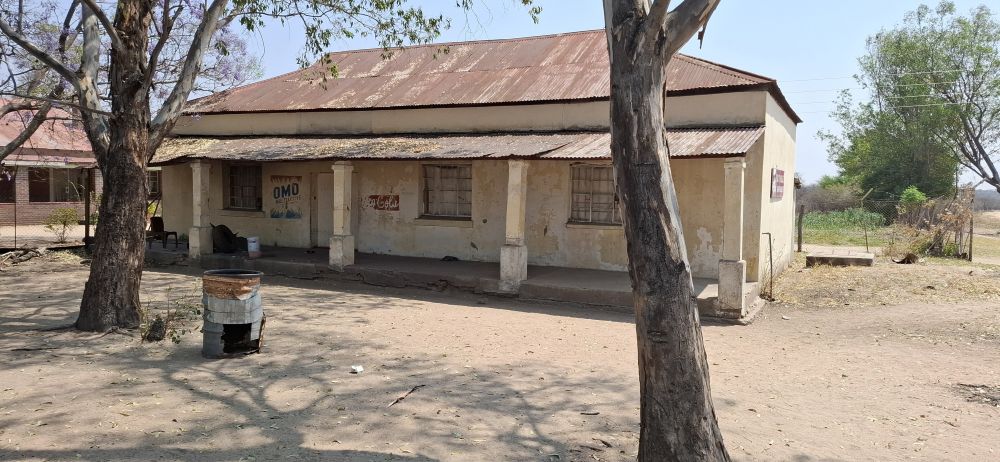
A Marula store; closed when the author passed through
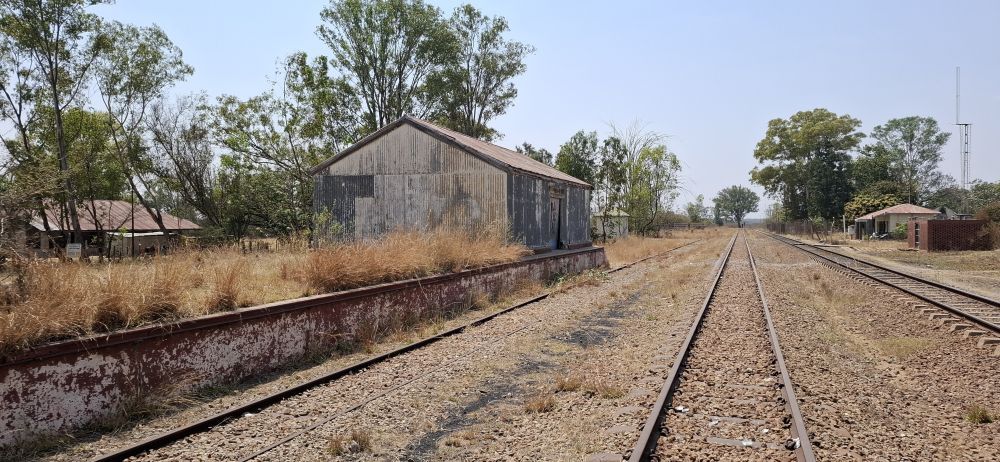
Marula railway siding in September 2025
References
L.W. Bolze. The railway comes to Bulawayo. Rhodesiana Publication No 18, July 1968, P47-84
A. H. Croxton. Railways of Rhodesia: The story of Beira, Mashonaland and Rhodesia Railways. David and Charles (Publishers) Ltd 1982
D. Jones. 100 Years The Railway in Zimbabwe 1897-1997. Pangolin Press, Harare 1997
http://www.nigeltout.com/html/zimbabwe--towards-plumtree.html
[1] The railway comes to Bulawayo
[2] 100 Years The Railway in Zimbabwe 1897-1997
[3] Railways of Rhodesia: The story of Beira, Mashonaland and Rhodesia Railways
[4] Railways of Rhodesia: The story of Beira, Mashonaland and Rhodesia Railways
[5] The rinderpest virus spread south through Africa crossing the Zambesi river and first being diagnosed near Bulawayo on 18 March 1896, It killed an estimated 90% of the cattle herds belonging to the amaNdebele and Mashona people, as well as white settlers. It was one of the contributing causes to the outbreak of the Matabele Rebellion or Umvukela in late March 1896.
[6] The Marula fruits contain vitamins (A, B, C, E, and carotene), minerals (potassium, magnesium and calcium), amino acids, and fatty acids