
The development of the Mineral industry
This article is taken from the Rhodes Centenary Supplement published by the Chronicle in Bulawayo on the 3rd of July 1953 Page 9 and was written by F.P. Mennell.[1] The article reflects the attitudes and opinions that were prevalent at the time. Other sources and notes have been added.
The initial importance of Gold
It is often forgotten that though Rhodesia was not occupied because of its mineral wealth, it was the lure of gold that had made it easy to man the expedition which undertook the occupation of Mashonaland in 1890.[2]
Speaking in Glasgow in May 1891, Lord Salisbury, prime minister of the United Kingdom, referred to the territory entered by the British South Africa Company (BSA Co) The area, he said, was one which, “If they have fairly good fortune and are not disturbed by any untoward incidents, they have every prospect of developing highly. They have great mineral wealth in prospect, and that mineral wealth will give them the material with which to pursue their administrative task.”
As it happened, the reservations which the prime minister made were only too necessary and fate was very unkind to the new country for the next ten years. But in spite of wars and pestilence, the search for gold continued apace. For the first few years, it is true, the yield was almost negligible, largely due to the condemnation of the goldfields by outside experts, who as experts so often are, were completely wrong. But their adverse reports had a disastrous effect on the flow of capital and if it had not been for a few enthusiasts like Major Heany, Sir John Willoughby and Dr Hans Sauer, things might have come almost to a standstill.
Early mistakes in the mining regulations
And in those early days the chartered company had endeavoured to recoup themselves by making it a condition of “working for profit” that a company should be formed, of which half the vendor interest went to themselves.[3] The amount was soon reduced to thirty percent, but was nevertheless a great drawback to progress.
It is indeed remarkable how much prospecting was carried out in the most remote parts of the country while this arrangement was in force. Of course, prospecting as then understood was little more than a search for ‘ancient workings,’ of which the size was the chief factor in determining the market value. In any case, the troubles that had to be faced did not loom very large in the eyes of men with the pioneer spirit. They came along with optimistic accounts of their finds to one or other of the development companies which had somehow managed to raise a certain amount of capital to invest in promising properties.

First Peg Pioneer, 10 claims, Umfuli, Hartley District, pegged 1st October 1890 (the day after the Pioneer Corps were disbanded) Transferred to Rhodesia Goldfields Ltd, 21st October 1898, and abandoned by them, 28th December 1898. The inscription reads: "Pioneer. United Rhodesia Gold Fields, Regd. 1.10.90. No. 3, Inspd. 6.1.91. End Centre E."
The owner was paid something down and got a percentage of the vendor interest if the claims turned out good enough to be floated into a company for actual production. It was also usual to give the claim holder a contract on favourable terms to carry out a certain amount of work on his ground.
Towards the end of 1903, a new era set in. It had become evident that the flotation of companies was not possible in the case of many of the smaller properties that were considered commercial.[4] Most were not big enough to work on a large scale, though they often contained a sufficient amount of good ore to be of considerable value. The right to work on a royalty basis heralded the rise of the importance of the ‘smallworker.’[5]
Not only did it lead to a rapid and large increase in the gold output due to the working of numerous small mines, but to the proof in the course of this work that some of them were of much greater importance than had been supposed.[6] Some indeed, turned out to be bigger and richer than most of the mines previously opened up by the companies, as will be seen from the fact that they included such properties as the Cam and Motor,[7] the Lonely and the Shamva.[8] By 1905 the output was worth over £1 million and by 1907 well over £2 million. It was £3.9 million in 1916 at the price of £4 5s an ounce.[9] Only in 1948 did the value of metals and base minerals produced surpass that of gold.[10] This might have happened earlier but for a combination of low prices and the outbreak of World War II.
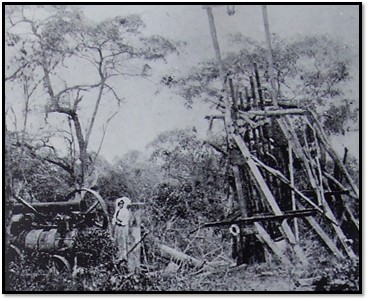
The five-stamp battery lent to Lobengula by the BSA Co and supervised by James Dawson.[11] Note the portable steam engine (Colonial wood-fired version) with chimney folded down being examined by two ladies with sun parasols. Photo kindly provided by Rob Burrett.
Growth of base minerals
This was not all. What has proved of still greater importance was the attention that began to be directed to the so-called base minerals. Up to the end of 1903, apart from coal of which 46,000 tons were produced in that year, the whole of the mineral output had come from gold mines. This included some silver, of which a small amount is always alloyed with the gold, and also lead,[12] in concentrates from the Penhalonga mine at Umtali. Copper came into the list in 1906, but this again was from a small blast furnace treating the refractory ore of the Valley mine at Gwanda.[13]
The production of minerals quite apart from the gold industry, really began with a small output of chrome ore in 1905, regular returns beginning in the next year. Then came the production of tungsten ore (wolfram) from the Essexvale (now Esigodini) area, and of diamonds and other precious stones from the Somabhula gravels near Gwelo[14] (now Gweru) Antimony was added to the list in 1907 but has never reached large figures.
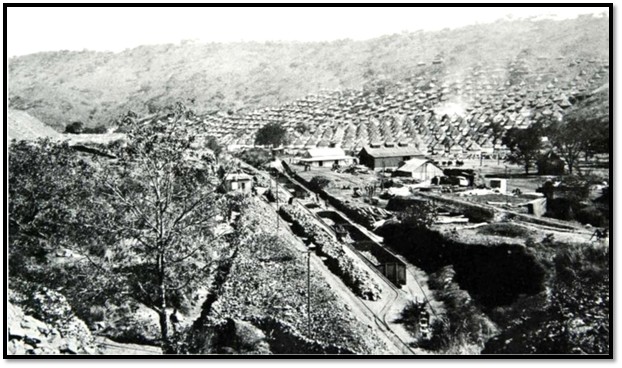
Chrome ore from Selukwe (now Shurugwi) loaded into the narrow-gauge rail wagons operated by the mine – staff housing in the background
Then with a modest return of fifty-five tons from Garth's mine in 1908, asbestos came on the scene.[15] By 1919 it had grown in importance until its output had surpassed in value that of every other mineral except gold. Tin did not come into production until 1916, though it had been discovered some years before and mica first appeared in 1919.[16] More recently, we have seen the start of iron smelting in 1948[17] and such interesting additions to our list as beryl and lithium minerals.
Base minerals exceeded gold in value for the first time in 1929, but owing to poor prices dropped back again till 1948. Asbestos has now displaced gold from the head of the list.
At the time that responsible government was granted in 1923, the value of the gold output alone was more than double the whole of the government expenditure. The total value of the minerals produced exceeded by a considerable sum that of all the imports into the country. How different is the position now! All our exports combined fetch a sum many millions short of the amount required to pay for our imports, in spite of the fact that tobacco is worth more than the whole of the mineral output.
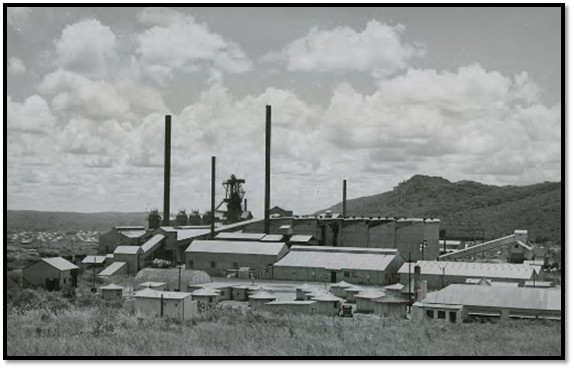
Blast furnaces and the steel rolling mill at Redcliff in the near Kwekwe
There was gloom around the mining industry in 1953
What is the remedy for the current state of affairs? If there were any reason to believe that our mineral industry had reached its zenith, it would be useless to discuss the question further in the present connection. It is quite true, as the chief government mining engineer points out in his annual report, that the output of gold can scarcely be maintained at its present level, much less expected to increase. And present conditions are not particularly favourable to any branch of the industry, more especially in the case of those minerals which make heavy demands on the transport system.
Meanwhile, the rights of the miner have been gradually whittled down to such an extent that prospecting came to an almost complete standstill until the phenomenal rise in prices of the base metals during the last few years. To quote a well-known mining man, Mr W.H. Elliot, speaking three or four years ago, “of prospecting for gold today in any form, it can be said that the game just isn't worth the candle.”
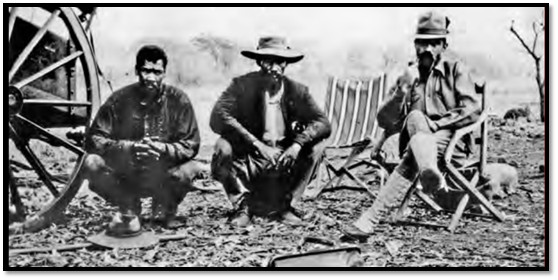
NRZ: Albert Giese on the right who was led by local Africans to the coal outcrops at Hwange with two of George Westbeech’s hunters from Pandamatenga (photographed in the late 1890’s)
It would be to suggest that the taxpayer should be asked to assume fresh burdens to help the miner, even though the latter has done far more than his share in the past to keep the country going. Relief from taxation might be a help. It is quite a mistake to suppose that minerals worth a large sum per ton like tantalum or tungsten ores, should pay more in royalties. The mere fact that it is high in price is sufficient evidence that the metal is difficult and expensive to produce in any quantity.
And it is the same with railway rates. Because scheelite is worth in the neighbourhood of £1,000 a ton, it does not follow the miner is making a large profit on it and while they may be something in their idea of making the traffic pay as much as it will bear, the railage, bagging and so on, make up a very serious item in the cost of production of most of the more expensive minerals.
There are also all kinds of regulations and restrictions which are troublesome to the miner and for which there is very little need. For instance, there are numerous cases in which people live in houses originally erected by miners, which now hold up the pegging of the mine nearby in spite of the fact that present prices may render it possible to open it up again with a good chance of making a profit.
But there can be no doubt that the prime necessity for the production of the lower priced minerals on a larger scale is transport. As long as it is impossible to get them to the railway, or to get them taken off promptly by the railway when they get there, we can scarcely expect any great increase in production.
References
F.P. Mennell. The development of the mineral industry. The Chronicle, P13. 3 July 1953. Rhodes Centennial Supplement.
F.P. Mennell. The Rhodesian Mining Industry. The Rhodesian Graphic Jubilee Number: Southern Rhodesia 1890 – 1950: A Record of Sixty years progress
https://archive.org/details/SouthernRhodesia1890-1950ARecordOfSixtyYearsProgress/page/n77/mode/2up
G. Bond. F.P. Mennell Obituary. https://nmrs.org.uk/resources/obituaries-of-members/obituaries-of-members-names-beginning-with-m/frederic-philip-mennell/
V and S. Stocklmayer. The Geological Society of Zimbabwe newsletter No 3 of 2015, P4. A review of Diamonds in Zimbabwe – a Century On. https://www.geologicalsociety.org.zw/sites/default/files/documents/GSZ%20NL%20Oct%202015_0.pdf
Notes
[1] Frederic Philip Mennell (1880 – 1966) was the first Curator of the Bulawayo Museum from 1901 – 1908. The post was given to a geologist so that early Southern Rhodesian miners and prospectors could get competent advice on their mineral samples. From 1908 – 1912 he was Abe Bailey’s mining representative in the country. Between 1920 – 1939 he did some remarkable journeys on foot examining mineral occurrences in Tanzania, Zambia and Mozambique walking an estimated 48,000 kms. His books ‘The Rhodesian Miner’s handbook’ and ‘A Guide to Mining in Rhodesia’ were a great help to miners and prospectors. He was a Fellow of the Geological Society for sixty years and died in Bulawayo.
[2] Mennell writes in ‘A record of Sixty years progress’ that the early prospectors were referred to as ‘blanket prospectors’ because they relied on local Africans to reveal the location of ‘ancient workings’ for the locations of gold, copper and iron. Whilst thousands of claims were registered it meant the newcomers were not trained in prospecting and if the workings were large they tended to believe they were worked out. For instance, the Globe and Phoenix was initially left unpegged because it was thought to be worked out!
[3] Mennell states that this policy was intended to recoup the BSA Co’s administration costs, but had a very adverse influence on the early mining industry
[4] The first regular gold production was from the Geelong Mine at Gwanda from September 1898 that had a twenty-stamp mill
[5] ‘Small workers’ as they were called, started on claims of their own, many of which had been abandoned by the mining companies as insufficiently large or rich for them. Others were ‘tributed’ with the smallworkers paying a royalty for their gold.
[6] The Globe and Phoenix Mine; In terms of profitable life, this mine is the premier gold producer of Southern Rhodesia, having been operating continuously at a profit for more than 50 years. It has faced many fluctuations of fortune in development and more than once, years ago, it has been given only a few months to live. The town of Que Que (now Kwekwe) has grown up between the Phoenix and Globe mines. Ancient workings extended continuously along the Phoenix main and Phoenix parallel reefs for a length of about 400 feet (120 metres) The greatest depths of these workings on the main reef was 126 feet (38 metres) on the incline; on the parallel reef, it was 36 feet (11 metres)
[7] Harvey Brown one of the original owners of the Cam and Motor Mine told Mennell that early mining engineers trained on the great goldfields of the Rand condemned the workings as inconsequential. In fact it became one of Zimbabwe’s biggest gold producers.
[8] All of these mines were first started by smallworkers
[9] Mennell writes that gold production until 1917 was of sufficient value to pay for the whole of the imports into the country and in 1917 the value of gold output was enough to pay the total government expenditure nearly five times over!
[10] Southern Rhodesia 1890 – 1950: A Record of Sixty years progress, P101
[11] James Dawson was a long-time trader at Bulawayo – his knowledge of gold mining would have been minimal and apparently the only result was a small button of gold
[12] Lead being the first base mineral to be produced, but as a by-product of gold-mining
[13] Most early copper output was as a by-product of gold-mining until the Falcon mine at Umvuma came into production
[14] From A review of Diamonds in Zimbabwe – a Century On. In 1903 H.R. Moir noted gravels in the Somabula River (spruit) were similar to those in the Vaal alluvial diamond fields in South Africa. He and his brother prospected the area and discovered diamonds, sapphire and chrysoberyl. The South African Option Syndicate, a subsidiary of Sir John Willoughby’s Consolidated Company bought the mineral rights and worked the area from 1905 – 8 before the area was thrown open to individual diggers. Recorded output from 1905-1954 is 15,886.4 carats, however A.E. Phaup, one-time Director of the Geological Survey, noted that many stones were believed sold to illegal diamond buyers
[15] Large-scale commercial production began in 1917 with the formation of Rhodesian and General Asbestos Corporation. Production of asbestos in 1948 was 68,896 tons, valued at £2.6 million
[16] Nearly all mica production was from Miami in the Lomagundi district
[17] The first blast furnace at the Rhodesian Iron and Steel Commission (RISCOM) went into production in 1948. However, it was only in the 1950’s when private business engaged with RISCOM that production took off and the business began to show a profit. On 1 January 1957, the business became the Rhodesian Iron and Steel Company Limited and a £10 million expansion took place that increased the number of blast furnaces and added a steel rolling mill.